



At his retirement press conference in December of 2013, Roy Halladay called his final four seasons, which he spent with the Philadelphia Phillies, the icing on the cake to his career. His legacy now has a cherry to put on top of that icing.
Halladay was elected with ease to the Baseball Hall of Fame in his first year on the ballot, garnering 85.4 percent of the vote. He'll be joined by Lee Smith, Harold Baines, Mariano Rivera, Mike Mussina, and Edgar Martinez.
In 16 major league seasons, Halladay posted a 3.38 ERA, a 3.39 FIP and a 65.2 fWAR. "Doc" was the true definition of a workhorse, posting eight seasons over 200 innings pitched and 67 career complete games. Halladay was an eight-time All-Star, and finished in the top five in Cy Young Award voting seven times, winning the award twice (2003, 2010). Given that he won a Cy Young Award as a member of the Toronto Blue Jays and Phillies, he's one of six pitchers in baseball history to win the award in both the American League and National League.
In 2016, Halladay said that if he was ever elected to the Hall of Fame, he wanted to don a Blue Jays cap on his plaque. Given that he spent 12 of his 16 major league seasons in Toronto, his wish will almost certainly be honored. But his first two seasons in Philadelphia cemented him as a Hall of Famer.
After reports suggested that Halladay preferred to be traded to the Phillies, he got his wish, as the Phillies sent Kyle Drabek, Travis d'Arnaud and Michael Taylor to the Blue Jays for Halladay, ahead of his age-33 season, on Dec. 15, 2009.
All Halladay would do is turn in one of the more memorable individual seasons in recent history in his first season in red pinstripes.
Halladay opened the season by throwing seven strong innings in a victory over the Washington Nationals in D.C. He capped off that regular season by throwing a two-hit complete game shutout in the nation's capital on Sept. 27, allowing the Phillies to clinch their fourth consecutive National League East title.
In between those two starts against the Nationals, Halladay logged over 230 innings, pitching seven other complete games. The most noteworthy complete game came in Miami on May 29, when Halladay tossed a perfect game against the Marlins. It was the second perfect game in Phillies history, the first since Hall of Famer Jim Bunning tossed a no-hitter on Father's Day in 1964.
Halladay would win his second career Cy Young Award in 2010, but the reason he ultimately left Toronto was for a chance to pitch in the postseason for the first time in his career. He got that opportunity in 2010, and though the Phillies weren't able to return to the World Series for a third consecutive season, Halladay created one of the most iconic moments in postseason history the first time he ever pitched in the playoffs.
On Oct. 6, 2010, Halladay pitched a playoff no-hitter against a Cincinnati Reds lineup that included Joey Votto, someone likely to join Halladay in Cooperstown at the conclusion of his career. He became the second pitcher in baseball history to pitch a no-hitter in baseball history, the first since Don Larsen threw a perfect game in Game 5 of the 1956 World Series. In doing so, Halladay also became the first Phillie to every throw two no-hitters—not in one season, at any point during any player's Phillies career.
Halladay may not have topped 2010 in terms of iconic moments, but he had a hell of an encore in 2011. Even with two other All-Star pitchers in the Phillies rotation that season—Cliff Lee and Cole Hamels—Halladay again set himself apart from his peers.
In 2011, Halladay posted a career-low 2.35 ERA, a career-low 2.20 FIP and a career-high 8.3 fWAR across 233.2 innings. His dominant season helped the Phillies to win a franchise-record 102 games. Halladay finished runner-up to future Hall of Famer Clayton Kershaw in National League Cy Young Award voting, though he topped Kershaw in complete games and fWAR, while posting a lower FIP.
The Phillies didn't have the type of postseason success that they probably should have in 2011, falling to the eventual World Series Champion St. Louis Cardinals in one of the greatest divisional series ever.
Halladay got the ball for the Phillies at Citizens Bank Park in the deciding game of that series. Things didn't start out well for Halladay, as Rafael Furcal hit a leadoff triple and was plated by the next batter, Skip Schumaker. Halladay labored through the first inning of that game, ultimately throwing 33 pitches.
What looked like it could turn into a short night for Halladay proved to be his final classic start. Even after throwing 33 pitches in the first inning, Halladay went eight strong innings for the Phillies in an elimination game, allowing just the one run.
Unfortunately for Halladay and the Phillies, Chris Carpenter, Halladay's former teammate in Toronto, was just a little bit better for the Cardinals. Across nine frames, Carpenter, one of the better pitcher's of his era, allowed just three hits. His complete game eliminated the Phillies. Halladay was never the same after, and neither were the Phillies.
Halladay wrapped up his career after 2013, his first season with the Phillies. At his retirement press conference, there was a Phillies cap and a Blue Jays cap. Halladay's two sons, Braden and Ryan, also had their baseball hats on the podium, a sign of how important family was to Halladay.
Since the conclusion of his career, Halladay has been inducted onto the Toronto Blue Jays level of excellence and the Phillies Wall of Fame. In addition, the Blue Jays retired the No. 32, which Halladay wore during his time with the team. Halladay was also inducted into the Canadian Baseball Hall of Fame. This honor, no doubt, will be the biggest among many that Halladay received.
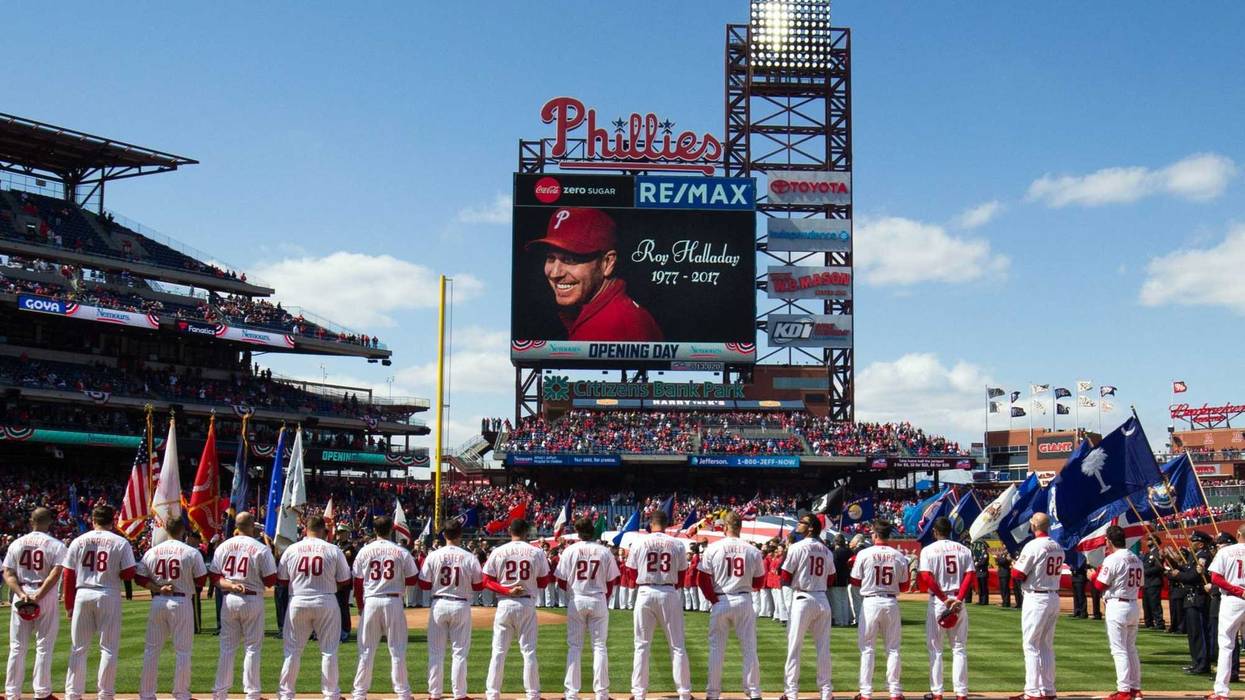
Halladay was tragically killed when a plane he was piloting crashed on Nov. 7, 2017 in the Gulf of Mexico. But when he's inducted into the Hall of Fame on July 21, the world will be reminded of the impact that Halladay left in his four decades of life. Whether it's Carpenter, Carlos Ruiz, either of his sons or his wife Brandy, there's sure to be an incredible speech delivered on his behalf this upcoming summer. The speech will touch on how Halladay was one of the greatest competitors the sport ever saw. More importantly, it will speak to the type of impact he had on his teammates, friends, family and the two cities he had a Hall of Fame career in.