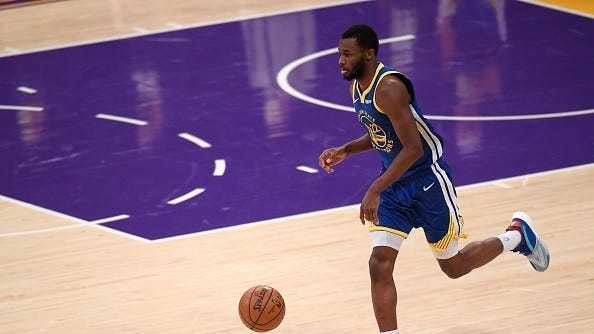



SAN FRANCISCO (95.7 The Game) - If Golden State can clarify the questions below, the Warriors 2021-22 voyage is destined for a smooth cast-off – even if Captain Klay Thompson is not on board yet. Thompson’s return, and effectiveness, remain the key to any long-term team success, but he will need time. It is not reasonable to expect Klay to carry a large weight out of the gate. Putting the cart before the horse sets him back along with Golden State, whose aspirations for title contention depend as much on health as they do on performance. To maximize this season much must be answered. Preseason is the perfect time to sort through these queries. With five games to do so, there is no time to waste.
What Does Small Ball Mean for THIS Roster?
Going small in the modern NBA has been less about playing with a height-challenged rotation than spacing the floor with length, shooting, and versatility. Down the stretch of last season, Golden State was forced into such a rotation (by injuries) and flourished. While finishing 15-5 to end the regular season, the Warriors shot better from the floor (46.1% à 48.8%) and improved their three-point defense (36.9% à 33.2%), which led to a +9.2 point differential in their final 20 games. To replicate that success, Steve Kerr has said he plans on playing small again in 2021-22.
This offseason, the Warriors front office brought in talent that, on paper, should balance what was a top-five defense with some athleticism and additional marksmen. That will be key if smaller rotations see the Chase Center floor more often. However, can Golden State rebound efficiently enough to hang with a Western Conference littered with physical bigs? The Warriors were out-rebounded by all but six of their opponents last season. If that continues, going small will not remain a viable long-term option. However, if they win the rebounding battle and minimize possessions, the net benefits of a smaller lineup should yield similar results to those at the end of last season.
Where Does James Wiseman Fit In?
It is no secret that James Wiseman had a difficult rookie campaign, relative to expectations. His self-bestowed B+ grade was probably on a curve but rooted in flashes that warranted his second overall selection before last season. Wiseman, at times, demonstrated a knack for interior defense and provides Golden State with a rim-running big man in a league where it is almost a requirement to be successful. Yet, after meniscus surgery in April, the 20-year-old cannot begin arguably the impactful part of his current skill set, jumping, until October 15. That impedes his progress at a crucial point in his young career.
Understandably, last season was about making Wiseman comfortable on the court and as a professional. It remains murky whether he receives the same luxury once he is cleared to play. When he returns, expectations (perhaps unfairly) for immediate production will as well. After one season, the organization's high hopes have not been disproven. Yet, with a team moving more towards a skill-centric style of play, Wiseman will either become an asset or detriment. He will add rim protection while hopefully contributing to a group in need of rebounding. It will also be interesting to see whether Wiseman has more confidence in a shot that has potential.
Stretching the court will earn him minutes and make him a focal point of a budding young core.
Listen to Bay Area sports talk now on Audacy and shop the latest Warriors team gear
Coaching Changes Sign of Internal Improvement?
During its title runs, Golden State benefited from the consistency of its coaching staff. Player development to a backseat for a roster with a horde of Hall of Famers. Two years later, the need to foster new talent became glaring. The Warriors addressed that this summer by bringing in three coaches with lofty credentials in that department – Kenny Atkinson, Jama Mahlalela, and Dejan Milojevic. Atkinson helped lift the Brooklyn Nets to relevancy before its recent superstar eclipse, Mahlalela was largely responsible for grooming a talented Toronto team, and Milojevic most notably developed last season’s MVP Nikola Jokic over three years.
The moves represent a change of philosophy, which should lead towards internal improvement. Kerr has always invited input, but now has three fresh (and intelligent) faces to brainstorm with. Each has prior head coaching experience and succeeded in adapting to a rapidly-changing sport. This means the Warriors that fans see on October 19 will be vastly different than in, optimistically, late April or June. During Golden State’s championship seasons, the final product was predictable. Now, the result can swing to either side of the fulcrum. Last year, Jordan Poole epitomized the growth potential.
The newest coaching additions should help find the next young Warrior to pass that baton too. If they do not, it will be a disappointing season. If they do, the 2021-22 Warriors will reach promising heights.