

The A’s-to-Vegas situation is changing by the day and approaching a crucial deadline.
As the Nevada legislature tries to figure out a state budget stalemate before the 2023 session ends Monday, the A’s are also trying to push through a new stadium deal, backed by dozens of lobbyists trying to apply pressure to dealmakers.
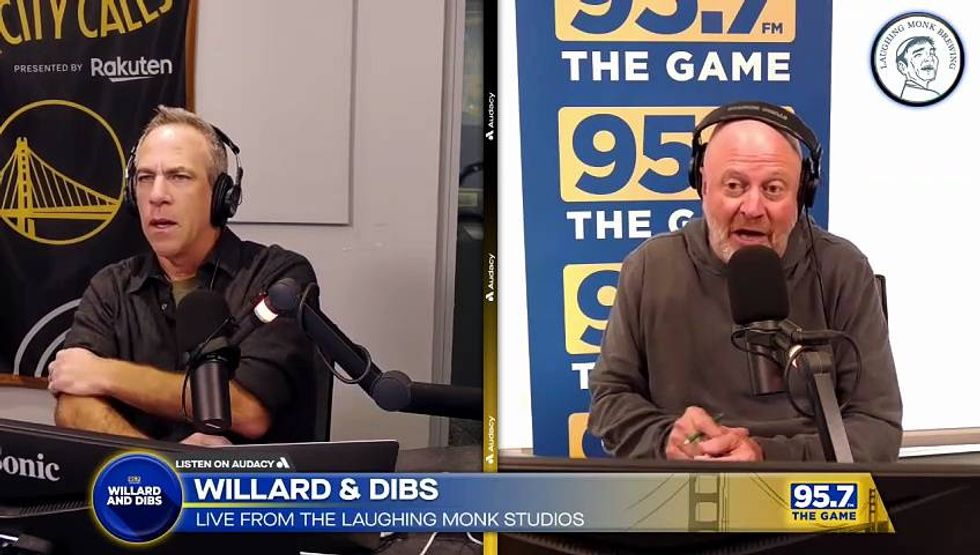
Casey Pratt of ABC7 Bay Area has been following the A’s saga for years and joined 95.7 The Game’s “The Morning Roast” Friday to give the latest update on the situation. As Pratt noted, the ballpark plan was formally introduced as Senate Bill 509 (SB509) on Friday night, before being heard in a joint session on Memorial Day. Unless a special session is called to discuss SB509, the A’s and Nevada will have to close a deal by Monday.
“In reality, what’ll happen is, if they don’t get this deal in Vegas, I think they’re gonna sell the team,” Pratt told hosts Bonta Hill and Joe Shasky. “There’s a reason this all looks so rushed and chaotic. I think it’s because they’re out of financial resources. Why would you dump your entire roster, spending no more than what you’re getting in TV revenue, have the absolute worst team in baseball, the absolute lowest payroll in baseball – while you’re in the middle of trying to secure the most important deal in history of your franchise for a new home? That is not how you do things.”
Reclusive A’s owner John Fisher has been in Nevada making the case this week along with team president Dave Kaval, though they are yet to speak publicly. While SB509 doesn’t explicitly name the A’s or a specific stadium site – the franchise is zeroed in on a nine-acre plot of land on the 35-acre Tropicana Hotel lot on The Strip, which is owned by Bally’s and Gaming & Leisure Properties, Inc. (GLPI).
The A’s are planning to build a $1.5 billion publicly-owned 30,000-seat stadium with a retractable roof, with no ancillary developments. Nevada and Clark County have offered $325 million of public financing and the deal calls for a $380 million cap in public funds. However, that figure doesn’t include the potential $50 million savings in waived property taxes, the estimated $180 million the A’s got in a free land deal, and a $175 million commitment from land owner Gaming Leisure Properties (GLPI) for “shared site improvements.”
On April 19, the A’s walked away from the negotiating table with Oakland after doing most of the legwork on a $6 billion waterfront ballpark district at Howard Terminal -- which included $5.8 billion in private investment. According to Pratt, the A’s and Oakland were just $88 million away from completing a deal, with the main hang-up being off-site infrastructure.
Oakland has already secured $375 million in off-site infrastructure grants and has another $100 million potentially coming down the pipe in June, so the framework is in place for the A’s to build at Howard Terminal.
“They went about this the complete backwards way,” Pratt said. “I think it’s because they’re just flat out of time, they’re flat out of resources. I think John FIsher, who’s a billionaire, does not have the liquid assets. All of his value is tied up in the team and the GAP, and the stocks are plummeting. I think this is a ‘We got a pump-and-dump this thing and get out.’”
Perhaps Fisher doesn’t have the cash to make the grand Howard Terminal vision come true – as the A’s proposed a 35,000-seat stadium, 3,000 residential units, an 18-acre park, 3,5000-seat performing arts center, hotels and commercial space on the 55-acre lot near Jack London Square.
Fisher’s family fortune derives from his parents' Gap clothing empire. Gap stock (GPS) is currently trading at $8.66, down from $15.49 in March – a drop of 56 percent in just two months. As recently as May 2021, GPS was trading at $35.71 – which is 412 percent higher than its current value.
The company is on the verge of shuttering its flagship Old Navy store on Market Street in San Francisco, after closing down the flagship Gap store in 2020 and the flagship Banana Republic store earlier this year. San Francisco mayor London Breed discussed the closures, which many are attributing to rampant shoplifting.
“2018 is when they announced (their intentions for Howard Terminal),” Pratt said. “The world was a completely different place. It was a $6 billion development. It would have been one of the biggest developments ever in the state of California. Now, do you look at A’s ownership and say I have confidence in a $6 billion development? The answer is no. But they at least thought they could do it. They put a ton of time and resources into this.”
“They couldn’t even sign a $6 million free agent,” Shasky said. “I’m not even trying to be mean.”
“I don’t disagree with you at all on that,” Pratt said. “They really did try to do this. They had it in the best interests. They passed laws, they passed an environmental impact report – it’s hard to build in California. They got port priority use, which was a massive battle. They’ve cleared so many huge hurdles. It took an insane amount of work and energy. This is why it’s so weird for them to quickly up and walk away from a deal that they paved the way for, on the water in Oakland.”