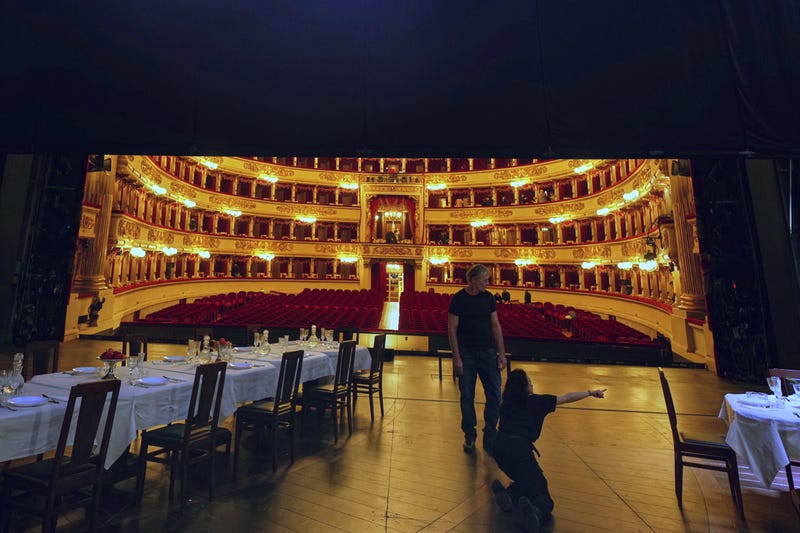
MILAN (AP) — The gala crowd at Milan's Teatro alla Scala cheered the season premiere of Dmitry Shostakovich's "Lady Macbeth of Mtsensk '' with a 12-minute standing ovation Sunday, as the storied theater synonymous with the Italian repertoire opened with a Russian melodrama for the second time since Moscow's 2022 invasion of Ukraine.
The crowd of luminaries fully embraced stage director Vasily Barkhatov's bold telling of merchant wife Katerina Izmajilova's fall into a murderous love triangle against the backdrop of Stalin's Soviet Union, right up to the jarring final scene with a Soviet truck barreling into a wedding party, and two characters perishing in burst of flames.
U.S. soprano Sara Jakubiak was showered with carnations and cheers for her tireless portrayal of Katarina, the title character, and the audience cheered its appreciation for conductor Riccardo Chailly, making his last Dec. 7 gala premiere appearance as music director.
“No one ever expects this,'' Jakubiak said backstage. ”I am just so happy.''
From Boris Godunov to Lady Macbeth
While the 2022 gala season premier of “Boris Godunov” drew protests from the Ukraininan community for highlighting Russian culture in the wake of the invasion, the premiere of "Lady Macbeth'' inspired a flash mob demonstrating for peace.
Shostakovich's 1934 opera highlights the condition of women in Stalin’s Soviet Union, and was blacklisted just days after the communist leader saw a performance in 1936, the threshold year of his campaign of political repression known as the Great Purge.
A dozen activists from a liberal Italian party held up Ukrainian and European flags in a quiet demonstration removed from the La Scala hubub that aimed “to draw attention to the defense of liberty and European democracy, threatened today by (President Vladimir) Putin’s Russia, and to support the Ukrainian people.’’
Another, larger, demonstration of several dozen people in front of city hall called for freedom for the Palestinians and an end to colonialism, but was kept far from arriving dignitaries by a police cordon. Demonstrations against war and other forms of inequality have long countered the glitz of the gala season premiere that draws leading figures from culture, business and politics dressed in their finest frocks.
Culture Minister Alessandro Giuli was joined by the senator for life Liliana Segre, a Holocaust survivor, and Milan Mayor Giuseppe Sala in the royal box.
Shostakovich’s journey to La Scala premiere
Chailly began working with Barkhatov on the title about two years ago, following the success “Boris Godunov,'' which was attended by Italian Premier Giorgia Meloni and European Commission President Ursula von der Leyen, both of whom separated Russia’s politicians from its culture.
But outside the Godunov premiere, Ukrainians protested against highlighting Russian culture during a war rooted in the denial of a unique Ukrainian culture.
Chailly called the staging of Shostakovich’s “Lady Macbeth" at La Scala for just the fourth time “a must.’’
“It is an opera that has long suffered, and needs to make up for lost time,’’ Chailly told a news conference last month.
La Scala’s new general manager, Fortunato Ortombina, defended the choices made by his predecessor to stage both Shostakovich’s “Lady Macbeth” and Modest Mussorgsky’s “Boris Godunov " at the theater best known for its Italian repertoire.
‘‘Music is fundamentally superior to any ideological conflict,’’ Ortombina said on the sidelines of the news conference. “Shostakovich, and Russian music more broadly, have an authority over the Russian people that exceeds Putin's own.’’
An American soprano makes her La Scala Debut
Jakubiak made her La Scala debut in the title role of Katerina, whose struggle against existential repression leads her to commit murder, landing her in a Siberian prison where she self-immolated to kill herself and her treacherous second husband's new lover. It’s the second time Jakubiak has sung the role, after performances in Barcelona last year, and she said Shostakovich's Katerina is full of challenges.
“That I’m a murderess, that I’m singing 47 high B flats in one night, you know, all these things,’’ Jakubiak said while sitting in the makeup chair ahead of the Dec. 4 preview performance to an audience of young people. “You go, ‘Oh my gosh, how will I do this?’ But you manage, with the right kind of work, the right team of people. Yes, we’re just going to go for the ride.”
Speaking to journalists recently, Chailly joked that he was “squeezing” Jakubiak like an orange. Jakubiak said she found common ground with the conductor known for his studious approach to the original score and composer’s intent.
“Whenever I prepare a role, it’s always the text and the music and the text and the rhythms,'' she said. “First, I do this process with, you know, a cup of coffee at my piano and then we add the other layers and then the notes. So I guess we’re actually somewhat similar in that regard.''
Jakubiak, best known for Strauss and Wagner, has a major debut coming in July when she sings her first Isolde in concert with Anthony Pappano and the London Symphony.
Stage direction highlights Stalin's end
Barkhatov, who at 42 has a flourishing international career, said “Lady Macbeth” is a “very brave and exciting" choice.
Barkhatov's stage direction sets the opera in a cosmopolitan Russian city in the 1950s, the end of Stalin’s regime, rather than a 19th-century rural village as written for the 1930s premier.
For Barkhatov, Stalin’s regime defines the background of the story and the mentality of the characters for a story he sees as a personal tragedy and not a political tale. Most of the action unfolds inside a restaurant appointed in period Art Deco detail, with a rotating balustrade creating a kitchen, a basement and an office where interrogations take place.
Despite the tragic arc, Barkhatov described the story as “a weird … breakthrough to happiness and freedom.’’
“Sadly, the statistics show that a lot of people die on their way to happiness and freedom,’’ he added.