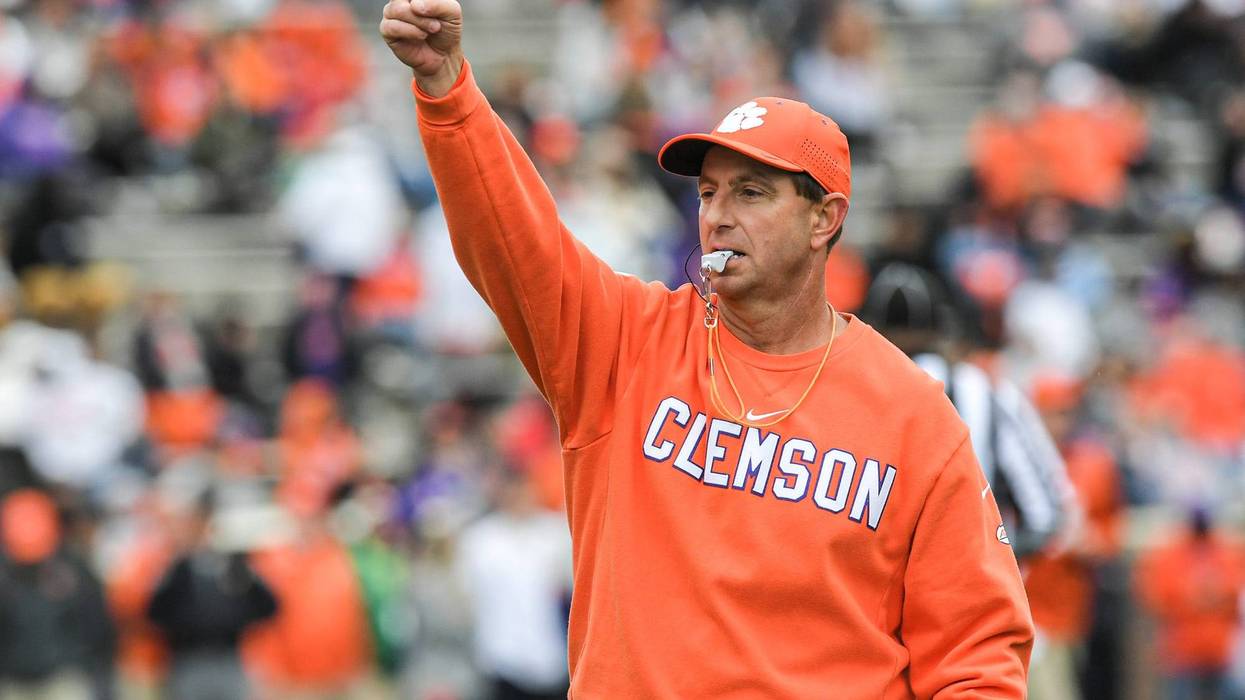

Although its popularity has become comparable to the NFL, college football has long been known as the poster child for dysfunction and unfairness. So when Clemson coach Dabo Swinney garnered attention by recently arguing why there needs to be a "complete blowup," despite new NIL regulations, it was actually a much-needed dose of reality that the sport has a long way to go in leveling the playing field.
Brand-new laws that allow players to profit off their brands are a step in the right direction, in terms of compensation. The transfer portal gives kids fair autonomy over their future. Both were long overdue measures, which need significant modification to be completely just. There's still a stigma around transferring, and players are quite commonly viewed as selfish for having a business-first mindset.
Swinney is no different, having ripped the transfer portal multiple times, while reaffirming his commitment to staying away from it. This is an outdated line of thought, however, as the portal has allowed many players to find success at different schools when they needed a change of scenery. Gone are the days when a student-athlete is forcibly stuck with a university from signing day, and it isn't about "commitment issues."
As salaries increase for coaches, schools have multiple sources of money that are larger than ever before. And as television deals keep skyrocketing, there's one group that's still largely marginalized: the players. In his critique of the system as a whole, Swinney made an analogy to corporate America that made less sense than a non-football person trying to understand X's and O's.
"We live in a capitalist society. The head of Delta probably makes a lot more than the people who are checking your baggage in, but those people are as vital as anybody," Swinney said. "None of us set markets on what we do. It's a free market we live in, in anything. It's just that our jobs are so visible and so public."
Well played, comparing the CEO of a major corporation to a college sports head coach and drawing a parallel between baggage handlers and student-athletes. Airplanes wouldn't be able to take off without them -- fair enough. But they don't have a hard-to-find skillset, or directly define the value of the company the way student-athletes do. The truth is, without talented student-athletes, these coaches commanding them around are a bunch of nobodies.
Matter of fact, their worth in society would be more comparable to someone performing manual labor, than a white-collar executive.
In the race to equality and fairness, college football has only just crossed the starting line. And the real thing that needs a complete blowup is the outdated attitude of most people involved in governing the sport. For far too long, the student-athletes have been viewed as devalued, replaceable pawns to make the universities money.
Maybe they're still technically children. But when they're putting their body, long-term livelihood, and careers on the line to play a highly dangerous sport, they deserve adult treatment. So, from that line of thought, comparatively low endorsement deals are insufficient compensation for their labor. And they still are being oppressed by money-hungry organizations.
College football is heading in the right direction -- there just needs to be a more thorough, universal understanding of the current relationship dynamic between the student-athletes and their universities. There needs to be better methods of compensation, as well as a greater respect for what's at stake. Swinney really wasn't wrong in making such a bold statement -- his methods of implementation just needed modification.
The big thing working in football's favor right now, which its hardwood friends lack, is continuity. As opposed to college basketball -- where student-athletes commonly depart after just one season -- in football, the players are required to spend three years in school. This then leads to higher player recognition on a year-to-year basis, while helping student-athletes build recognition and visibility not just for the pros, but for sponsors as well.
While college football scored a touchdown in giving student-athletes more control last season, the sport remains in an awkward gray area, in need of more regulations to stabilize a heavily-tilted scale. The only way to fix it is by having everyone accept the problems at hand, and realizing that there's still many points left on the field for student-athletes to capitalize on.