


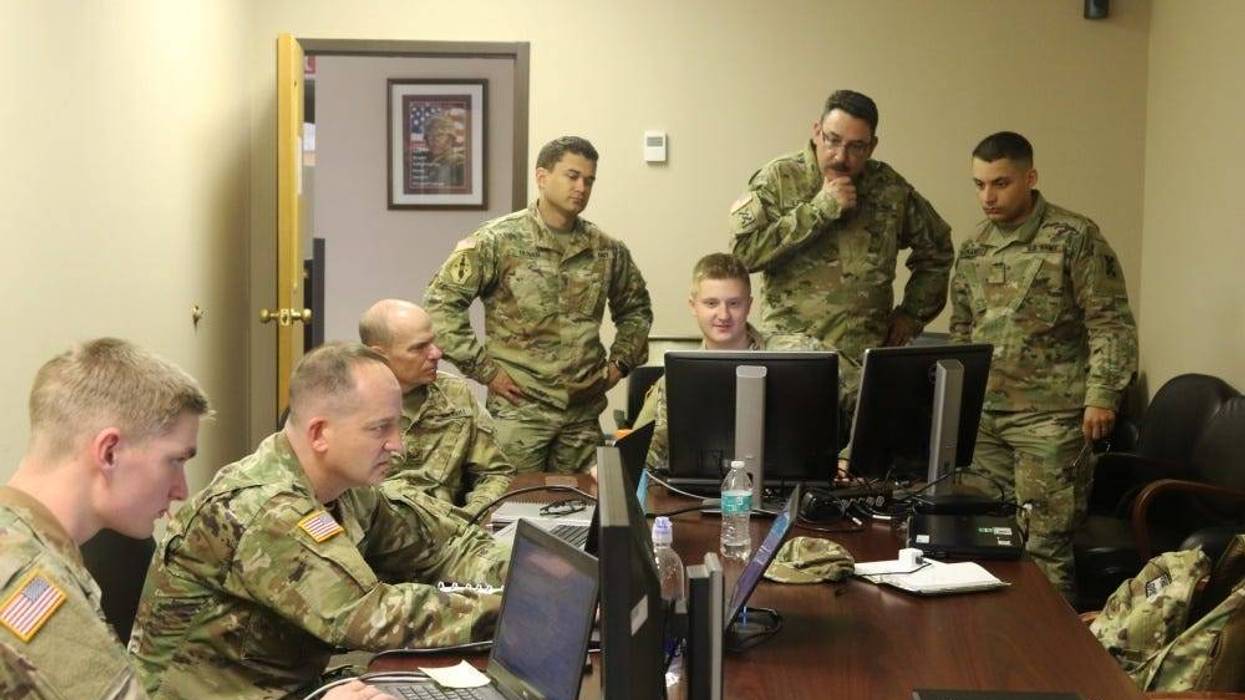

A recently published Rand Corporation study found that Company Commanders, Executive Officers, and First Sergeants were overworked and frustrated with the degree to which they have been tasked with mandatory training.
The study was designed to look at whether soldiers are being overworked and dovetails with Dr. Leonard Wong's 2002 study which also found that soldiers are expected to carry out more mandatory training than there are training days on the calendar.
"Company leaders in the Army face an inherent tension between activities that develop combat readiness and other mandatory training and administrative tasks associated with life in garrison," the study says finding that, "soldiers reported using varied strategies to manage their time effectively, but several frequently mentioned strategies appear counterproductive and may lead to suboptimal performance, inaccurate readiness reporting, exhaustion, and burnout. Rather than pushing back on higher command taskings, soldiers may resort to lying, misrepresenting the truth, or seemingly tasking themselves and their subordinates beyond the limits of productivity and effectiveness."
When it comes to mandatory training, much of it is non-mission essential and over the years has been shunted to online training modules.
“I have 90 people and only three computers," one platoon sergeant said in an interview. Another service member lamented that "My office has two computers for 42 people. And one computer belongs to the LT [lieutenant]. And everyone wants something online. Technology tools. It’s fine that the Army is trying to do online, digital training, but most platoons with 30–40 guys have two computers. We have more computers available, but we don’t have enough internet drops. The IT [information technology] infrastructure doesn’t support the mission. It’s not wireless, it’s antiquated."
Soldiers are known to conduct this time-consuming training in a check the block manner which does not inspire pride in their work.
“Online training is just checking boxes," one of those interviewed by Rand described. "If you put it online that means that you don’t care about it. If it was face-to-face and a [Colonel] has to sit here, then the Army finds it important.”
In a Army that is increasingly focused on trackers and making sure their troops are in the green on various types of non-essential training, many leaders complained about a lack of focus and prioritization.
"It’s all about stats. The real question is, are we good at our job? All of these mindless metrics don’t help. It should be about if the company is good at what we do—go find and kill the enemy," one soldier said.
An even more disturbing finding is that in order to meet these mandatory training requirements, soldiers have to get creative with their time management skills. One of the more effective strategies they have found is to simply lie to superiors about completing training that they haven't.
"The focus is on if all of your stats are green. There is [a] zero defect mentality. If someone is delinquent then you are bad at your job. We are lying to ourselves. I say I am truthful and you are considered bad and so we have normalized it—'Yeah we are good.' They say green . . . good to go. If I have one overdue then it is the end of the world, so you might as well make green," another soldier explained.
In other interviews, soldiers laid it out in blatant terms saying:
“Nobody does the online training. We click through things. We don’t have time. Whatever they think is happening, it’s not.”
“Lie constantly.”
“You want numbers, I can give you numbers.”
Curiously, Rand published another study almost in tandem with this one claiming that soldiers were likely overpaid. However, this latest study concluded that middle managers are being overworked with the average workday being around 12.5 hours.
While outside of the scope of the Rand report, it is worth noting that there is some evidence that this garrison mentality has been carried overseas into combat zones. In the Afghanistan papers recently published by the Washington Post, one disturbing story about a Marine Corps unit notes “They had a really expensive machine that would print these really large pieces of paper like in a print shop,” a contractor advising the Marines in Helmand province said talking about how progress in Afghanistan was tracked. “There would be a caveat that these are not actually scientific figures, or this is not a scientific process behind this.”
A National Security Council staffer said in the Afghanistan report, which was prepared by the Office of the Special Inspector General for Afghanistan Reconstruction (SIGAR) that, "It was impossible to create good metrics. We tried using troop numbers trained, violence levels, control of territory and none of it painted an accurate picture. The metrics were always manipulated for the duration of the war," in reference to the military making progress in Afghanistan.
The answer for at least some officers has been to push back against their chain of command by simply telling them no, the new Rand report's concluded.
“Of all the time-management techniques ever developed, I’ve found that the most effective is the frequent use of the word no," another interviewee said. "You cannot protect your priorities unless you learn to decline— tactfully and firmly—every request that does not contribute to the achievement of your goals."
Want to get more connected to the stories and resources Connecting Vets has to offer? Click here to sign up for our weekly newsletter.
Reach Jack Murphy: jack@connectingvets.com or @JackMurphyRGR.