

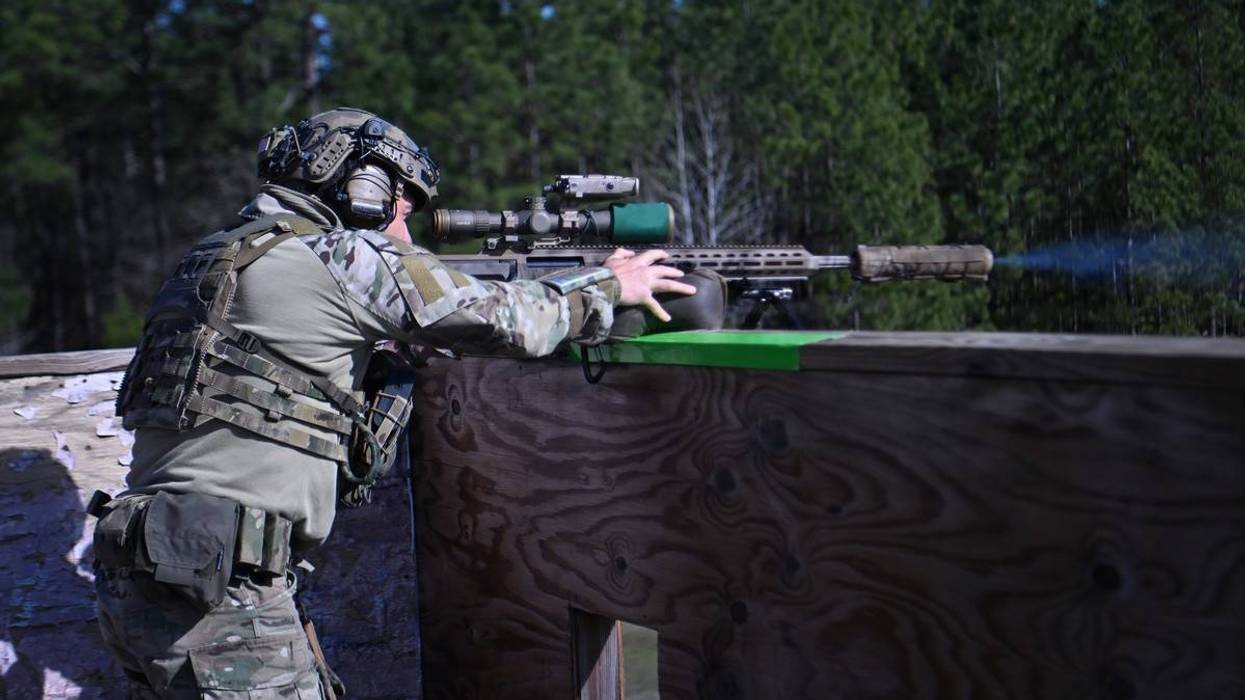

The 17th annual sniper competition brings together snipers from across the American and the allied special operations community for a multi-day event held at Fort Bragg and overseen by instructors as the Special Forces Sniper Course.
“This competition represents the pinnacle of the sniper craft,” explains Col. Simon Powelson, the commander of 2nd Special Warfare Training Group. “We have brought together highly trained teams from across the joint force and partner nations. These competitors are not just here by chance; they are the product of intense and specialized training within their respective units.”
During the five-day competition, two-man sniper teams are pushed to the limits on various ranges on Fort Bragg, testing their precision marksmanship skills out to ranges of 1,200 meters. The first day of the event, the snipers had to contend with high winds and rain brought in by thunderstorms, significantly impacting visibility and making taking accurate shots that much more difficult.
Two-man sniper teams operate as a sniper and spotter. Typically, the more experienced sniper is the spotter who helps the sniper get on target and make range and windage estimations. The sniper dials this data into the scope on his rifle and fires. Interestingly, the key aspect of being an effective sniper is communication between the sniper and spotter.
“Good, clear, concise communication is a must,” said Richard Cuza, a Special Forces Sniper Course instructor. “It’s beyond important; it’s crucial.”
“Being in synch with your teammate is equal in importance to communication,” said Timothy Gozelski, the sniper course manager. “To be successful, the two have to talk and be on the same page in everything they do.”
After five days, it was announced that a team from the United States Army Special Operations Command (USASOC) won the competition. USASOC is a command, but doesn't have maneuver units per se. In this case, USASOC is likely used as a euphemism for a team from the Army's secretive Delta Force.