

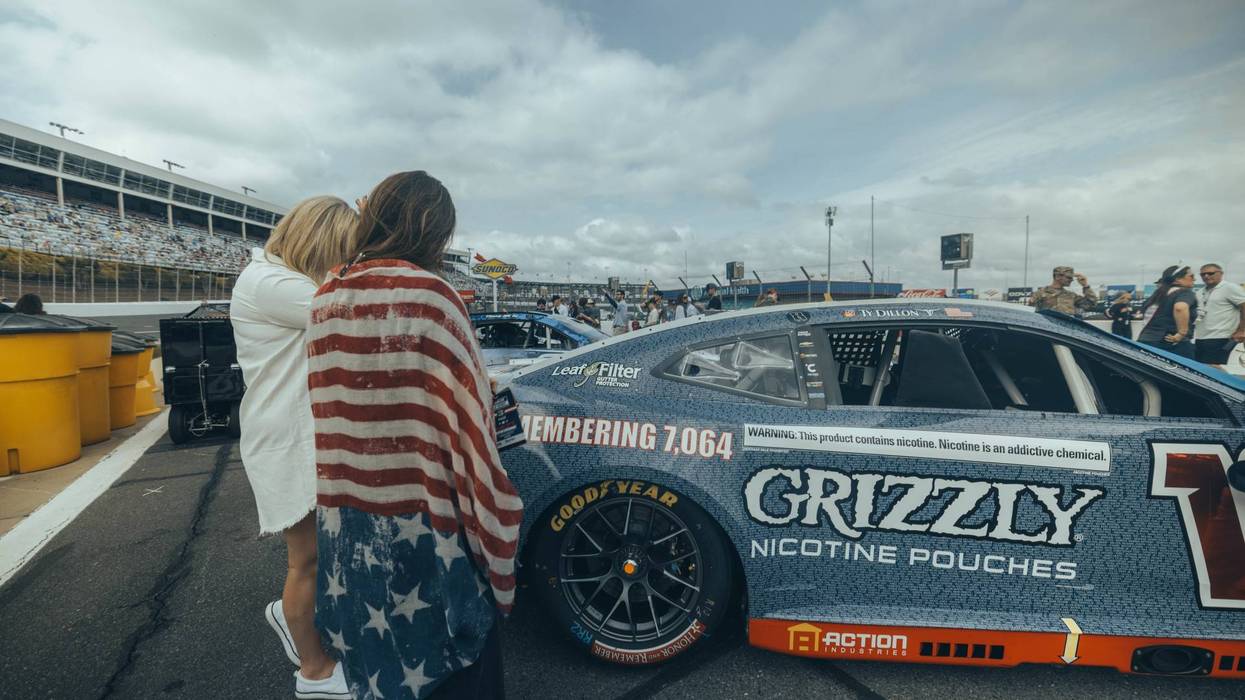

At Charlotte Motor Speedway in North Carolina, the Coca-Cola 600 was everything it is supposed to be: horsepower, heat, noise and 600 miles of punishment. It was also something harder to stage and easier to cheapen. It was remembrance.
Charlotte Motor Speedway and NASCAR did not hide Memorial Day in a program note or a patriotic graphic between green flags; they built it into the race. Each car carried the name of a fallen service member. The Gold Star family luncheon — an annual feature of the race for years now — brought surviving families together with drivers, military leaders and guests. At the race's halfway point, the engines shut off, the grandstands went still and thousands of people were asked to stop long enough to remember why the weekend exists.
For Jane Horton, one of those names was not a name on a windshield. It was her husband.
Army Spc. Christopher David Horton, a sniper assigned to the Oklahoma Army National Guard's 45th Infantry Brigade Combat Team, rode with Ty Dillon's No. 10 Chevrolet. He was 26 when he was killed Sept. 9, 2011, in Zormat district, Paktia Province, Afghanistan. He left behind parents, siblings, friends, soldiers who loved him and a wife who has spent nearly 15 years refusing to let his life become a slogan.
Gold Star families are families of service members killed in combat operations. And Jane Horton knows how easily America turns sacrifice into ceremony without letting the ceremony change anything.
"I haven't [been featured in] a Memorial Day article in years," Horton said during race weekend. "I used to go on the news all the time and talk about Memorial Day, because it would drive me nuts that the American people don't know what it is."
Then she put the day into one sentence.
"364 days out of the year is about you, and we could never do enough for you," she said. "But this one day is for the dead."
Even at the speedway, Horton kept looking for Gold Star badges. She watched lanyards, shirts and lapels the way others watched pit road. When she saw a family wearing that mark, she went to them. She traded contact information and exchanged phone numbers; not to network and not to be seen, but because she knows what it feels like to carry a loved one's death into a crowd. She wanted them to know their families had an advocate. She wanted them to know their fallen would not fade.
That is what she does. At the Pentagon. In Congress. At Dover Air Force Base, Delaware. At a racetrack. On the phone at 1 a.m.
"I'm just an advocate for them," Horton said. "If they need something, they'll call."
That sentence sounds small only to someone who has never needed the call answered.
Horton has spent her adult life making sure the government remembers that casualty assistance is not a process. It is a family standing in a doorway after the worst knock of their lives. It is a child who wants to follow a parent into service. It is a spouse who needs a fellowship in government service, a mother who needs answers, a father who needs someone to say his son's name without looking away. Horton has championed education benefits for surviving spouses, Gold Star family fellowships, survivor policy changes in defense legislation and initiatives that give families direct access to senior leaders. More recently, she has helped lead Gold Star family efforts from inside the secretary of war's office, where policy becomes real only if someone forces it to touch people.
She learned that work first through Chris.
Jane met him when they were 18 and 19 at a small school in New York City. They talked about America, government and politics. He was from Alabama and Oklahoma, a military school kid from seventh through 12th grade, a civilian shooter, a man who would become a sniper.
He was not warm and fuzzy.
"He was more like a warrior," Horton said. "He was stoic, but he also had a huge heart."
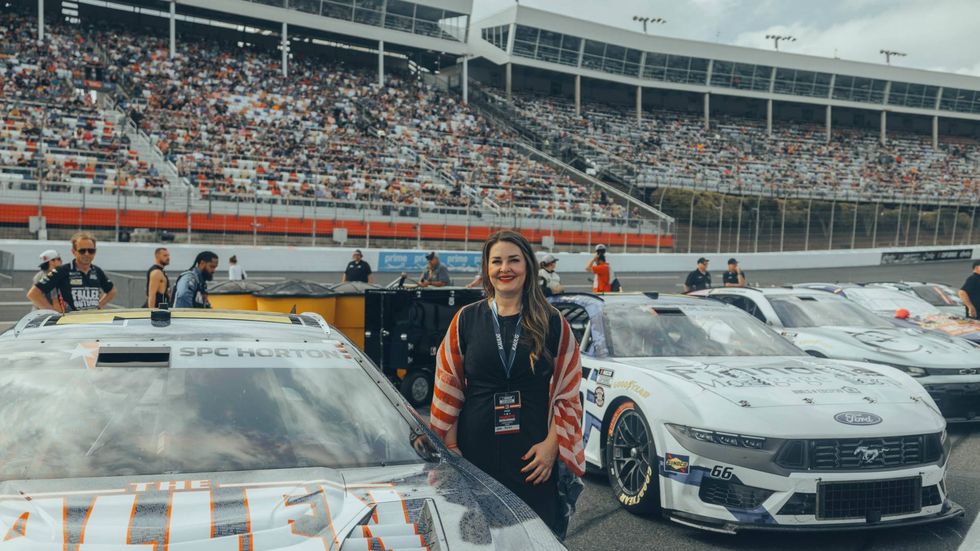 Jane Horton poses next to Ty Dillon's No. 10 Chevrolet before the Coca-Cola 600 NASCAR race at Charlotte Motor Speedway in North Carolina, May 24, 2026. Courtesy of the Pentagon
When he brought Jane to Oklahoma, his family was stunned. They never expected Chris to marry young. Then he sold his guns to buy her engagement ring.
"Yes, Chris, the trained sniper, sold his guns," Horton said.
They married in 2009. War bent the calendar. He left for pre-mobilization in February 2011. They believed he would come home because he was good at what he did, because he had trained for war the way a surgeon trains for an operating room, because young couples have to believe the future belongs to them.
Seven months later, he was dead.
Two days after that, on the 10th anniversary of 9/11, Jane stood at Dover to receive the flag-draped casket of the man she had expected to grow old with. The war that began when America was attacked had taken him. His final flight home was not the one either of them imagined.
Years later, Jane made the flight Chris never could take alive.
In 2016, she traveled to Afghanistan with then-Marine Gen. Joseph Dunford, chairman of the Joint Chiefs of Staff, serving as a special assistant and ombudsman to the troops. She went not for closure. Closure is too clean a word for grief that never leaves. She went to see the land where Chris fought, bled and died. She went because the soil there held part of her life. She went because terrorism had killed her husband, but would not define his story.
It was not her last trip. Horton eventually made six trips to Afghanistan in different official capacities, traveling with senior U.S. leaders, meeting Afghan officials and seeing the country not as a headline but as a people. She later served as congressional and military liaison for the Embassy of Afghanistan in Washington, where she helped connect the embassy with Congress, the Pentagon and the military community.
Her work there was not just abstract diplomacy.
She hosted hundreds of fellow Gold Star families at the Afghan Embassy so Afghanistan could become more than the place their loved ones died. She bought Afghan silver and lapis for the daughters of fallen heroes so they could hold something beautiful from the land where their fathers' blood remained. She told families about girls going to school, women serving in parliament and children building robotics teams. She wanted them to see that the sacrifice had produced life, that something good had grown in the hard ground.
In 2017, she went outside the wire to Afghanistan's Presidential Palace. Afghan women she worked with helped her prepare, even warning her against the red lipstick she wore almost every day. She passed through layers of security and saw Afghan soldiers drilling in ceremonial uniforms. Former Afghan president Ashraf Ghani thanked her for the sacrifices of America's fallen and their families.
The weight of that moment never left her.
Neither did the weight of what came later.
When Kabul fell in 2021, the country where Chris died collapsed before the eyes of Americans who had spent years not looking. For Horton, the withdrawal reopened wounds, not because she had mistaken Afghanistan for easy, but because she had seen the people who would pay for American forgetfulness. She had held Afghan children. She had met Afghan women who believed in the future they were promised. She had sat with troops and families who had given pieces of themselves to that mission.
"Nobody paid attention to Afghanistan until it was over," Horton said. "They didn't. Nobody cared."
After the withdrawal, she wrote that the fall of Afghanistan broke her in a way Chris' death had not. She saw his picture and the pictures of other fallen Americans thrown back into public debate under a cruel question: Did they die for nothing?
Her answer demanded more from America than sympathy.
"When I sent my husband to war, he was no longer mine," she wrote. "He was ours. He was America's."
That is the line Americans should carry into Memorial Day. Not because it absolves the country, but because it indicts the country. If America sends its sons and daughters to war, America does not get to forget the war while they fight it. It does not get to discover Afghanistan only when the last C-17s are leaving Kabul. It does not get to thank a widow and avoid the harder question of whether she understood what her husband was ordered to do.
And that is why the Coca-Cola 600 matters when it is done right.
A race cannot repay a life. A luncheon cannot erase a knock at the door. A name on a car cannot bring Chris Horton home. But a racetrack can force a crowd to learn a name. A driver can carry a story. A speedway can make the living sit still with the dead. A family can walk into a room and be treated not as a prop for patriotism, but as part of the American story.
At Charlotte, Horton accepted the gratitude but kept redirecting it.
When she saw police escorts and VIP treatment, she did not confuse it for something she earned.
"That's for my husband," she said.
That is the thread through her life. Turn it back to Chris. Turn it back to the fallen. Turn it into action. Hold people to their words.
"I hold people's feet to the fire that say they care about Gold Star families," Horton said. "Thank you for saying you care, but how do you actually turn that into action?"
It is a fair question for Memorial Day.
There is room this weekend for joy. Horton believes that. Chris would want people to live. Go to the race. Take the trip. Fire up the grill. Laugh with your children. Enjoy the freedom bought for you by people you may never meet.
But do not confuse enjoyment with ignorance.
Patriotism is not a hand wave. It is not a rubber stamp. It is not a flag emoji, a furniture sale or a thank-you delivered without understanding. It is informed gratitude. It is knowing where America sent its troops, why they went, what they endured, who did not return and which families still carry their names.
"Gold Star families are strong," Horton said. "We're serving as well in different roles and different capacities, and the best way you honor the fallen is by living the best life you can."
She has done it the hard way. By answering calls. By walking the halls of power. By going to Afghanistan. By standing at Dover. By finding families wearing Gold Star badges in a crowd and giving them her number. By making sure Chris Horton's name is not trapped in a casualty report or a widow's memory.
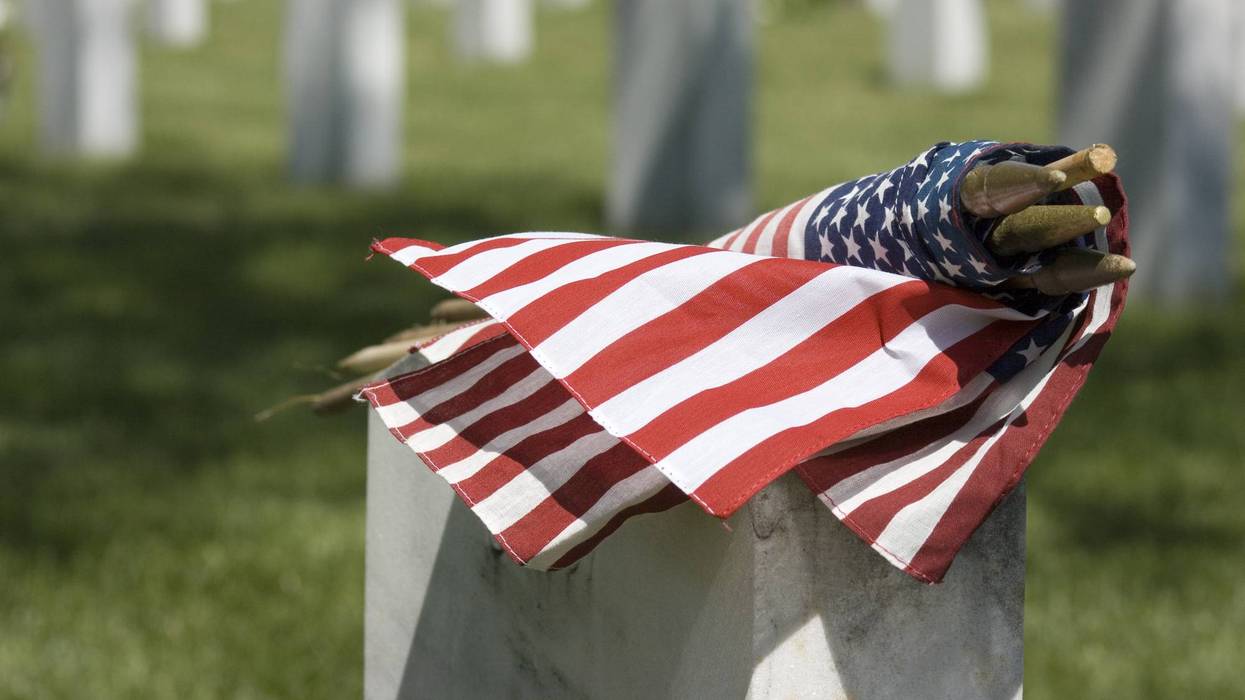
This Memorial Day, one of those names is Army Spc. Christopher David Horton.
Say it. Learn it.
Then learn another.
And when the engines restart, when the crowd stands again and the noise returns, remember what the silence was for.
One day is for the dead.
The rest is what we do with what they left us.