


More than 100 people gathered at Arlington National Cemetery, Virginia, on March 30 to honor and remember retired Air Force Col. Clarence E. "Bud" Anderson, the last surviving World War II triple ace, a pilot who had downed at least 15 enemy aircraft, and one of the most distinguished fighter pilots in American history.
Anderson, who passed away at age 102 in 2024, was laid to rest in section 38, joining his beloved wife of nearly 70 years, Eleanor Cosby, who was buried in 2015.
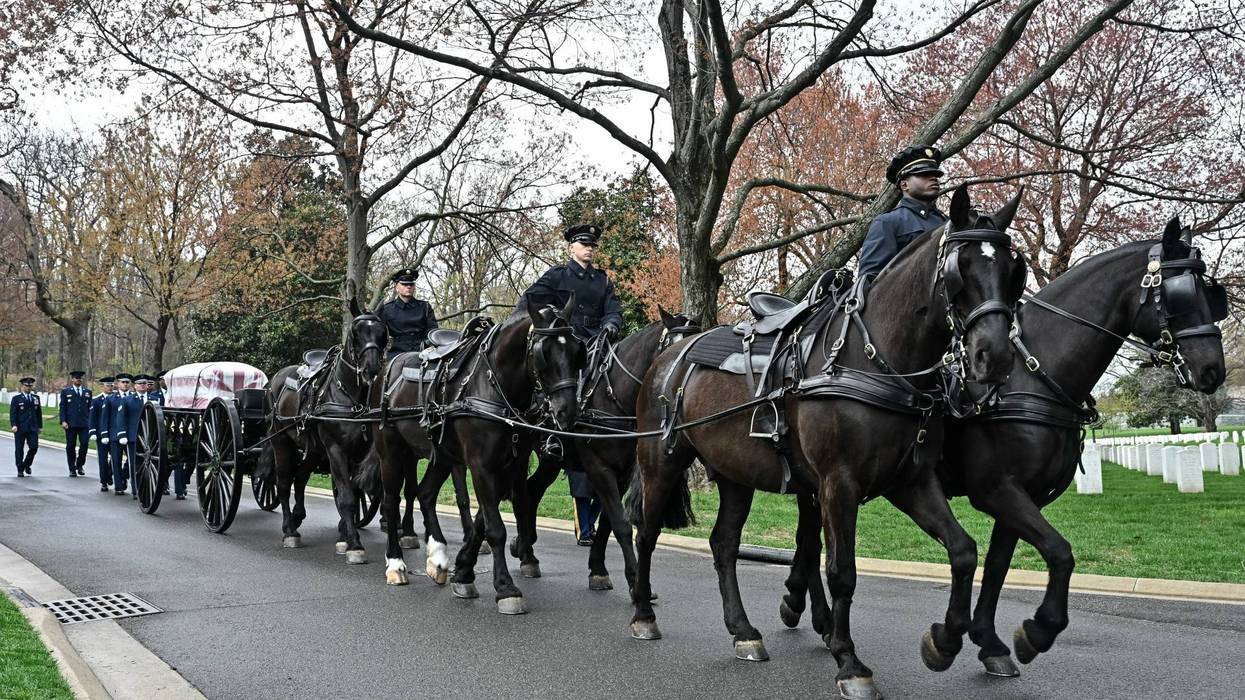
The full military funeral honors with escort service commenced with a double flyover: first by four F-35 Lightning IIs, followed by four World War II-era P-51 Mustangs, two of which bore the name "Old Crow," the name of Anderson's fighter. A horse-drawn caisson carried Anderson's urn to section 38, where an Air Force firing team shot three volleys, a bugler sounded "Taps" and a bagpiper concluded the ceremony by playing "Amazing Grace."
Air Force Chaplain (Capt.) Andrew Lloyd, who oversaw the service, told the mourners, "In life, Bud Anderson honored the flag with his service to the nation; now, it is our honor to present our nation's flag in honorable and faithful service."
After the U.S. Air Force Honor Guard crisply folded the American flag over Anderson's urn, Chief of Staff of the Air Force Gen. Kenneth S. Wilsbach presented it to Anderson's son, Jim, who then passed it to his sister, Katherine Burlington, seated next to him. "We're sharing it," he later explained.
Receiving the flag from Wilsbach humbled Jim. "I appreciate that he would take time out of his busy schedule to be here," he said. Both siblings were deeply moved by the service, particularly the double flyover. While Jim had worked to ensure that the P-51s would be part of the ceremony, the addition of the F-35s came as a surprise. "That was really special," he said.
Anderson's journey to becoming an aviation legend began in the 1920s, when he was growing up on a California farm and became fascinated by airplanes flying overhead. In 1941, at age 19, he earned his private pilot's license.
He joined the Army Air Corps Aviation Cadet Program in January 1942, shortly after the United States entered World War II, and was commissioned in the Army Air Forces later that year.
During World War II, Anderson served two tours with the 363rd Fighter Squadron, flying P-51 Mustangs that escorted heavy bombers — helping to win Allied air supremacy over Europe. He flew 116 individual combat missions that resulted in 16 downed aircraft and one shared combat victory, earning him triple ace status. After World War II, Anderson remained in the Army and then the Air Force, after it was established as a separate service branch in 1947.
As a fighter pilot, test pilot, and combat and operational commander, Anderson logged over 7,500 flight hours and flew more than 130 types of aircraft. His many decorations include five Distinguished Flying Crosses, two Legion of Merits, 16 Air Medals, and the French Legion of Honor and Croix de Guerre.
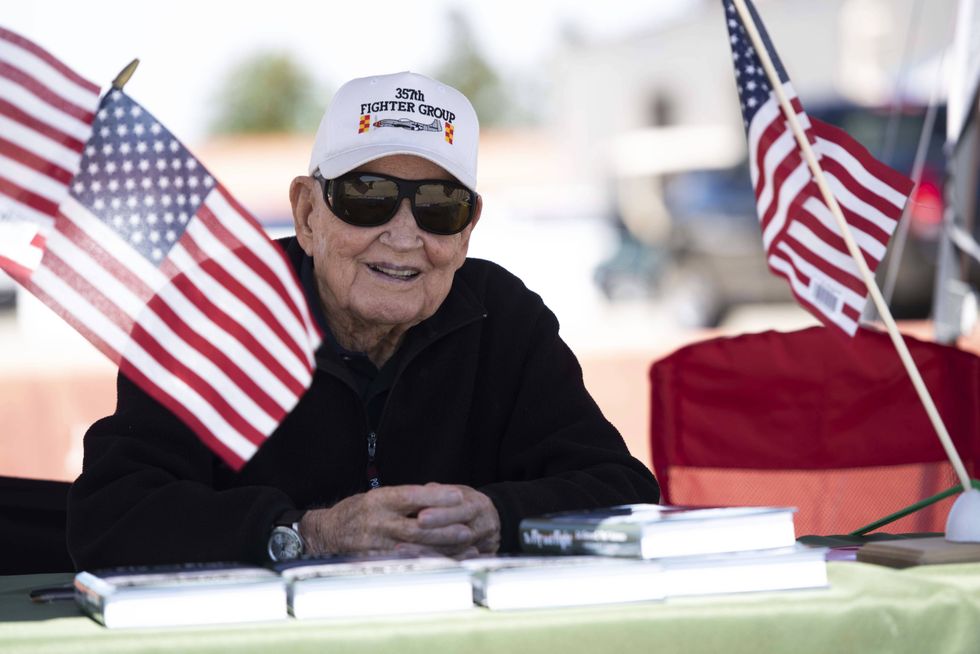 Retired Air Force Col. Clarence E. "Bud" Anderson, World War II fighter pilot, sits at his booth during the Wings Over Solano Airshow at Travis Air Force Base, Calif., May 15, 2022. Air Force Senior Airman Alexander Marchak
Yet Anderson's legacy is not defined by numbers alone. After he retired from the Air Force in 1972, he became a public ambassador for the World War II generation and America's achievements in aviation. Through his 1990 memoir and frequent speaking engagements, Anderson brought to life the experience of aerial combat and the significance of military service.
Reflecting on his father's influence, Jim — who attended the U.S. Air Force Academy, served during the Vietnam War and then became a commercial airline pilot — said, "When I was in the Air Force, I tried to keep it a secret who my father was because I wanted to make [my career] my own. But eventually people would find out."
Anderson continued flying until the age of 90. In 2022, he was honored at the nation's largest aviation convention, where he took his last flight, as a passenger, in a P-51. He was 100 years old.
Beyond his remarkable career, Anderson was a devoted husband, father, grandfather and great-grandfather. Jim and Katherine each shared fond memories of their father.
The funeral at Arlington National Cemetery offered a poignant farewell to a beloved family man and aviation icon.
"Bud Anderson is a hero and legend in air combat; he wrote the playbook," Wilsbach said. "He mastered his craft, flew with immense courage and leaves a legacy of service that will inspire generations."