


The Navy is looking for a few good men; just make sure your TRICARE is up to date. Active-duty service members and TRICARE dependents are eligible for a new NASA study that examines the effect of gravity on the human body.
With America committing to establishing a moon base in the not-so-distant future, astronauts have to contend with leaving Earth's gravity field, then living in zero gravity, and then being subjected to the moon's substantially weaker gravity field, all of which can lead to vestibular issues in the human body.
The experiments will take place at Wright-Patterson Air Force Base, overseen by the Naval Medical Research Unit Dayton, the Air Force Research Laboratory's 711th Human Performance Wing, Johns Hopkins University School of Medicine, and NASA's Human Research Program. Each volunteer must pass an aviation medical clearance and be currently enrolled in TRICARE due to the physical stress their bodies will be put through.
"The participants' physical readiness for the unique aspects of the centrifuge exposure, coupled with the need to have reasonable astronaut analog subjects, is key," explained Rich Folga, who is a project manager assigned to Naval Medical Research Unit Dayton. "Having an aeromedical clearance notice from a competent flight medicine examiner ensures candidates have 'the right stuff.'"
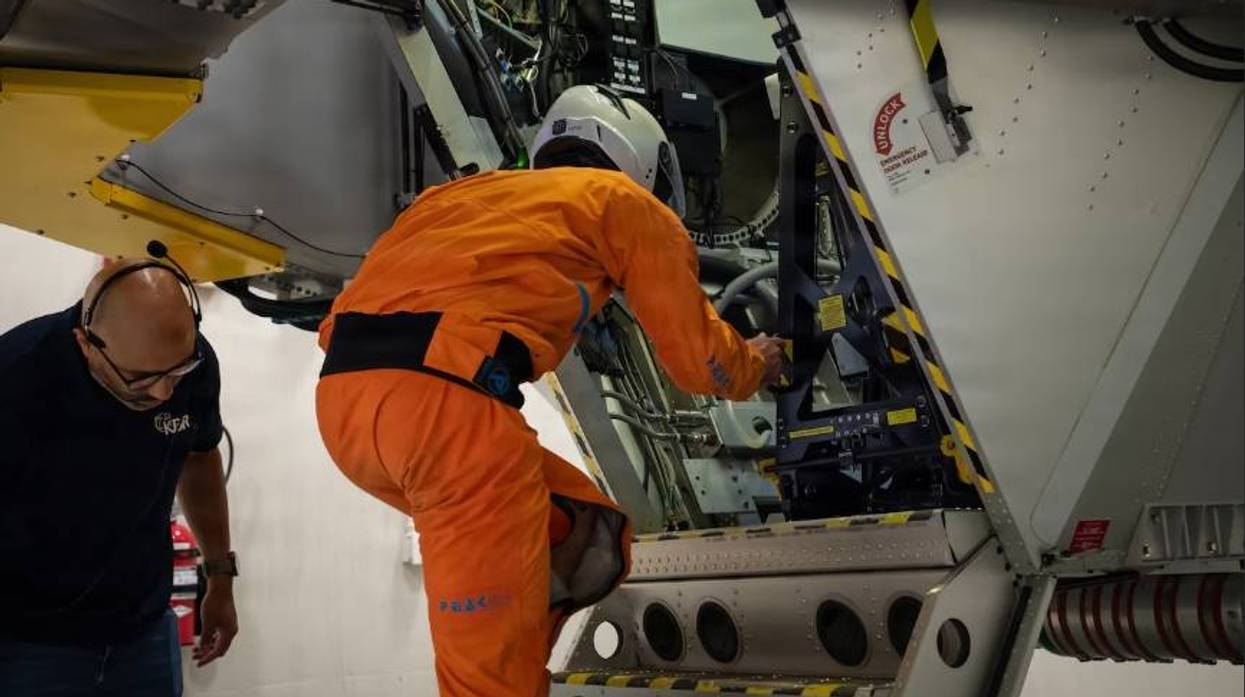
Here is what the test subject can look forward to: First, participants will be subjected to controlled acceleration in a centrifuge module spun at high rates of speed to simulate different types of gravitational fields. After emerging from the centrifuge, while still feeling its effects, participants will wear special goggles that track eye movements while being assigned to complete different tasks. The purpose of the experiment is to help NASA develop new countermeasures to how astronauts are impacted by the different gravitational fields they will experience during space travel.
The study supports NASA's Artemis moon exploration program, which aims to create a sustained human presence on the moon by the end of the decade.