

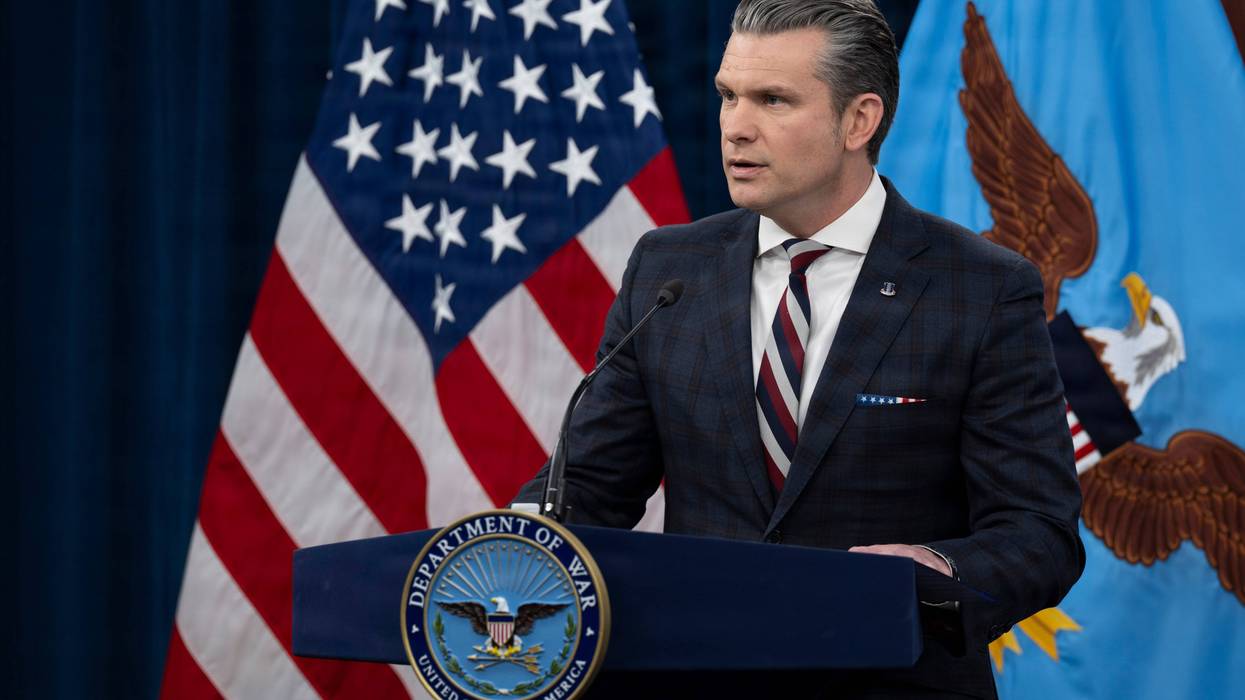

Defense Secretary Pete Hegseth took a boastful tone in describing the size, scope, and lethality of U.S. military operations in the war on Iran during a press conference at the Pentagon on Wednesday.
"I stand before you today with one unmistakable message about Operation Eric Fury: America is winning decisively, devastatingly, and without mercy," Hegseth said, referring to the U.S. military action against Iran.
In describing the "incredible" and "historic" results of the war, which began on Saturday, undertaken with Israel, Hegseth said the combination of the two forces has resulted in the "sheer destruction for our radical Islamist Iranian adversaries."
"They are toast, and they know it," the Defense Secretary said. "Or, at least, soon enough they will know it."
Hegseth said that the "starting last night" and to be "completed in under a week," the combined U.S. and Israel forces will have "complete control of Irianian skies, uncontested airspace." Under that scenario, he outlined Iranian leaders seeing American and Israeli air power overhead "every minute of every day until we decide it's over."
"B-2s, B-52s, B-1s, Predator drones, fighters controlling the skies picking targets, death and destruction from the sky all day long," he continued. "We're playing for keeps. Our warfighters have maximum authorities granted personally by the President and yours truly.
"Our rules of engagement are bold, precise, and designed to unleash American power, not shackle it. This was never meant to be a fair fight, and it is not a fair fight. We are punching them while they are down."
Hegseth said the Navy is having similar success on the seas, including the sinking of an Iranian vessel by a torpedo fired by a U.S. submarine.
"The Iranian Navy rests at the bottom of the Persian Gulf," Hegseth said. "Combat ineffective, decimated, destroyed, defeated, pick your adjective."
In a video posted to social media on Tuesday, Adm. Brad Cooper, head of U.S. Central Command (CENTCOM), said that more than 50,000 troops, 200 fighters, two aircraft carriers and bombers were participating in the fight in what is "the largest buildup by the U.S. in the Middle East in a generation."
Hegseth, speaking on the fifth day of the armed conflict, said it is still "very early," and the "metrics are shifting," adding that "as President Trump said, more and larger waves are coming."
"We are just getting started. We are accelerating, not decelerating," Hegseth said. "Iran's capabilities are evaporating by the hour, while American strength grows fiercer, smarter, and utterly dominant. More bombers and more fighters are arriving just today."
As far as a timeline of hostilities and if the Iranians could "outlast" the American war effort, the Defense Secretary said that through the "violence of action" that is not possible.
"The only limits we have is President Trump's desire to achieve specific effects on behalf of the American people," he said. "You can say four weeks, but it could be six, it could be eight, it could be three.
"Ultimately, we set the pace and the tempo, the enemy is off balance and we're gonna keep 'em off balance."
Hegseth said more bombers were arriving on Wednesday, and added that with control of the air, the U.S. will be using 500-pound, 1,000-pound, 2,000-pound GPS and laser-guided precision gravity bombs "of which we have a nearly unlimited stockpile," dismissing reports that stocks of standoff munitions used earlier were running low.
"We can sustain this fight easily for as long as we need to," Hegseth said.
As far as Iran's strength in firing ballistic missiles, Gen. Dan Caine, the chairman of the Joint Chiefs of Staff, said ballistic missile strikes were down 86 percent from the first day of fighting, "with a 23 percent decrease just in the last 24 hours." And the one-way attack drone strikes were also down 73 percent from the opening days.
"This is not a 'Mission Accomplished' situation," Hegseth added, referring to a banner that hung behind President George W. Bush when he announced the end of "major combat operations" in Iraq six weeks after the war began in May 2003. "This is simply a reality check."
The Defense Secretary said Iran and its proxies will continue to be able to launch ballistic missiles and one-way attack drones, and criticized the "fake news" for missing the story by focusing on continued Iranian strikes.
"This is what the fake news misses. We've taken control of Iran's airspace and waterways without boots on the ground," he said. "But when a few drones get through or tragic things happen, it's front page news. I get it, the press only wants to make the President look bad, but try for once to report the reality.
"The terms of this war will be set by us at every step."
Hegseth added that to improve the defensive posture, before the military action got underway, the U.S. moved "the vast majority of American troops – over 90 percent of the Americans who were on our bases - 'off the X', out of the range of Iranian fire."
"Our defensive shield is equally formidable, the most sophisticated air and missile defense network ever fielded," he said, adding that while these measures have been extensive, that "does not mean we can stop everything."
The U.S. has sustained six killed in action and nearly 20 wounded, according to the latest figures released by CENTCOM. The six deaths appeared to occur when an Iranian drone struck the operations center that the soldiers were occupying on a base in Kuwait. The U.S. Army has named four of the soldiers killed.
"To our Gold Star families, to our wounded warriors, and their loved ones, we will never forget your sacrifice," Gen. Caine said. "Our nation stands with you and we are eternally grateful for your courage, your resilience, your devotion to this mission and to our mission."