

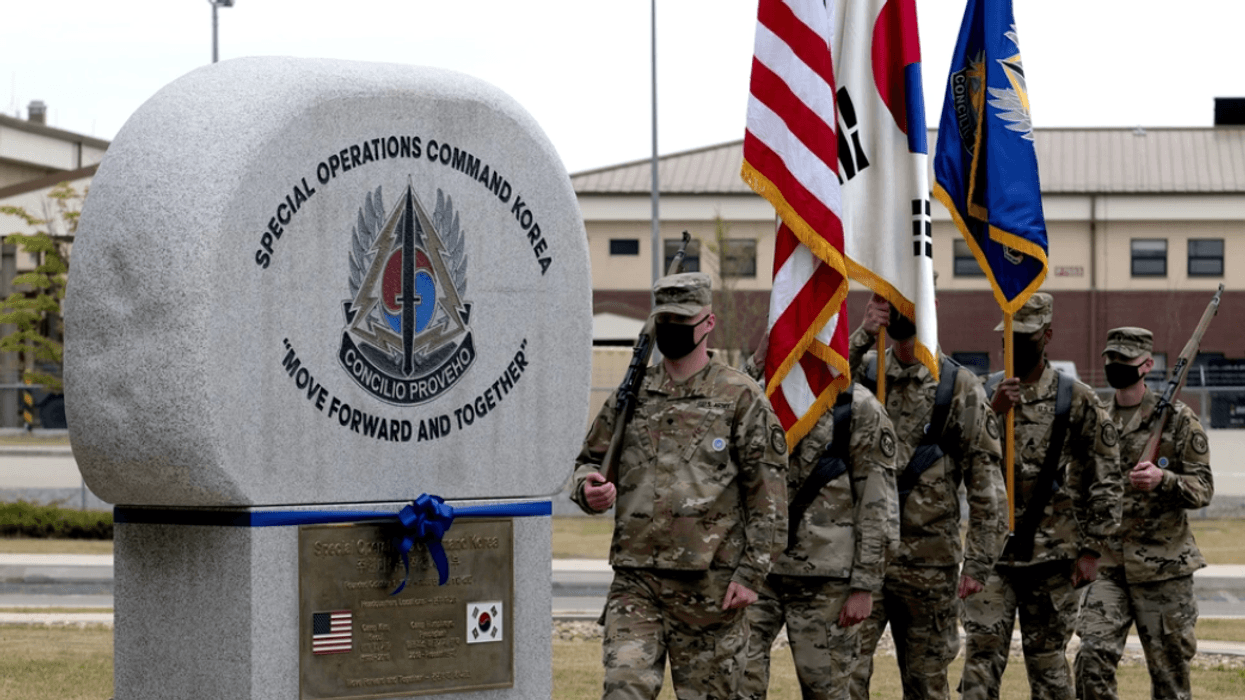

“With over 70 years in the making, our ROK-U.S. Alliance is one of the strongest in the world,” announced Brig. Gen. Derek Lipson, the current commander of SOCKOR (Special Operations Command-Korea).
“We at SOCKOR advance that special relationship every day through training and engagements with unique special operations capabilities in mind," Lipson explained.
At the end of the Korean War, Special Forces soldiers were stationed in South Korea on a temporary basis initially, which then became formalized in 1961 when Green Berets were stationed in Korea's under the command of Military Assistance Group Korea (KMAG). Later, this element became known as Special Forces Detachment Korea, or Det K for short.
In 2000, the U.S. Special Operations Command in Korea became known as SOCKOR and served as a full Theater Special Operations Command (TSOC). If war were ever to break out on the Korean peninsula, SOCKOR and South Korea's Special Warfare Command would merge to create a combined unconventional warfare task force. The aforementioned Det K would serve as a reception unit that would guide follow on American forces to the front lines as they arrived in Korea.
"In today’s technologically robust world, it’s easy to forget the fundamental principle that people are our greatest asset,” Lipson explained. “That’s not to say we don’t use advanced tools to our advantage. But at the end of the day, we need to know we have the relationships in place and an adaptive nature conditioned into our SOF warriors to meet both our nations’ defense priorities."
For SOCKOR and Det K, it is that human element that creates such a strong enduring relationship that has lasted for 70 years.