



Rockets guard Eric Gordon is one of the more accomplished players on the market with Thursday's trade deadline fast approaching. The 33-year old guard has played at a high-level this season while staying healthy, making him the perfect fit for any team chasing a championship.
However, there are complications. The Rockets are going to want a first round pick in return for Gordon, who is owed $19.6 million next season, and they will not want to take back players owed money past this season. With that said, there are four teams who should be breaking the door down to snag Gordon. Here are proposals to get a deal done, along with why the trade should be made, but ultimately won't.
Phoenix Suns
 Fanspo
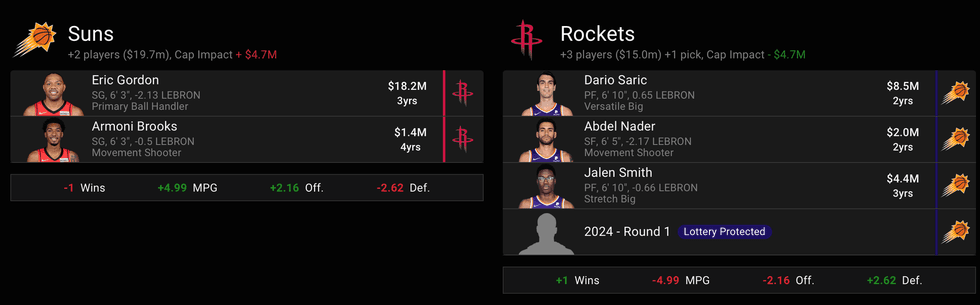
Why it should happen: I can hear Chris Paul telling Suns GM James Jones to "Go get Gordy" over and over again in the back of my head. Gordon is a perfect fit on an already great Suns roster. I can't think of a better third guard to play behind Paul and Devin Booker, and he could easily share the floor with both in three guard lineups. Gordon has played in big games and he has a history with Paul as well as Suns coach Monty Williams. The Rockets get the first round pick they want, but also get a free look at Smith, who is a restricted free agent this summer (more on this in a second). Saric is under contract for next season, but the number isn't bad and he's more than serviceable at multiple positions.
Why it won't happen: The Suns currently have nine players under contract for next season at over $126 million. That doesn't include Deandre Ayton, who if re-signed, would push the Suns well over the luxury tax. Gordon is slated to make $10 million more than Saric next season, and the option on the final year of his contract kicks in if his team wins a championship, so there's another $20 million plus luxury tax fees for next season, and possibly the year after. This matters because under Robert Sarver the Suns are one of the cheapest organizations in the entire sport, which is why Smith's third year option for a mere $4.7 was declined a year after he was taken with a top 10 pick. You don't decline the third year option on a top 10 pick unless you are terrified of the luxury tax. It is possible Sarver, who is under investigation by the league for all sorts of stuff, won't own the team much longer, but he will still be in charge on Thursday.
Utah Jazz
 Fanspo
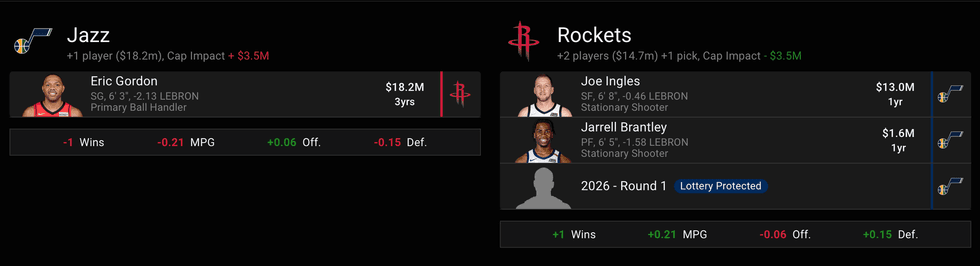
Why it should happen: Utah needs to have playoff success this season after back-to-back disappointing exits. Ingles tore his ACL last month, leaving a huge hole in the Jazz's rotation. Gordon could easily slide into that spot, and while he's not the same type of distributor as the Aussie, he does give the Jazz a perimeter defender it lacked in the West Semis against the Clippers last season while still being space the floor and get to the rim. The Rockets get the first round pick they want, take back no future money, and even save a little bit this season.
Why it won't happen: The Jazz currently have just nine players under contract for next season and are just $4 million below the luxury tax threshold. They paid the tax last season, will pay it this season and are almost certainly going to pay it again next season, that means they are paying repeater penalties, and boy are those penalties significant, especially for a small market team. Utah would pay $4.25 for every dollar over the tax line if they eclipse it by $15 million, which would be a certainty with Gordon's $19 million on the books, so Gordon is going to cost them closer to $80 million for next season.
Boston Celtics
 Celtics
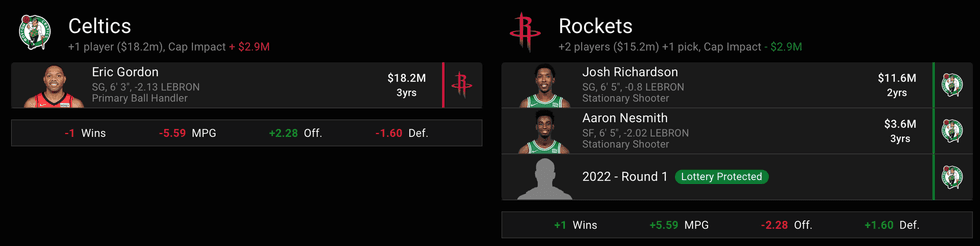
Why it should happen: Gordon would give Boston some much needed punch off their bench, especially if Brad Stevens elects to trade Dennis Schroder. He would also fit perfectly with Jayson Tatum and Jaylen Brown in crunch time units, while lessening the Celtics dependence on Marcus Smart. The Rockets get the first rounder they want, though Rafael Stone may want to push it back a year since he already owns two in this year's draft, and as a carrot for taking on the $12 million owed to Richardson next season, the Rockets get a free look at Nesmith, who was a lottery pick in 2020, but has been unable to find his footing in Boston thus far under two different coaching staffs.
Why it won't happen: First of all, the Celtics are already over the tax line, so this trade makes that bill a little bigger, but Richardson is playing really, really well. The last couple of months have been his best since he was in Miami. More importantly, Boston is currently eighth in a jumbled East after finishing seventh last season. The East is certainly wide open, but how much does Gordon in place of Richardson actually move the needle? Does it vault them into the top of the East standings and make the legitimate title contender or does it just move them out of play-in territory where they'd lose a first round series in six or seven games instead of five?
Minnesota Timberwolves
 Fanspo
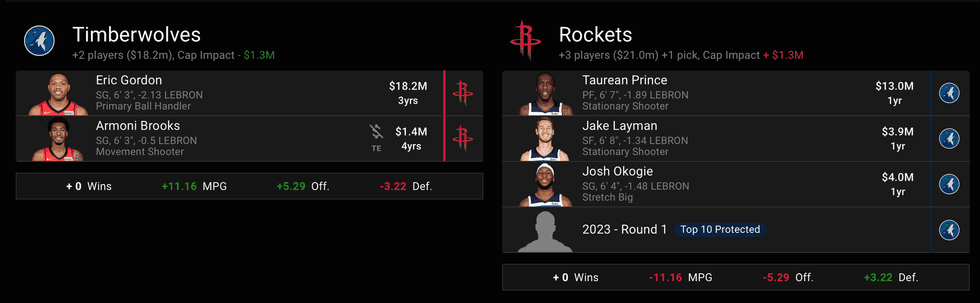
Why it should happen: The Wolves are a lock to at least get to the play-in tournament, but they are also just one game back of the six-seed. This is a team with new ownership and an interim GM that has one playoff appearance since 2004. The addition of Gordon won't push Minnesota ahead of Phoenix or Golden State in the West, but this is one of the teams where the extra year on his contract is a good thing. The Wolves are set to bring almost their entire rotation back next season, but they are nowhere near the luxury tax, so trading expiring contracts for Gordon this week would essentially amount to a free agency pick up a few months early. For those wondering, Okogie is included in this proposal to keep the Wolves out of the luxury tax for this season, which is why the protection on the pick is lighter.
Why it won't happen: There really is no reason why this trade shouldn't happen. The Rockets get what they want, and the Wolves add a very good, experienced player to an already talented roster.