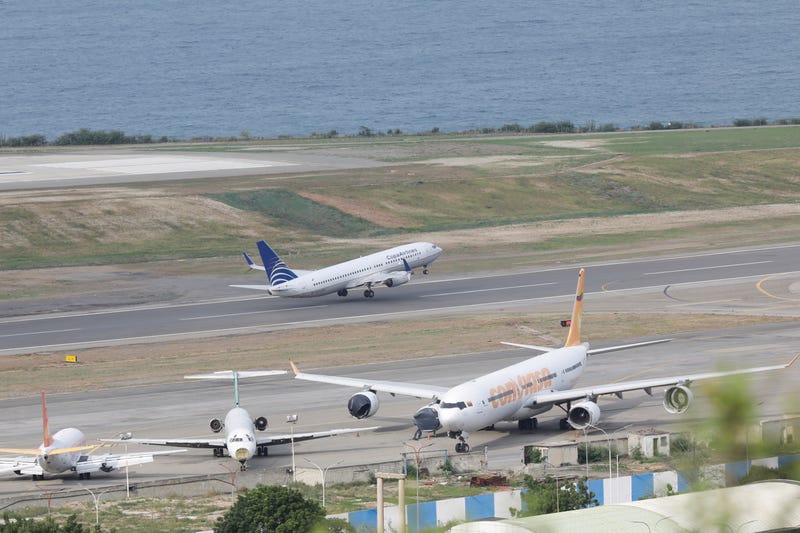
CARACAS, Venezuela (AP) — U.S.-operated flights returning deported migrants to Venezuela will continue despite President Donald Trump’s assertion that the airspace of the South American country should be considered closed.
The government of Venezuelan President Nicolás Maduro announced Tuesday that the twice-weekly flights will go on following a request from the Trump administration. That reverses a Venezuelan government announcement Saturday that indicated that U.S. immigration authorities had unilaterally suspended the flights.
An overflight and landing application submitted Monday by U.S.-based Eastern Airlines requests permission for an arrival Wednesday. The application was made public Tuesday by Venezuela’s foreign affairs minister.
Venezuelans have been steadily deported to their home country this year after Maduro, under pressure from the White House, did away with his long-standing policy of not accepting deportees from the U.S.
Immigrants arrive regularly at the airport outside the capital, Caracas, on flights operated by a U.S. government contractor or Venezuela’s state-owned airline. More than 13,000 immigrants have returned so far this year on the chartered flights, the latest of which arrived Friday
The flights have continued despite U.S. military strikes against vessels suspected of smuggling drugs in the eastern Pacific Ocean and off Venezuela's Caribbean coast.
The Trump administration says the strikes are aimed at drug cartels, some of which it claims are controlled by Maduro. Trump said Tuesday that the U.S. would start doing strikes on land soon, though he didn’t specify where and said attacks might occur in countries besides Venezuela, suggesting Colombia could see military strikes.
“You know, the land is much easier, much easier. And we know the routes they take,” Trump said to reporters as he met with his Cabinet at the White House. “We know everything about them. We know where they live. We know where the bad ones live. And we’re going to start that very soon too.”
Later, when asked to elaborate, Trump said he was speaking about countries that are manufacturing and selling fentanyl or cocaine. The president said he heard that Colombia is manufacturing cocaine and selling it to the U.S.
“Anybody that’s doing that and selling it into our country is subject to attack,” Trump said.
He added a few moments later, “Not just Venezuela.”
Colombia is indeed the world’s top cocaine producer. Its president, Gustavo Petro, rejected Trump’s assertion that any country that produces drugs bound for the U.S. could be hit with U.S. strikes. Petro also warned Trump that any attack on Colombia would be perceived as a “declaration of war.”
Petro, in a post on X, invited Trump to visit the South American country and “participate” in the destruction of cocaine labs.
“Don’t ruin two centuries of diplomatic relations” Petro wrote. “If there is a country that has helped to stop thousands of tons of cocaine from reaching American consumers, it is Colombia.”
As tensions continue to escalate, Pope Leo XVI on Tuesday called for the U.S. to pursue dialogue and even economic pressure on Venezuela, rather than threats of military action, to achieve its goals.
Leo, history’s first American pope, told reporters aboard the papal plane returning from Lebanon that the Venezuelan bishops conference and the Vatican Embassy in Caracas were trying to calm the situation and look out for the plight of ordinary Venezuelans.
“The voices coming from the United States change, with a certain frequency at times,” he said. “On the one hand, it seems there was telephone conversation between the two presidents, on the other, there’s this danger, this possibility of an activity, an operation including invading the territory of Venezuela.”
He stressed that he didn’t have further information. “Again I believe it’s better to look for ways of dialogue, perhaps pressure -- including economic pressure -- but looking for other ways to change, if that’s what the United States wants to do.”
___
Associated Press writers Nicole Winfield aboard the papal plane, Manuel Rueda in Bogota, Colombia, and Michelle L. Price in Washington contributed to this report.