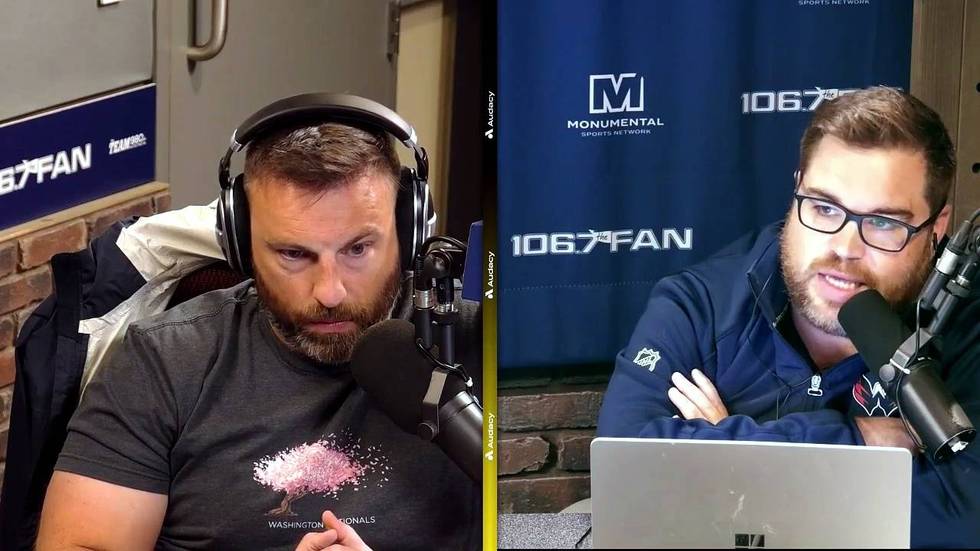


In a piece in The Athletic after the trade deadline passed, our good friend Ben Standig revealed that according to someone in the Commanders organization, Washington hoped to keep Montez Sweat, but the Bears’ offer was too good to refuse – something Grant Paulsen had heard, too.
Here’s the damning thing about today’s moves, though: per Standig, the Commanders see the Chase Young deal as “a potential addition by subtraction.”
All Danny Rouhier could say when GP dropped that was “whoa,” and yeah, that’s heavy.
“Again, this is a number two overall pick by this group that they gave up for a pick that'll be sandwiched between the 3rd and 4th round,” Grant said. “I'm not really sure what they're suggesting there, but one thing I was told earlier this year is that part of the issue they were having defensively was that they had two guys that were in contract years, kind of both at times trying to get up the field, get sacks, do what they had to do for their contracts.”
According to GP, that notion came up more in Young conversations than Sweat, which could explain Sweat’s better numbers and bigger return – but as the idea that having two guys trying to get paid could’ve hurt the defense overall is bad enough, there was potentially another caveat to that addition by subtraction idea.
“Maybe they're getting at what has loosely been suggested in the media, and through the coaches at times, that Chase Young does his own thing occasionally,” GP said. I don't know, but the quote to Standig from someone in the building is that they at least partially viewed trading Chase Young as addition by subtraction.”
“I mean, think about the company you're in, right? That’s a James Harden-level type thing; the type of comment that’s reserved for a locker room cancer,” Danny responded. “That is a heavy statement.”
An interesting corollary given Josh Harris’ basketball team just dealt Harden this week, too, but there may be something to it in DC.
“There are players who at times have voiced their displeasure about how he has operated over the years, in terms of defense is about everyone doing their role,” Grant said. “I remember when they didn't pick up the option – I wouldn't have picked up the option either, but I thought it was stunning that this group didn't because they drafted him – and I called over there and I was talking to someone, and basically what I was told at that time was ‘we've been just as good or defensively collectively, we haven’t really been a lot worse when Chase wasn't on the field.’
Basically, guys like Casey Toohill and James Smith-Williams were better than replacement level in that way, because they played within the scheme and played their role, which is what you want.
“They make life easier on guys like Allen and Payne, who the team had already paid at that point, because they're not freelancing; essentially, they are doing exactly what they're supposed to be doing,” GP said. “There are coaches that would rather have 11 average players doing exactly what they're asked than have exceptional players kind of doing their own thing. I don't know if that's what they're getting at, but man, does that quote jump out at me.”
And maybe, that is the real reason Montez Sweat fetched a second-rounder from Chicago, while Young got a compensatory third from San Francisco.
“It's not like that offer knocked their socks off, right? I mean, one of them screams you couldn't turn it down, and the other is like, ‘oh, they traded him for a compensatory third?’” Grant said. “Now, expiring contract, you could say better than nothing, but it's pretty clear that they took what they could. That is a sign they were clearly trying to trade him, and they got an offer and they were willing to take it, more so than the Sweat deal.”
Take a listen to the whole discussion above, as well as a caller’s thought on why the Young deal may have actually been a bad move overall?