
With a fresh blanket of snow on the ground, it's hard to imagine that Washington Nationals pitchers and catchers report to Spring Training in less than a month.
Between now and then, the front office will make more roster moves and bring in fresh talent to fill holes and provide depth.
Hopefully, they also reach agreements with Michael A. Taylor and Kyle Barraclough, who are the only two Nats currently headed to arbitration hearings with the team.
Arbitration is the process through which young MLB players make salary increases based on last year's performance. Basically, the league sets a deadline (Jan. 11 this year) where teams and eligible players must submit proposed salaries.
Because all of this is based on formulas and player comparisons, the numbers are rarely astronomically different. Most cases are settled by splitting the difference.
Occasionally, both sides dig in, which forces the player and team to go through a hearing to decide a winner and loser (no middle ground option). The player's side presents his case for a raise, while the team presents its side for why he doesn't deserve it.
Needless to say, this creates some awkward tension heading into Spring Training, which is usually about two weeks after the trial. If the team wins, that can be very bad for a team's relationship with the player, as it was with left-handed reliever Jerry Blevins in 2015.
Blevins spent just one forgettable season in Washington in 2014, pitching in 57.1 innings across 64 appearances to the tune of a 4.87 ERA. As MASN's Mark Zuckerman points out, Blevins and the Nats were just $200,000 apart in arbitration numbers, which is incredibly small to not reach a compromise.
As often happens with numbers this small, the player won his case and earned his raise, but was traded within the division before Opening Day. He has gone on to pitch well for the New York Mets, with a 3.38 ERA across 219 appearances over four seasons.
Would the Nats similarly risk alienation Taylor over $250,000 or Barraclough over $275,000? Perhaps they would, but they shouldn't.
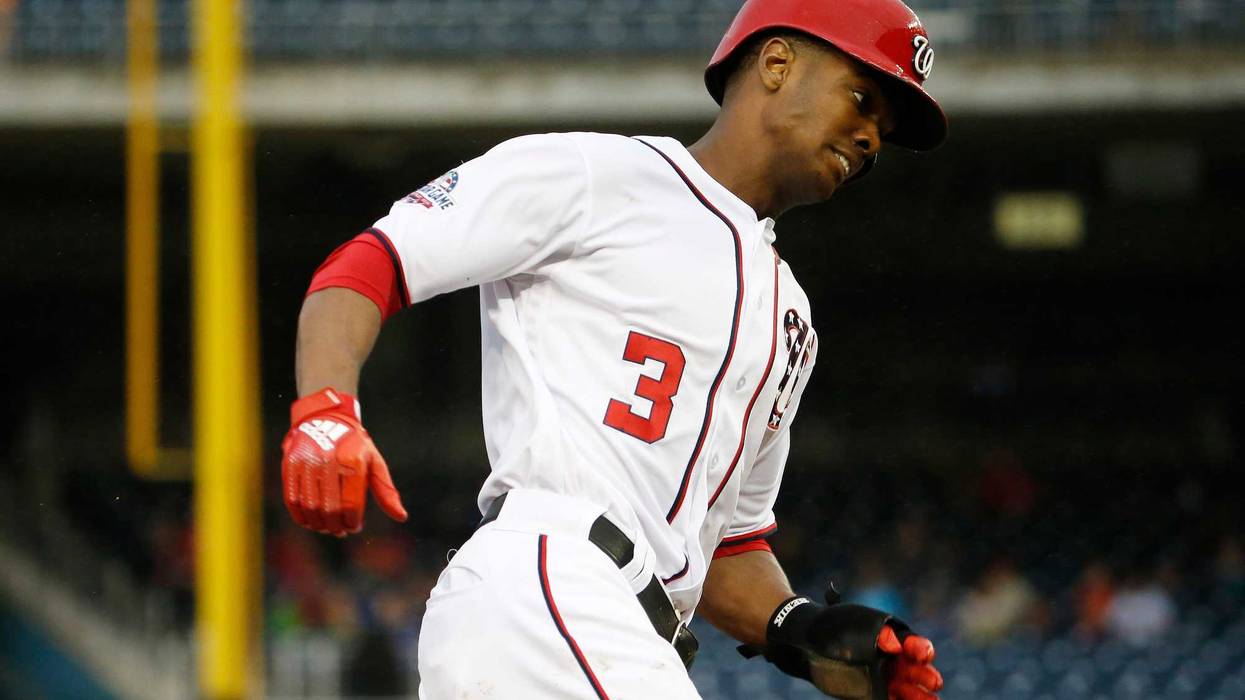
Taylor has been a valuable part of the Nats outfield in the past, often making his biggest impact when filling in for injury. Taylor was one of the team's hottest hitters in 2017 but regressed to career averages in 2018 as he was overtaken by some of the team's prospects. He finished the season with a batting line of .227/.287/.357.
How the team handles him could be impacted by how the team finishes the Bryce Harper sweepstakes, as Taylor would be the fifth outfielder if Harper comes back, behind Adam Eaton, Victor Robles and Juan Soto. Then again, Taylor could stick around if the team trades any of that trio.
Barraclough was one of the team's first moves this offseason, picked up via trade with the Miami Marlins. The hard-throwing righty is also coming off of a tough season, which likely made him expendable. The Nats are betting on him turning it around with a fresh start, but an arbitration hearing would fixate on his past failures.
The Nats are entitled to spend money however they choose, and no one can question how much they invest in the team. But in the interest of not alienating talented players, it's worth finding middle ground before the hearings.
Follow Brian Tinsman and 106.7 The Fan on Twitter.