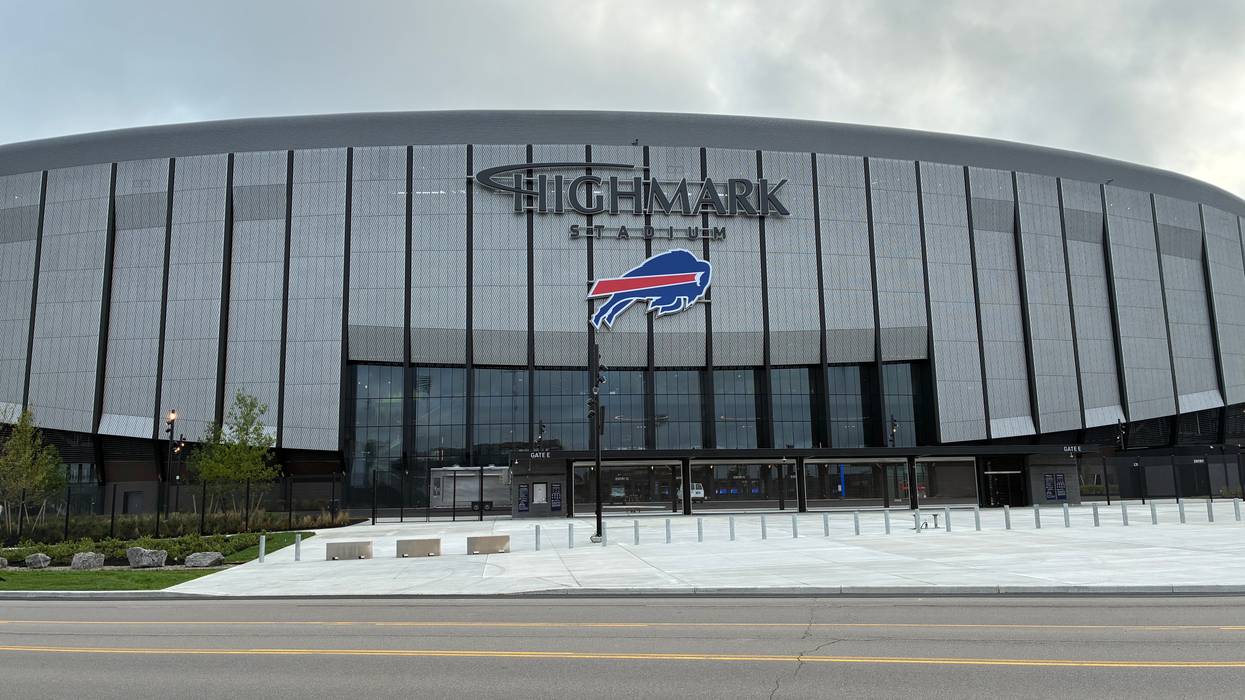

Buffalo, N.Y. (WBEN/WGR) - It has been a little more than three years in the making, but Tuesday will officially mark the substantial completion of the new Highmark Stadium in Orchard Park. The Buffalo Bills and other local officials will mark the major milestone by holding a ribbon-cutting ceremony, officially welcoming everyone to the state-of-the-art, football-first facility along Abbott Road.
For Erie County Executive Mark Poloncarz, the new Highmark Stadium has been nearly 15 years in the making ever since he took office back in 2012.
"One of the first things I did in my tenure as county executive was to ensure the future of the Bills, and I signed on Day 1 an executive order to help begin the process for the negotiations, which ultimately led to the lease extension. And here we are coming up near the end of my term - though I have another year and five months left - that many years later and now everything that was done in the interim is going to guarantee this team is going to be here for a long time. That's something I'm very proud of," said Poloncarz in an exclusive interview with WBEN.
While a new lease agreement for the old Highmark Stadium was the first task at hand with the future of the Bills, Poloncarz says original discussions over the potential of a new stadium started pre-COVID. He admits he has to take a moment to reflect on how fast time has flown by.
"It's been a project that's been ongoing, I kept on getting reports, I'd get weekly reports on how it was going, what percentage of steel is in place, what percentage of seats are in place. And here we are, it's done," Poloncarz said. "It's a legacy project that we can all be proud of. It's going to keep the team here for 30 years-plus, and it's something I'm very proud of that we were able to accomplish."
Poloncarz admits some of the initial conversations over a new stadium with the Bills were not very productive.
"There were a lot of things that were difficult with this negotiation. We were dealing, initially, with a request from the team that was truthfully unreasonable, they wanted the state and the county to build it all by ourselves. I was like, 'No, we're not going to do that,'" he recalled. "Sometimes it's tough, because you've got to walk and say, 'No, we're not going to do that,' and hope they don't walk away at that point. Then we get into the hardcore negotiations and it got better, and the team understood it had to come up with a contribution."
One of the important points for Poloncarz in getting a new stadium for the Bills was knowing other football communities were losing their NFL teams.
"I negotiated the prior lease extension back in 2012, went in effect in 2013, and during that period, three NFL teams moved. And each of those communities are larger than Buffalo and Erie County - San Diego, St. Louis, and Oakland. So there was never a guarantee that the team was going to stay," Poloncarz noted. "Everyone said the Bills were gonna move. The NFL is a business, and there's a number of NFL owners that would have liked to have seen that team move. So the goal was to ensure we keep the team, we do it in an affordable manner, and we were able to do that. And we have this gorgeous new stadium that's going to be the envy of the league."
It was early June of 2023 that shovels first hit the ground in Orchard Park, and at this time three years ago, a substantial amount of dirt and shale had already been moved from the site in preparation for concrete and steel later in the year.
It was the winter of 2023-24 that worried Poloncarz the most as to if the stadium could get done on time.
"[It] was a brutal winter, and it delayed a lot of construction that we were hoping to do. But in the end, the stadium got built on time," Poloncarz said. "It didn't necessarily get built on budget, but that's not something I worried about too much, because Mr. Pegula was paying for it, Terry and Kim were responsible for paying for the cost overages. But it was just knowing the difficulties associated with constructing and putting concrete in the ground, and building a new stadium during one of our harshest winters. That was a problem. I was worried at that point, 'Are we going to get this thing done by the deadline?'
"We had provisions put into the lease that we could have extended the [current] football stadium another year if we had to, because we thought this stadium wouldn't be completed in time. But then the next year, we had a good year, we had a decent winter, and we were able to say, 'Yeah, I think we're going to get this done on time.' And here we are."
Poloncarz adds with any major construction, there's still some punch list items that have to be done at the stadium after Tuesday's ribbon cutting, but the Bills will be ready to host football games in the new facility.
When construction started, Poloncarz was interested with a number of different elements to the stadium design and how it would truly effect game days in Orchard Park. One was the wind perforation thanks to the large metal panels erected on the facade of the new stadium.
"The idea was to build the stadium position in a different position than the current one so that it was not as windy as in the stadium as it is at the current one. And the first time I really went down on the field, when most of the shell was there, it was a very windy day, I remember was in October two years ago, and it was pretty calm on the field. I was like, 'Wow, it actually worked! The wind is not blowing down here,'" Poloncarz said with a chuckle. "And then I was there just about a month ago, and once again, there's a little wind - depending on the side that sort of faces towards Lake Erie - but the one that backs up to it and against us on the field, there's really no wind. It shows that the design worked, and that was something I was really concerned about, because there was a design element that was key, but I was always questioning whether it was going to work."
In discussions he's had with a number of Western New Yorkers and others relating to the new stadium, he says to be prepared for something that this region has not seen yet.
"I've told people you have to be prepared for something that, unless you've gone into brand new stadiums elsewhere, you're not going to believe. It's not your father's or grandfather's stadium," Poloncarz said. "It's not like the stadium was built in 1973 or the work that was done in the interim. It's a modern facility, and the modern NFL is different than the old NFL. It's definitely a different type of animal, so to speak, the play on this field is important, but just sometimes as much as what happens off the field. That's not something that we would have considered, or the county executives previously would have considered when they were talking about building a stadium or the first renovations. Now what happens off the field matters for the NFL, especially with regards to their revenue generation, so it's going to be a different stadium than what I think most people are expecting."
Another nice surprise Poloncarz feels many fans will enjoy is just how protected from the elements they truly will be with the new stadium.
"When you walk into it, you're enclosed. Unlike now, you'd go through the gates and then walk into an open-air stadium. Yes, this is an open-air stadium, but the vast majority of it is enclosed," he said. "If it's snowing or raining outside, once you're in there, you're going to be protected. I think a lot of people just aren't going to be ready for that, and I think the fans who are in there during a very windy, wet day are going to be appreciative of this new stadium."
Poloncarz is entering his 15th year in office as county executive in Erie County, and has been part of a number of actions and other happenings in the county over the years. He says getting the stadium negotiated, approved, and built ranks right up there among his greatest accomplishments, to date.
"A lot of people assume it's No. 1, it's not," he admitted. "Actually the redevelopment of the former Bethlehem Steel site into the Renaissance Commerce Park is No. 1, because it was abandoned for 30 years and people thought it never was going to get done. We've now made it a productive location, where there's more than 1,000 people employed. The [stadium] is up there. We've dealt with a lot of terrible things, unfortunately, whether it's weather-related, and the mass shooting, those aren't positive things, but those are issues we had to deal with. But when it comes to economic development matters and things like that, it's right up there."
With Tuesday's ribbon-cutting ceremony for the new stadium, Poloncarz feels the day will carry plenty of significance for not just Western New York, but for Bills fans across the globe.
"We keep our football team, and that was never a given. I know a lot of people think the Bills would never move, but there was a concern there that the Bills would move," Poloncarz said. "We did a really good job in the negotiation back in 2012 to put, what we call, a poison pill in: To prevent somebody else from outside the area buying the team after Mr. [Ralph] Wilson died, and then moving them. But there was still no guarantee that Mr. Pegula was going to keep the team in Buffalo. He said he wanted to, but we know there was a tremendous effort from Orlando, there was an effort from Austin [Texas], people in San Antonio wanted a team. So we had to have strong negotiations that protected our investment.
"When I look back at it now, I'm 58, this new lease expires when I'll be 88. And there are individuals who haven't even been born yet that are going to be Bills fans that are going to be at that stadium, enjoying football games. And they're not going to know my role in it, they're not going to know who the county executive was or what happened back then. But I hope they appreciate the work that we did to ensure that they could enjoy those games."
He also looks at the long-term community benefits agreement that will last the next 30 years, one that most other communities don't have in the NFL.
"That's millions of dollars that will go back into the community," Poloncarz noted. "All of the workers that worked on that, not all of them were from Buffalo, Erie County and Western New York, but the vast majority of them were. Those salaries that went back into our economy. This was a win for a lot, and when I look back at it, it's going to be knowing that I played a little role in ensuring the future of a team that we all love."
What's one part of Tuesday's ribbon cutting that he's looking forward to the most?
"I want to see the looks on people's faces who've not been in there yet," Poloncarz answered. When I've been with people who it's the first time that they've gone in, their look on their face is like, 'Oh my lord! Oh wow! This is incredible.' I do want to see the looks on other people's faces."
After Tuesday's ceremonies, all that remains left for the county's involvement in the new stadium is the official transfer of ownership with the land in-and-around the facility over the New York State. Poloncarz says that process will be finalized very soon.
"They're finalizing documents right now," he said. "As you can imagine, it has to be signed off by all the engineers and the construction manager and stuff like that. So once we get through tomorrow, that's going to be the primary focus, is ensuring we're in a position where we can sign off and say, 'It's done, here you go.' Sign the documents, and then in the end, it'll be just like any kind of deed - you transfer to the state, a final document gets filed and then it's done."
Tuesdays ribbon-cutting ceremony in Orchard Park begins at 10 a.m. and can be heard live on WBEN.
