
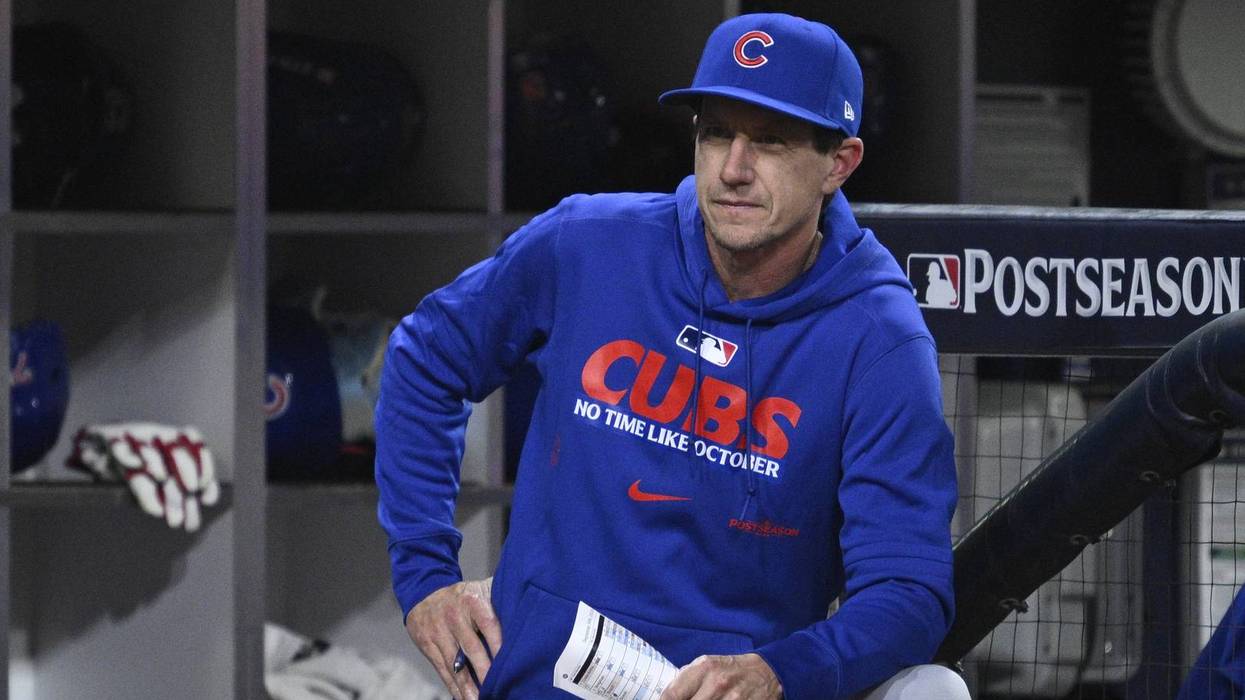

(104.3 The Score) The Cubs’ season officially died at midnight local time in Chicago as Wednesday turned into Thursday, some 2,000 miles away from Wrigley Field. The long road there was turbulent and quite disappointing.
The Cubs didn’t see their 2026 campaign end simply because of 8-0 and 4-1 losses to the Padres in a two-game sweep in their National League wild-card series. They earned the abysmal result over the course of an uneven 162-game season that reflected their significant organizational issues.
The Cubs went 89-73 in the regular season, underperforming their Pythagorean record by six games and failing to meet manager Craig Counsell's desired threshold of at least 90 wins. They had a 10-game losing slide that was balanced out by a pair of 10-game winning streaks. They also scuffled in September, when they went 11-13.
The Cubs were outclassed yet again by the rival Brewers, who won their fourth straight NL Central crown, with the three latest coming after Counsell left Milwaukee for Chicago. The Cubs were then thoroughly outplayed by the red-hot Padres, who went 18-6 in September to earn the top NL wild-card seed and the right to host a series at Petco Park instead of traveling to Wrigley Field.
Much more was expected from these Cubs, who underachieved this season. After losing to the Brewers in a five-game National League Division Series last October, they took a step back. And it was a reflection on the entire organization.
Any single firing or roster change will ring hollow. True change needs to come in adjustments to the philosophies of the Cubs’ baseball operations under president Jed Hoyer.
The Cubs, who led MLB in runs per game, should embrace platoons more in their daily lineups. The Cubs had five of their everyday players play 155 or more games this season. In 2025, they had six position players play at least 150 games. By each September, they all seemed exhausted.
Cubs first baseman Michael Busch regressed in 2026 and shouldn't have been run out for 160 games. Veteran left fielder Ian Happ may have played his last games with the team after logging 156 games this season. He hit .145 with a .484 OPS against lefties this season. The addition of southpaw masher Tyrone Taylor at the trade deadline was overdue, as Happ shouldn't have been an everyday player for the past two seasons.
The Padres utilize a platoon-heavy lineup that has been clicking down the stretch. Look no further than Game 2 hero Gavin Sheets, who delivered a key two-run homer while pinch-hitting in the fourth inning Wednesday before later being pulled in the eighth inning against left-hander David Peterson.
The Cubs' offense was really good when viewed through the entirety of the 2026 season, but it also had inconsistent stretches. The Cubs scored double-digit runs 20 times but were also shut out 14 times.
Hoyer has prioritized run prevention and built a great defense, which is an admirable strategy. But when the lineup itself is inconsistent, its profile needs to change.
After all, the Cubs’ team defense can't prevent the ball from flying over the wall. The Cubs allowed 1.44 home runs per nine innings, which was second-to-last in baseball behind only the Athletics. That mark was tied with the Rockies, who play their games in a launching pad at Coors Field.
The Cubs need to overhaul their pitching philosophy to put more of an emphasis on strikeouts. The Cubs averaged 7.84 strikeouts per nine innings this season, which ranked 26th in baseball. The top four teams in that category were the Phillies, Brewers, Guardians and Dodgers, all four of which are playoff teams that remain alive.
Rather than hoping a batted ball turns into an out, the Cubs would benefit from more often preventing the ball from being put in play in the first place.
As it relates to the Cubs’ bullpen, they can't rely on the organization's pitching infrastructure giving them cost-efficient magic each year. Hoyer’s preference is to find reclamation projects in quantity rather than spending much on relievers in free agency. There are often success stories like Ryan Rolison and Jacob Webb, but the philosophy comes with a cost as Counsell must use a patchwork approach to get high-leverage outs.
The Cubs need their own Mason Miller, Jhoan Duran or Aroldis Chapman in the back end of the bullpen. They haven’t had one in about a decade.
In San Diego on Wednesday night, the bells tolled in the ninth inning as Miller recorded the final three outs of the 2026 Cubs. Back in Chicago as the lights remained off at Wrigley Field, it was a predictable outcome.
The Cubs' frustrating flaws were exposed once again – not just in two games against the Padres but over the course of 162 contests before that.
What led to that outcome yet again for the Cubs needs be changed at its very core.
Chris Emma covers the Bears and the Chicago sports scene for 104.3 The Score.