


A.J. Brown has been one of the biggest storylines of the offseason, both for the Patriots and across the football world. How New England approaches this upcoming draft could offer real insight into what the future might hold for the star wide receiver.
For now, though, Brown remains in Philadelphia, and the Patriots are still searching for playmakers to elevate their offense.
Last week, we took a deep dive into some of the edge rushers that the Patriots could target with the 31st overall selection. Today, the focus will be on wide receivers.
This offseason, the Patriots added former Green Bay Packer Romeo Doubs to their receiver room. Doubs has been a steady, reliable target and is coming off a career-high 724 receiving yards. Set to turn 26 in a few weeks, his production doesn’t necessarily jump off the page. While he operated in a crowded receiver room in Green Bay, he still lacks the experience and top-end ability to profile as a true No. 1 option for a team with hopes of returning to the Super Bowl.
Stefon Diggs was the first Patriots receiver since Julian Edelman in 2019 to eclipse 1,000 yards receiving in a single season. With Diggs gone, the Patriots could turn to the NFL Draft to find someone to make up for his absence. Here are some of the options the Patriots could turn to with their first-round selection.
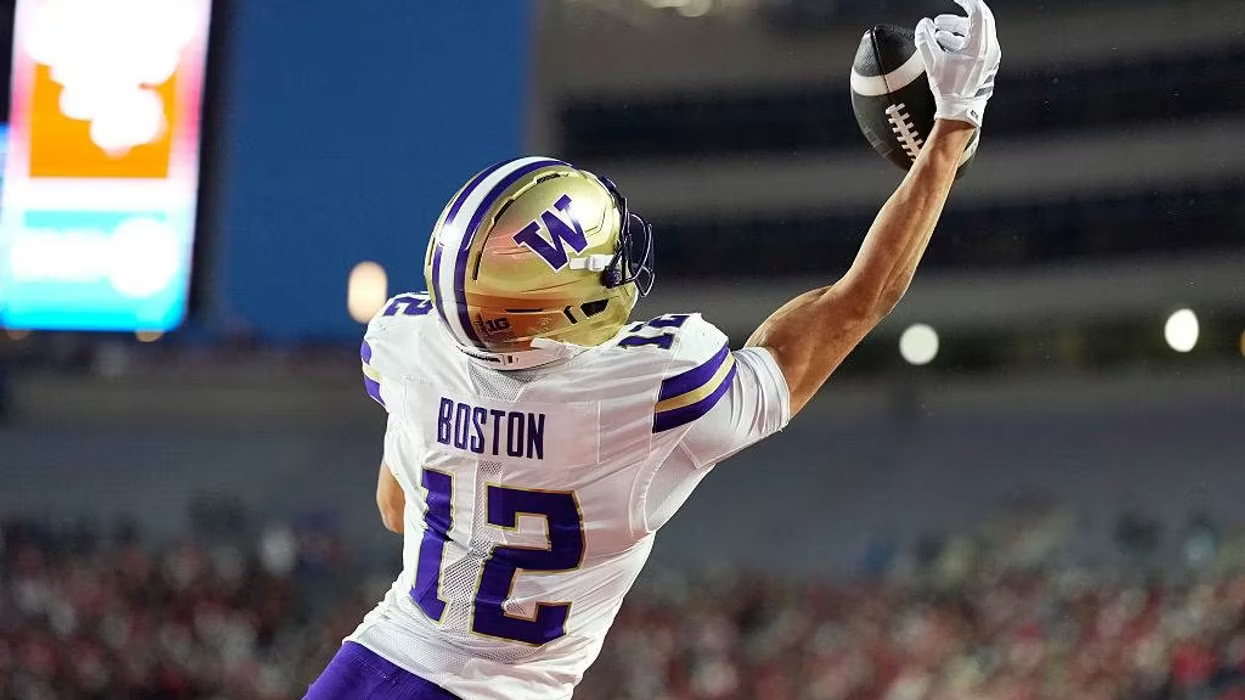
Denzel Boston, Wide Receiver, Washington: One of the most frequently mocked players to the Patriots in the first round has been Denzel Boston, from the University of Washington.
The classic “big-bodied receiver,” Boston stands at 6-foot-4, 212 pounds. Boston might be the best jump ball receiver coming out this season. He possesses elite ball skills, with strong hands, and is able to make catches at the ball’s highest point. Boston scored 20 touchdowns in the last two seasons and is a true threat inside the red zone.
Boston is a threat after the catch as well. He is an angry runner who doesn’t shy away from contact and is difficult to bring down due to his size and strength. He isn’t a player who looks to go out of bounds after the catch; he wants to fight for yards.
The downside to Boston’s game is his speed, or lack thereof. Boston opted to skip running the 40-yard dash at the NFL scouting combine and chose not to run again at Washington’s pro day. Not a great sign for a player who already had concerns about his speed.
While he consistently makes tough catches in traffic, that reliability is partly a necessity, as he struggles to create separation on his own. Boston fits the mold of a receiver who needs to be schemed open rather than one who consistently wins with natural burst or route-driven separation.
Lastly, Boston struggled against top-tier competition. In Washington’s two games against College Football Playoff teams last season — Ohio State and Oregon — he managed just seven catches for 54 yards combined.
Patriots fans have some familiarity with receivers from the University of Washington (remember Ja’Lynn Polk?).
KC Concepcion, Wide Receiver, Texas A&M: Concepcion had great success against man coverage and thrived against press coverage. He has great quickness that, paired with his strong footwork, allows him to create separation. He gets open quickly and excels in a quick-passing game.
If the Patriots offensive line’s postseason struggles carry over into this season, Concepcion is a perfect receiver to hide those offensive deficiencies.
He’s a playmaker who found the endzone 28 times in his three seasons in college, both rushing and receiving. His ability to run all different kinds of routes pairs well with a great offensive coordinator in Josh McDaniels, as he can attack all over the field.
Concepcion boasts impressive speed and excels at making plays after the catch. Last season at Texas A&M, he even returned two punts for touchdowns, showcasing his game-changing potential in the return game. His shiftiness and quick feet allow him to evade defenders with sharp cuts and sudden changes of direction, making it rare for the first tackler to bring him down. Whether in the screen game or taking handoffs, Concepcion is the kind of player coaches will want to get the ball to in any way possible.
The biggest concern in Concepcion’s game is his hands. Over his college career, he recorded 19 drops, many coming with defenders in close proximity, a situation that, while understandable, will need improvement at the next level.
Additionally, while he has excellent quickness and change-of-direction ability, his top-end speed doesn’t quite stand out as elite.
Jordyn Tyson, Wide Receiver, Arizona St: Tyson is a versatile player who can line up anywhere on the field, making him a matchup nightmare for defensive coordinators.
At 6-foot-2, 203 pounds, he has good size and will haul in plenty of contested catches. Tyson thrives as a route runner, specifically in man coverage, where he gains plenty of separation. He has a great burst and a sudden quickness to his game that helps him get open. He wins at all three levels of the field and helps create easy throws for his quarterback. He isn’t the fastest pass catcher in the draft, but he has enough speed to be a threat downfield and create explosive plays.
Unlike what the Patriots had last season in Stefon Diggs, Tyson is a willing and solid blocker in the running game. He was coached by Hines Ward during his time at Arizona State, who was one of the best receivers at blocking downfield. The Patriots brought in a fullback in Reggie Gilliam this offseason, so if the plan is to run the ball more, Tyson can be a factor.
The biggest downside to Tyson has been his injury history.
He missed games in 2022 due to a brutal knee injury, in which he tore his ACL, MCL, and PCL. He also missed time in 2024 due to a fractured clavicle, as well as time last season due to a hamstring injury. Three different injuries in three seasons aren’t a great sign for a player coming out and would be the biggest reason he could slip in the upcoming draft.
A big day for the Arizona State product is April 17, when he will go through positional drills in front of team scouts that could decide where he falls.
The Patriots may have to trade up a few spots for Tyson, but if he stays healthy, he would be worth it and has the traits of a true No.1 receiver.
Omar Cooper Jr, Wide Receiver, Indiana: When you watch Cooper, it’s hard not to think of Deebo Samuel. With the ball in his hands, he runs like a tailback. Compact, powerful, and decisive, blending quickness with real physicality.
He does his best work out of the slot, but he’s versatile enough to line up outside and has the speed to stretch defenses vertically. Most importantly, he consistently finds the end zone, scoring 13 touchdowns last season.
His toughness may be the most appealing part of his game. He fights through contact at every stage. Whether it’s battling press coverage, absorbing hits mid-route, or refusing to go down after the catch. He embraces the physical side of the game, consistently grinding out extra yards and punishing defensive backs who try to bring him down. That same running style makes him a threat out of the backfield, where he’s comfortable taking handoffs and showcasing his versatility.
His route running needs a lot of work, as it lacks the kind of smoothness one would like to see from a star receiver. He doesn’t win consistently enough on his routes to rely on him in big spots, or to be a go-to guy in must-have situations. As a result, he might be more of a high-end No. 2 receiver than a true No. 1.
Whether it’s disinterest or just a lack of effort, his blocking in the running game left a lot to be desired. Hardly the only receiver, but something that needs to improve if he wants to be a three-down player.
His ability to haul in jump-ball catches is average, and for a player as physical as he is, it would be nice to see him win more contested catches and fight to make tough receptions.
Germie Bernard, Wide Receiver, Alabama: “Jack of all trades, master of none” is a phrase that comes to mind when watching Germie Bernard this season at Alabama.
But in his case, it speaks more to his versatility than any real limitation. He’s a polished route runner with good size and strong hands, and his footwork is consistently smooth, whether he’s working through his breaks or toeing the sideline. Alabama also wasn’t shy about using him out of the backfield, where he could lean on his speed and vision to create plays in space.
Playing at Alabama, Bernard routinely faced the best competition college football has to offer in the SEC. That alone doesn’t define a prospect (just ask Patriots fans who remember Mac Jones), but it’s still a meaningful piece of the evaluation.
More importantly, Bernard didn’t just line up against elite defenses — he produced against them, which is an encouraging sign for his projection to the next level.
While Bernard is effective in a variety of ways, it’s difficult to point to his best trait. He has solid size, but doesn’t consistently play to it, lacking the physicality needed to handle press coverage in man-to-man situations.
His speed is good, but not the kind that forces defensive coordinators to game-plan around it.
To take the next step, he’ll need to process defenses more quickly, especially when it comes to identifying and settling into soft spots in zone coverage. Diggs excelled at that in New England last season, and if Bernard hopes to fill that void, it’s an area of his game that will need to improve.