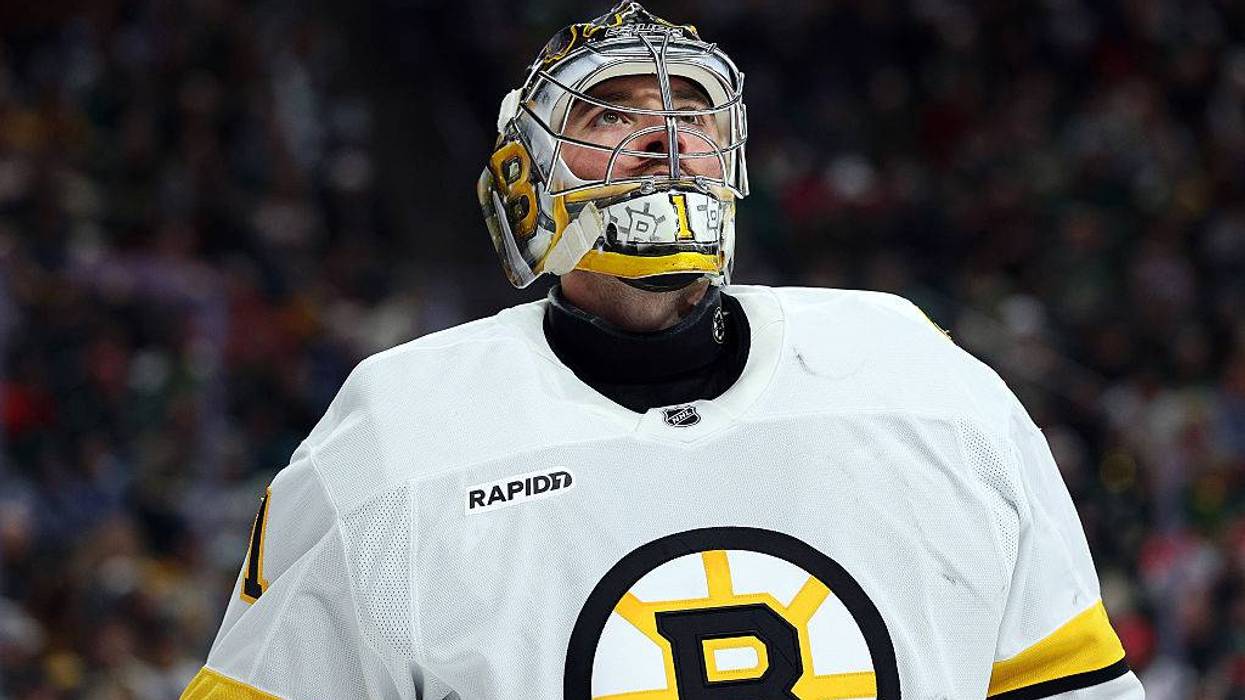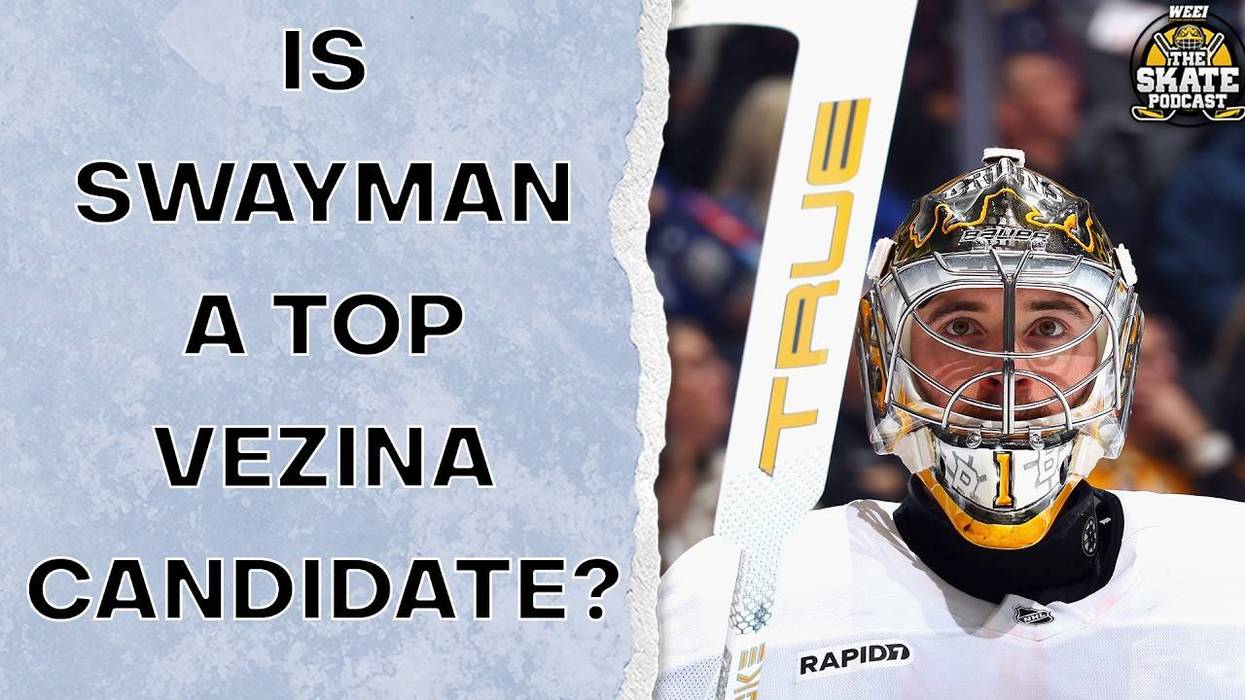


Jeremy Swayman has already guaranteed he won't 'ruin the goalie market'

One of the first clear signs this summer that Jeremy Swayman was prepared to dig in when it came to his contract negotiations came during his appearance on the "Shut Up Marc" podcast in August when he said, "I understand my comparables and how I can't ruin the goalie market for other guys that are gonna be in my shoes down the line."
It's a fair consideration. While some athletes may be content to take a "hometown discount" for the sake of comfort or convenience or as a sacrifice to help the team, others want to maximize their earnings not just for themselves and their families, but also to raise the bar for other players who are going to be looking for new contracts in the months and years to come.
This is likely the biggest contract Swayman will ever sign, which also means it's his best opportunity to help "set the market" for other goalies. That he wants to do that is completely understandable, because goalies do not like the direction their contracts have been trending.
While top skater contracts have been consistently going up in recent years, goalie contracts have not followed. Back in July 2019, Sergei Bobrovsky signed a seven-year deal with the Florida Panthers worth $10 million a year. That same month, Andrei Vasilevskiy signed an eight-year deal with the Tampa Bay Lightning worth $9.5 million a year. In the five-plus years since then, no other goalie has signed for even $9 million a year.
Until Connor Hellebuyck of the Winnipeg Jets and Ilya Sorokin of the New York Islanders signed extensions with average annual values (AAV) of $8.5 million and $8.25 million, respectively, in 2023, it had been four years since any goalie had even signed for $7 million a year.
The arguments against big goalie contracts have some merit. Bobrovsky looked like one of the worst contracts in the league for years as his play became too inconsistent. Carey Price only made it halfway through the eight-year, $84 million contract he signed in 2017 before essentially being forced into retirement. The Colorado Avalanche and Vegas Golden Knights recently won Stanley Cups without elite, highly-paid goalies.
Goalies and their agents will argue that the most important position on the ice is being unfairly suppressed because of a couple "bad" contracts. They will point out that Bobrovsky, despite those past inconsistencies, just helped the Panthers win the Cup. And that Vasilevskiy was a big reason the Lightning won two in 2020 and 2021.
Swayman has a role to play in this larger philosophical battle over the value of goalies. Entering this offseason, the three big goalie situations to watch were him, Juuse Saros of the Nashville Predators, and Igor Shesterkin of the New York Rangers.
Saros did not exactly do his part to help goalies fight back. A year before he was set to hit unrestricted free agency, he signed for eight years and an AAV of $7.74 million – a contract widely seen as team-friendly for a goalie with three straight top-five finishes in Vezina Trophy voting.
Shesterkin, who is also a year away from unrestricted free agency, has not yet signed an extension. The 2022 Vezina winner will definitely be doing his part to set the market, as all indications are that he wants to and will become the highest-paid goalie in NHL history, surpassing Price's $10.5 million AAV.
Swayman does not have Shesterkin's resume and does not have unrestricted free agency to use as leverage. He cannot play in the $10-12 million sandbox at this time.
But Swayman can help reset an important part of the goalie market: the one for restricted free agents. And he is actually already guaranteed to do that. If he accepted the eight-year, $64 million ($8 million AAV) offer that Bruins president Cam Neely threw on the table Monday, Swayman would be doing exactly that.
Only one restricted free agent goalie has ever signed for a higher AAV, and that was Vasilevskiy when he signed his current contract ($9.5M AAV) in 2019. Vasilevskiy had just won the Vezina when he signed that contract and had another top-three finish the year before. The only other restricted free agent to ever sign for more total money was Rick DiPietro when he signed one of the most absurd contracts in sports history back in 2006 (15 years, $67.5 million total for a $4.5 million AAV). Since contracts of that length aren't even possible anymore, it's barely worth referencing.
Since Vasilevskiy, though, young, talented RFA goalies have not been able to cash in on long-term deals. Most have settled for bridge deals that put them back on the market at 29 or 30 years old.
Thatcher Demko of the Vancouver Canucks signed for five years, $5 million AAV at age 25 in March 2021, near the end of his first full season as the Canucks' No. 1 goalie. A few months later, Shesterkin signed for four years, $5.67 million AAV at age 25, after his first season as the Rangers' No. 1. A week after that, Saros signed his bridge deal for four years, $5 million AAV at age 26, after – you guessed it – his first season as the Predators' No. 1 (and just after the retirement of franchise legend Pekka Rinne).
Swayman is 25 and just took over the Bruins' No. 1 job this spring. Like Demko, Shesterkin and Saros in 2021, he is talented and just entering his prime. His team is ready to turn the net over to him. But there is also a lot of projection baked into his next contract given the relative inexperience when it comes to being a workhorse NHL goalie.
It is almost certainly those three contracts that the Bruins were looking at when they initially offered Swayman a four-year deal with a $6.2 or $6.5 million AAV, if reports are to be believed. That was the market that had been established for top RFA goalies in their mid-20s.
Now their offer is eight years, $8 million AAV. Whether that offer was officially on the table before Monday or not, it certainly is after Neely's comments. In that respect, Swayman has already reset the market.
If Swayman signs that deal today, he has significantly raised the bar for restricted free agent goalies not named Vasilevskiy, in terms of both years and average annual value. He would actually top the contract Saros signed this summer as a pending unrestricted free agent and be close to the deals Hellebuyck and Sorokin signed last year, also as pending UFAs. Again, unrestricted free agents simply have much more leverage than restricted free agents, so that would be no small feat.
Swayman has guaranteed he will not "ruin the goalie market," as he said he feared. The question now is how much higher he wants to try to push the market beyond $64 million, and how much of the season he is willing to miss to do so.