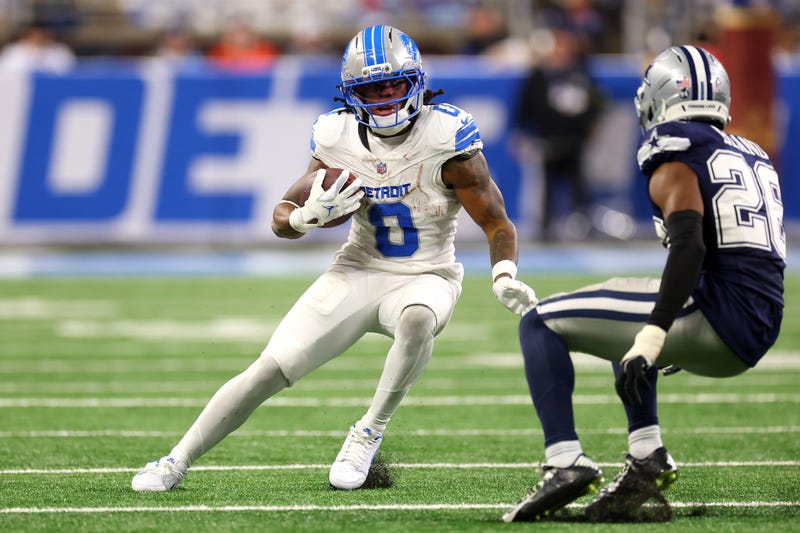

On his first touch of the night last week, on third and short on the Lions' first drive, Jahmyr Gibbs swung behind Jared Goff at the snap, caught a backward pass in the left flat, picked up a block from Taylor Decker and raced up field for 19 yards. On the next play, Gibbs sold a play-action fake before catching a short pass over the middle, putting a linebacker on skates with a jab step and eventually spinning out of a tackle from a safety for a 26-yard gain.
The Cowboys were in for a long night. Gibbs would wind up rushing for three touchdowns, but most of his damage in the Lions' 44-30 win that may have saved their season -- and sunk that of Dallas -- came as a pass-catcher. And "he’s just getting started," Dan Campbell said after the game.
"He’s starting to develop a pretty good route tree at this point," Jared Goff said Tuesday on 97.1 The Ticket. "We used to be able to throw it to him a ton, but it was mostly running back routes and stuff out of the backfield, and certainly he’s great at those. But he’s starting to become more of a, spread him out and he can run a litany of routes that's pretty special for a running back to be able to do."
The Lions clearly wanted to attack the Cowboys' linebackers in space last week, in particular with their most elusive player. On the first play of their first touchdown drive, Gibbs lined up in the slot, caught a quick throw from Goff for a short gain and very nearly spun out of another tackle for even more. He lined up in the slot again on 2nd and long on their ensuing drive and caught another slant for 13 yards.
On the TV broadcast, color commentator Kirk Herbstreit recalled attending Alabama's practices during Gibbs' lone season in Tuscaloosa and watching him frequently run routes with the receivers. That year, Gibbs not only led Alabama in rushing but in catches.
With the Lions trying to extend their lead toward the end of the first half, Gibbs lined up to Goff's right, ran a Texas route on linebacker DeMarvion Overshown -- see ya -- and picked up 18 more yards on a catch-and-run to set up a Jake Bates field goal.
On third and long early in the second half, Gibbs lined up wide left, motioned into the slot and caught an out route to the left sideline just shy of the sticks. With Cowboys' top corner Daron Bland bearing down on him, Gibbs slammed on the brakes, broke Bland's ankles and scooted past him for the first down as Bland fell to his stomach out of bounds. It was rude.
"This is what separates him," said Herbstreit.
Later that drive, Gibbs caught a swing pass in the right flat and stiff-armed Bland back to the turf, before five Cowboys converged on him to force him out of bounds. He finished with seven catches on seven targets for 77 yards, eight catches for 96 yards if we include his first touch that went down as a run.
"And it's really cool that it seems like it's just scratching the surface for him as far as routes and receiving," said Goff. "It's exciting to think about where he could possibly go. It could be a place that the league's never seen before, where he can do certain things at receiver while also playing running back. He's a special, special player and we’re lucky to have him."
Gibbs has always been dangerous as a receiver. You might remember how Brad Holmes described him after he drafted Gibbs 12th overall: "A multi-phase, elite, explosive, position-less weapon." And the Lions have always looked for ways to throw him the ball out of the backfield. Gibbs caught 52 passes each of his first two seasons -- top-10 at his position both years -- or about 3.3 per game. He was on a similar pace through the first half of this season.
Then Campbell started calling plays, hoping to spark an inconsistent offense. In five games since, Gibbs has as many catches (29) as he had in the first eight games and significantly more receiving yards (277). He leads running backs in both categories over that stretch, as well as in targets, with Christian McCaffrey (who had a bye last week) on a similar per-game pace.
None of this feels like a coincidence. Gibbs has run about 23 routes per game with Campbell calling plays, compared to about 17 per game when offensive coordinator John Morton was calling plays. And the Lions have really leaned into his versatility. Gibbs lined up only four times in the slot, seven times out wide in the first eight games, compared to 17 times in the slot and eight times out wide in the five games since.
And the most important adjustment might be the most natural one: the Lions have stopped asking their most dynamic offensive player to spend so much time in pass protection. Gibbs' rate of pass-blocking snaps has been sliced in half in the five games with Campbell calling plays. And while the splits here are partly skewed by the Vikings game when Gibbs had to pass protect 15 times, it's probably, again, not a coincidence that it was the very next game that Campbell took over for Morton.
"He’s unique," Campbell said after the Lions' win over the Cowboys. "He’s special. Everybody knows what he can do in the run game ... but the pass game stuff, he just continues to grow. The more we give him and the more we work with him in practice, we just continue to try to open his horizons and give him a little bit more. Man, he just grows. He gets better and better. Then he gets in the game and the routes get crisper and crisper.
"He just keeps going. There’s just not a cap on this dude yet. He works his tail off, he’s freaking smart, he’s instinctive. He’s a team guy. He’s something else. The sky is the limit for him."
Gibbs didn't have to pass block once against the Cowboys on a night that Goff dropped back 36 times, with the Lions often using Dan Skipper in jumbo sets to slow down Dallas' defensive front and/or create lanes on the ground. It worked perfectly. Goff threw for over 300 yards and was sacked just once. Jack Fox's final punt came midway through the second quarter, against a defense that came into the game playing its best ball of the season.
"I really felt like if that game kept going we would’ve scored on every drive, with the way we were rolling offensively and had them on their heels a little bit defensively," said Goff. "Could feel that during the game, certainly during that third and fourth quarter. I said to the guys, 'If we just keep scoring, they can’t win.'"
The way the Lions used Gibbs against the Cowboys is how the 49ers often use McCaffrey, maybe the only other running back in the league with the same dual-threat ability as Gibbs. Bijan Robinson is in this conversation, too. McCaffrey, who leads NFL backs by a wide margin this year in both catches and receiving yards, runs about 30 routes per game, with a handful of those typically coming in the slot. His average depth of target this year is 2.4 yards. Gibbs last week was at 2.0, up from the minus-0.3 he averaged entering the game.
The Lions have four games to go, needing at least three wins to secure a playoff spot. They'll face one of the stoutest defenses they've seen all year Sunday against the Rams, with a grudge match looming in Minnesota on Christmas Day and a potential win-or-go-home game in the season finale in Chicago. Their defense is riddled with injuries in the backend and their offense has issues of its own, starting with an inconsistent line.
But as long as they have Gibbs, the Lions have a chance -- which is more than most linebackers can say when they lines up against him.