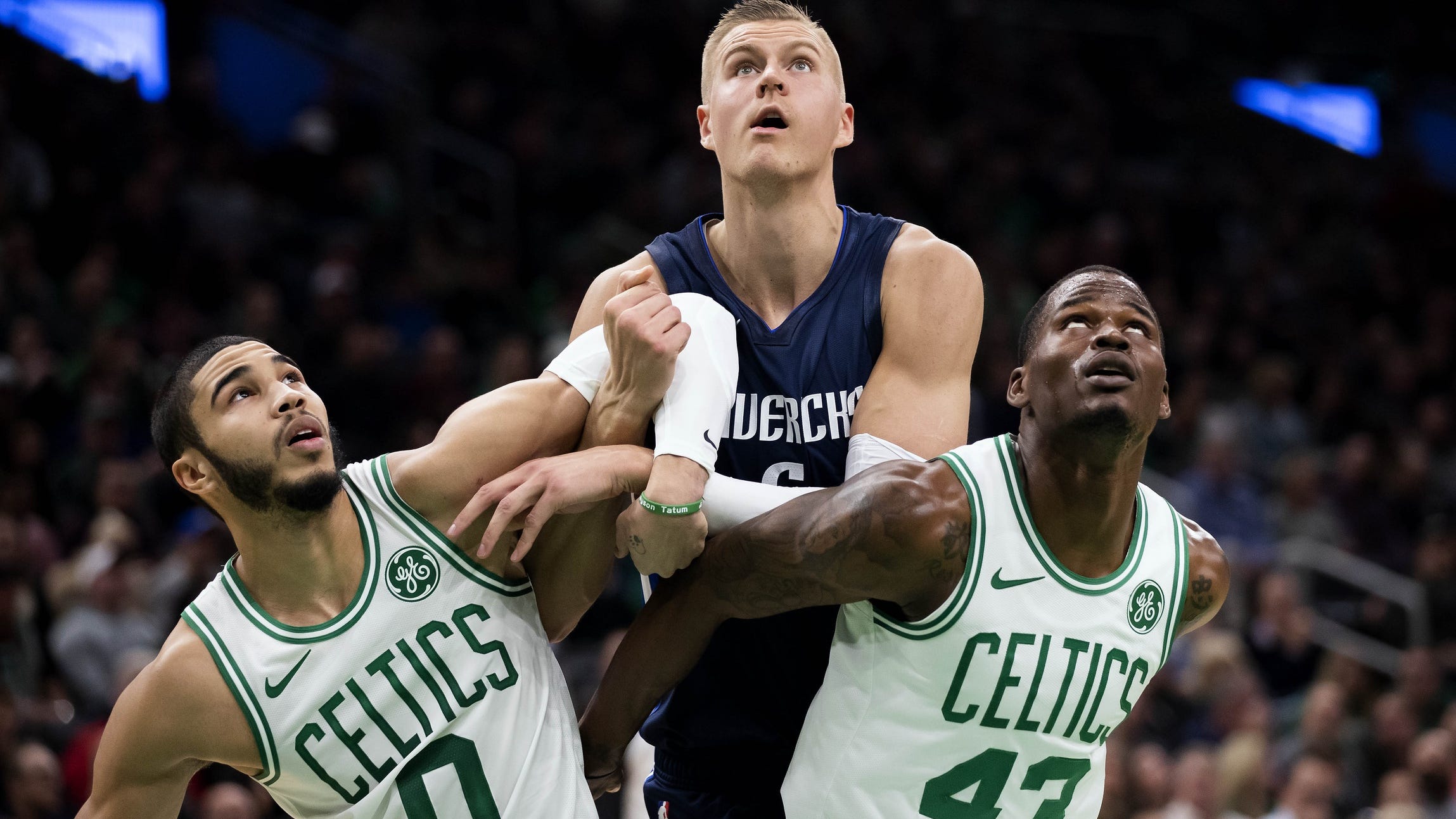
The Celtics dropped the first game of their weekend back-to-back with a 119–115 loss to the Minnesota Timberwolves on Saturday night. It was another winnable game for Boston, which featured 18 lead changes and six ties.
However, strong individual performances from Jaylen Brown and Neemias Queta weren’t enough to overcome the Celtics’ inconsistent offense and struggling defense.
Six Timberwolves scored in double figures, led by Anthony Edwards, who finished with 39 points (12/24 FG, 5/11 3PT), including a dagger three as the shot clock expired with 14 seconds remaining.
The loss dropped the Celtics to 10–9 on the season as they now head to Cleveland for the second night of a back-to-back against the Cavaliers on Sunday night.
Here are six takeaways as the Celtics fall to 4–5 on the road this season.
Tale of two halves
The Celtics scored 69 points on 29-of-52 (55.8%) shooting from the field and 9-of-22 (40.9%) from three, with only three turnovers in the first half. The 69 points were their fourth-most in any half this season.
That changed dramatically after halftime. Boston managed just 46 points on 16-of-44 (36.4%) shooting and 7-of-24 (29.2%) from three, while committing eight turnovers. The 46 points were their fourth-fewest in any half this season.
At times, the offense looked lost. Before a 12-0 run between the 3:50 and 1:38 marks of the fourth quarter, they had produced only 29 points in the half, with seven turnovers and just 12 made field goals. They also missed five of their 12 free-throw attempts, with four of those misses coming in the fourth quarter.
All told, the Celtics were outscored 60-46 in the second half, erasing their 10-point halftime lead.
“I thought they did a better job just kind of with their pressure in the second half,” Joe Mazzulla said. “And then at then at the end of the third, beginning of the fourth, we had our small lineup out there, and we just didn’t do a great job creating enough advantages. They picked up their pressure. Their individual defense was good. They tested our slips, our dribble-drive, our off-ball screens.”
Neemias Queta was dominant in his return from injury
In his first game back after missing Wednesday night’s win over the Pistons with a sprained ankle, Neemias Queta delivered his best performance of what has been a fantastic season for the big man. He finished with career highs in points (19 on 7-of-8 shooting), total rebounds (18), offensive rebounds (eight), defensive rebounds (10), and made free-throws (five).
The fifth-year pro became the first Celtic with at least 19 points, 18 rebounds, and two blocks in a game since Kevin Garnett in 2013. Only seven Celtics have ever posted such a stat line: Garnett, Al Jefferson, Mark Blount, Antoine Walker, Robert Parish, Larry Bird, and Dave Cowens.
His 18 total rebounds were the most by a Celtic in regulation since Enes Kanter’s 19 against New Orleans in January of 2020.
“He’s getting better,” Mazzulla said. “Obviously, we’re a different team when he’s on the floor, as you can see, on both ends. But tonight, you saw a clear difference offensively when he was out there. So it’s a credit to him. He’s got to keep getting better.”
Queta, who entered the season with just two career double-doubles, has already doubled that total. He secured his fourth of the year in the first half alone, putting up 13 points and 11 rebounds before halftime.
There have been a handful of positive developments from individual players this season, with Queta chief among them. It’s not hyperbolic to say he has been one of the most impactful big men in the NBA: his 15.2 net rating ranks third among centers averaging at least 15 minutes and appearing in at least 15 games, trailing only Chet Holmgren (16.5) and Isaiah Hartenstein (16.2).
Queta has proven he belongs as someone who can contribute on a title-contending team, and you can’t overstate how important he has been to the Celtics this season.
Jaylen Brown gave the Celtics all he had
Brown finished the night with 41 points (53.1% FG, 45.5% 3PT), seven assists, six rebounds, five steals, and a block — a stat line never before recorded in a Celtics uniform. He was involved in more than half of Boston’s offense, scoring or assisting on 24 of the team’s 45 field goals (53.3%).
It was the loudest performance of what has been an All-NBA-caliber season for Brown, who is now up to 28.8 points (49.8% FG, 35.1% 3PT), 4.7 rebounds, 4.5 assists, and 1.2 steals per game, making him one of just five players in the NBA hitting those marks this year (Luka Dončić, Nikola Jokić, Cade Cunningham, and Austin Reaves).
Brown has also now scored 30+ points in 10 of Boston’s first 19 games, the second-most through the team’s first 19 games in franchise history, tying Jayson Tatum (who’s done it twice) and trailing only John Havlicek (11). He has already surpassed his total of 30-point games from last season (nine).
Brown has given the Celtics exactly what they’ve needed almost every night, and Saturday was no different. He has embraced his expanded role and is playing like one of the top players in the NBA, proving how good he can be.
Not enough from Payton Pritchard and Derrick White (or Anfernee Simons)
Pritchard (4-of-14 FG, 1-of-8 3PT) and White (6-of-16 FG, 2-of-8 3PT) shot a combined 10-of-30 (33.3%) from the field and 3-of-16 (18.7%) from three.
The Celtics need more scoring from both of them. When one of them is off, the offense can get choppy. When both struggle, it becomes extremely difficult to overcome — and there have been a few nights like that this season as they search for more consistency.
Simons can be added to this mix as well. He played just 17 minutes, finishing 2-for-4 (1-of-1 from three), but wasn’t particularly sharp when asked to run the offense as the primary ball-handler
Another close loss
With the loss, the Celtics dropped to 4–7 in clutch games this season. Their seven clutch losses are tied for the second-most in the NBA with the Pacers and Pelicans, trailing only the Mavericks (11).
Four of their nine defeats have come by four points or fewer, and only three have been by double digits. They’ve been in nearly every game — but finishing them has been a recurring issue.
Sam Hauser has found his stroke
One of the most fascinating statistical trends in basketball is that Sam Hauser has never shot below 40% from three at any level he’s played — high school, college, the G-League, or the NBA.
So when he opened November shooting just 9-of-45 (25%) from deep, it felt like only a matter of time before water found its level.
And that appears to be happening now. After a 4-of-10 night on Saturday, Hauser is 9-of-20 (45%) over his last few games. His season average still sits at 34.5%, but it looks like he’s starting to turn the corner and rediscover his stroke.
Related