



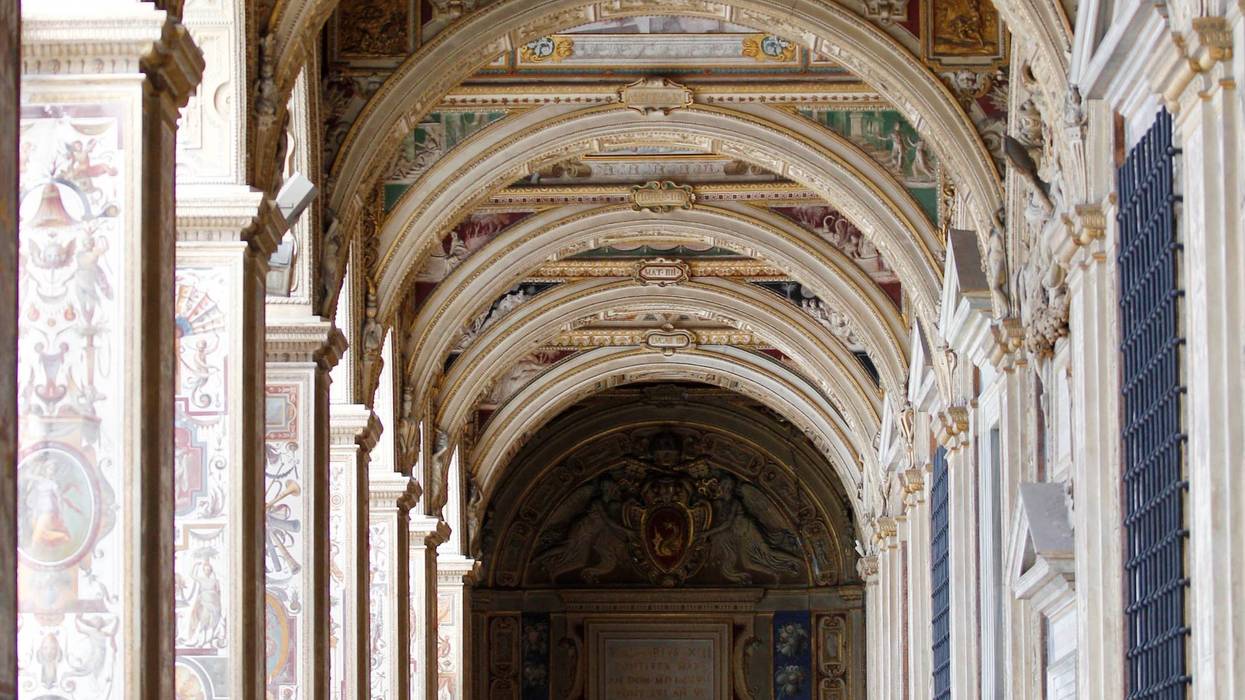

VATICAN CITY (AP) — One of the most intricately decorated parts of the Vatican’s Apostolic Palace, a passageway walked by popes and presidents and attributed to Renaissance master Raphael, is getting its first major face-lift in over 500 years.
The Vatican Museums on Wednesday announced the start of a five-year, $5.5 million project to clean and restore the Raphael Loggia, a 65-meter (yard) long, 4-meter (yard) wide corridor that is considered one of the highest expressions of Renaissance figurative art.
The windowed second floor corridor, which overlooks the palace’s San Damaso courtyard, is not open to the public. But lucky visitors to the pope or Secretariat of State walk along it en route to their audiences and are treated to biblical scenes, from the Old Testament and New, as well as botanical motifs in painting and stucco.
Pope Leo XIV, who moved back into the Apostolic Palace after Pope Francis famously stayed away, has his private apartments upstairs but walks along the corridor when going to audiences.
Raphael conceived of the decoration between 1517-1519 as one of his last commissions for Pope Leo X, alongside his more well-known and accessible masterpieces that are today highlights of any visit to the Vatican Museums: the recently restored Raphael Rooms and his tapestries.
Located deep within the inner sanctum of the Holy See, the passageway’s 13 arched bays are considered such a spectacular example of figurative painting that they were widely copied, including a full-scale replica at the Hermitage Museum in St. Petersburg, Russia.
Until 1813, the Raphael Loggia was open to the elements and suffered damage from rain and exposure, said Paolo Violini, in charge of painting restoration at the Vatican Museums. Even after windows were installed, the artworks suffered further because the windows trapped heat and humidity, leading to a particularly fragile state that requires special care.
Restorers will use hand-held lasers to clean and restore the stucco and wall paintings, using a “dry” cleaning method since the paints are water soluble and would suffer further if cleaned in a more traditional way or using chemical solvents, Violini said.
The restoration, being done in partnership with the World Monuments Fund, is being financed by the Stephen A. Schwarzman Foundation, a New York-based philanthropy.
At a press conference Wednesday, Schwarzman said the foundation’s overall contribution to the project was more than $14 million: $5.5 million for the restoration and the rest used to digitize images of the loggia so the public can appreciate it, to fund a documentary of the renovation and to endow a training program for art restorers at a Swiss university.
Alongside the restoration, the Vatican plans to also replace the arched windows of the loggia to install special glass that filters out the sun's harmful rays.
___
Associated Press religion coverage receives support through the AP’s collaboration with The Conversation US, with funding from Lilly Endowment Inc. The AP is solely responsible for this content.


