


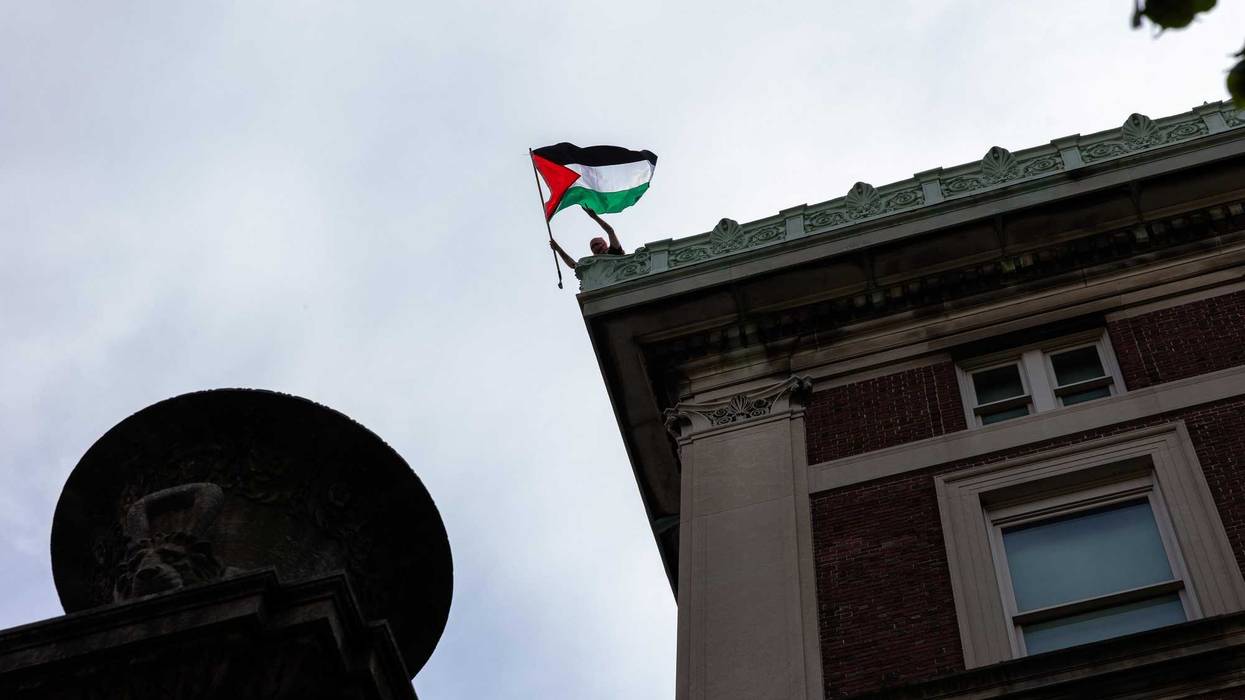
NEW YORK (1010 WINS/AP) — Columbia University threatened to expel dozens of students who've occupied an iconic academic building, but school leadership stopped short of calling in the NYPD to make arrests after dozens of the protesters smashed their way into the building overnight and barricaded the entrances in the latest escalation of demonstrations against the Israel-Hamas war that have spread to college campuses nationwide.
In a Tuesday afternoon update, university spokesperson Ben Chang said, "We regret that protesters have chosen to escalate the situation through their actions."
"Protesters have chosen to escalate to an untenable situation—vandalizing property, breaking doors and windows, and blockading entrances—and we are following through with the consequences we outlined yesterday," Chang went on to say, adding, "Students occupying the building face expulsion."
Chang said the university was continuing to suspend students who hadn't committed to its terms Monday to leave the lawn encampment. "This is about responding to the actions of the protesters, not their cause," he said. "As we said yesterday, disruptions on campus have created a threatening environment for many of our Jewish students and faculty and a noisy distraction that interferes with teaching, learning, and preparing for final exams, and contributes to a hostile environment in violation of Title VI."
 People check in with security to enter Columbia University on April 30, 2024.Michael M. Santiago/Getty Images
The college's Public Safety department said access to the campus was limited to students residing in buildings on campus and to employees who provide essential services to campus buildings, labs and residential student life. "There is no additional access to the Morningside campus," officials said in an advisory. All entry points are closed except for the gate at 116th Street and Amsterdam Avenue. An earlier advisory said the community should "avoid coming to the Morningside campus."
At an unrelated news conference in Central Park, NYPD Chief of Department Jeffrey Maddrey said police had not been asked by Columbia to enter the campus and that the department will not do so unless asked.
"It's something the NYPD is going to have to stand on the sidelines and be prepared to deal with," Maddrey said. "As far as the school is concerned, we are definitely in contact with the university, with university leadership. We speak with them daily."
Maddrey went on to say: "As of right now, the NYPD is always ready, but we will not be going onto Columbia's property without a specific request from them or unless there is imminent danger, an imminent emergency where we have to go on the property," the chief said. "As far as the protesters—the people who are elevating their voice—we will not go onto that property until we get a specific request from Columbia University, and as of right now we do not have that request."
Video footage from overnight showed protesters locking arms in front of the iconic Hamilton Hall at the Morningside Heights campus, bashing windows and carrying furniture and metal barricades into the building, one of several that was occupied during a 1968 civil rights and anti-Vietnam War protest on the campus. Posts on an Instagram page for protest organizers shortly after midnight urged people to protect the encampment and join them at Hamilton Hall. The sounds of cheers and chants filled the area.
A statement from the White House said President Joe Biden condemned the move by protesters as "not peaceful" and beyond free speech.
In the statement, deputy press secretary Andrew Bates said: "President Biden has stood against repugnant, Antisemitic smears and violent rhetoric his entire life. He condemns the use of the term 'intifada,' as he has the other tragic and dangerous hate speech displayed in recent days. President Biden respects the right to free expression, but protests must be peaceful and lawful. Forcibly taking over buildings is not peaceful—it is wrong. And hate speech and hate symbols have no place in America."
Gov. Kathy Hochul weighed in on the issue and said during a press conference on Tuesday that "there must be accountability" for the building takeover, "whether that's disciplinary action from the school or from law enforcement."
Hochul visited the campus last week and said that her team has been in contact with the administration ever since.
"Every American has a First Amendment right to peacefully protest and assemble," Hochul said. "Many students have strong beliefs and convictions about what has led them to protest. We don't have to agree with them. But when actions cross over to vandalism, harassment, destruction of property, or even violence, then the line has been crossed. A few of the individuals participating in last night's actions forced staff from their jobs, students from the security of using buildings, they broke windows and barricaded exits, and these individuals are clearly breaking the law."
Hochul also mentioned that she sent a notice to universities stating that the state of New York is ready to assist if needed.
Meanwhile during a hearing on Capitol Hill Tuesday, U.S. Education Secretary Miguel Cardona condemned antisemitism on college campuses, saying the department has more than 130 open cases related to the issue and is making sure universities have what they need to protect students. Additionally, the department is proposing $22 million to increase the number of investigators looking into cases involving Title VI, which prohibits discrimination on the basis of the basis of religion, race and more, Cardona said.
"I think what's happening on our campuses is abhorrent," he said. "Hate has no place on our campuses, and I'm very concerned with the reports of antisemitism. I've spoken to Jewish students who've feared going to class as a result of some of the harassment that they're facing on college campuses."
 A group of Columbia University students, advocating for Palestinians, access the iconic Hamilton Hall building as they gather to stage a demonstration at the campus in New York, United States on April 30, 2024.Lokman Vural Elibol/Anadolu via Getty Images
 Demonstrators from the pro-Palestine encampment on Columbia's Campus show a banner as they barricade themselves inside Hamilton Hall on April 30, 2024.Alex Kent/Getty Images
"An autonomous group reclaimed Hind's Hall, previously known as Hamilton Hall," in honor of Hind Rajab, a martyr murdered at the hands of the genocidal Israeli state at the age of six years old," CU Apartheid Divest posted on X.
The student radio station, WKCR-FM, broadcast a play-by-play of the hall's takeover, which occurred nearly 12 hours after Monday's 2 p.m. deadline for the protesters to leave an encampment of around 120 tents or face suspension. Students were being actively suspended late Monday—with just weeks to go until the May 15 commencement—but the protests continued.
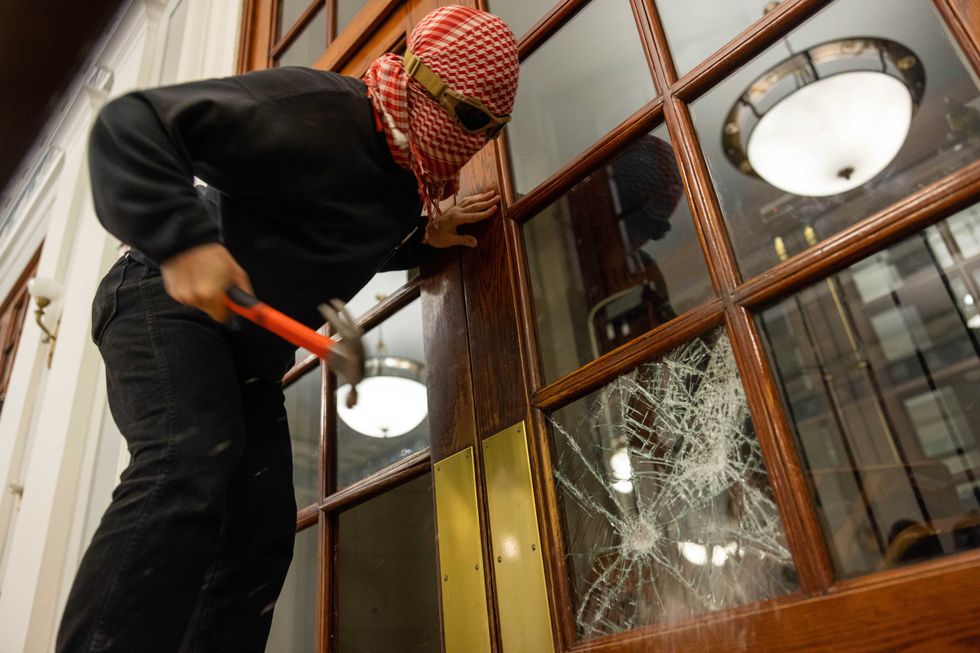 A demonstrator breaks the windows of the front door of the building in order to secure a chain around it to prevent authorities from entering on Tuesday, April 30, 2024.Alex Kent/Getty Images
 A group of students advocating for Palestine at Columbia University stage a demonstration and block the entrance of iconic Hamilton Hall building as they chant pro-Palestine slogans at campus on April 29, 2024.Selcuk Acar/Anadolu via Getty Images
 Demonstrators from the pro-Palestine encampment on Columbia's Campus barricade themselves inside Hamilton Hall, an academic building which has been occupied in past student movements, on Tuesday, April 30, 2024.Alex Kent/Getty Images
 Demonstrators supporting Palestinians in Gaza barricade themselves inside Hamilton Hall, an academic building which has been occupied in past student movements, on April 30, 2024.Alex Kent/Getty Images
In the X post, protesters said they planned to remain at the hall until the university conceded to CU Apartheid Divest's three demands: divestment, financial transparency and amnesty.
While the NYPD was in the area on Tuesday, there was no indication of imminent plans to have police enter the private campus. The university faced condemnation from many community members after it broke with tradition on April 18 and called in the NYPD to arrest more than 100 protesters at the encampment. Last week, school officials said they wouldn't call back the NYPD "at this time," though the university was more vague Monday about the next steps, only alluding to "disciplinary procedures" against protesters.
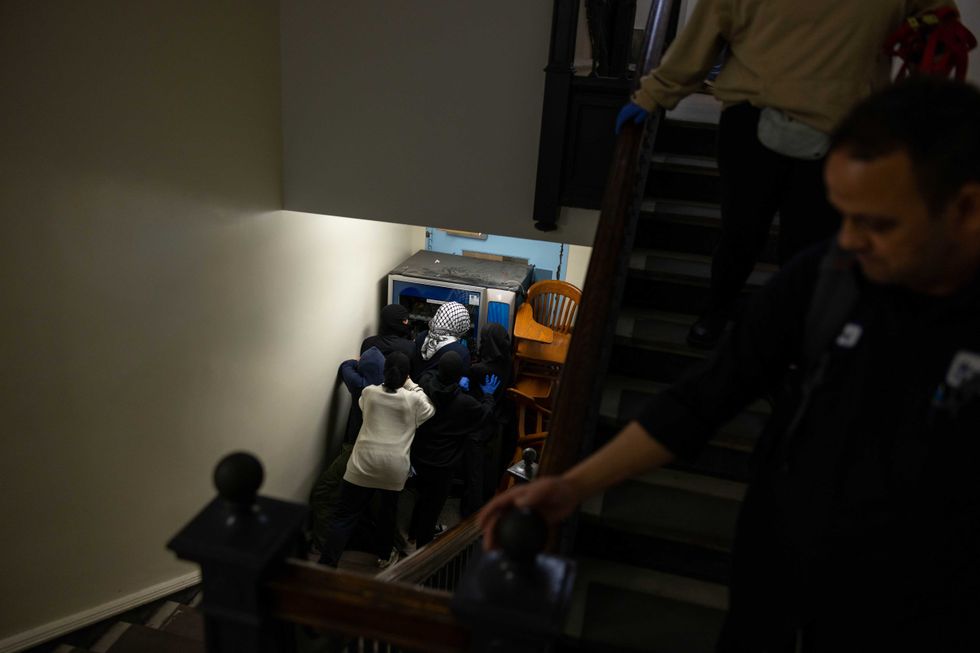 A member of the maintenance team is escorted out, but is met with a barricaded door on Tuesday, April 30, 2024.Alex Kent/Getty Images
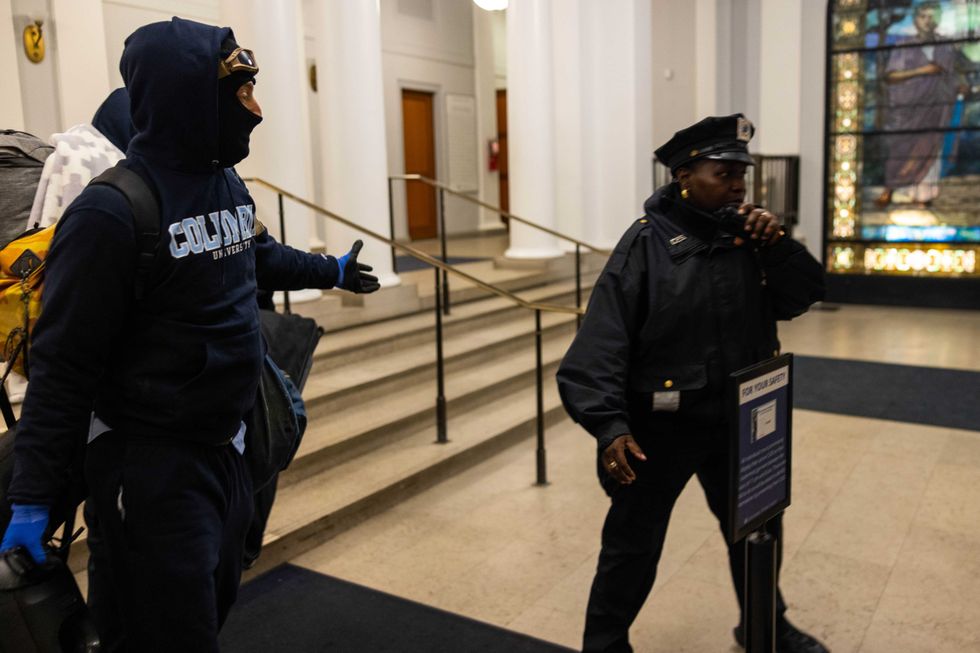 A lone officer reacts as multiple demonstrators enter into Hamilton Hall where they proceeded to barricade themselves in the academic building which has been occupied in past student movements, on Tuesday, April 30, 2024.Alex Kent/Getty Images
 Demonstrators supporting Palestinians in Gaza barricade themselves inside Hamilton Hall, an academic building which has been occupied in past student movements, on April 30, 2024.Alex Kent/Getty Images
Universities across the U.S. are grappling with how to clear out encampments as commencement ceremonies approach, with some continuing negotiations and others turning to force and ultimatums that have resulted in clashes with police and dozens of arrests on Monday alone. Columbia said hours before the takeover of Hamilton Hall that it had started suspending students involved in the nearly two-week-old encampment on the West Lawn.
Demonstrators are sparring over the Israel-Hamas war and its mounting death toll, and the number of arrests at campuses nationwide is approaching 1,000 as the final days of class wrap up. The outcry is forcing colleges to reckon with their financial ties to Israel, as well as their support for free speech. Some Jewish students say the protests have veered into antisemitism and made them afraid to set foot on campus.
 Alex Kent/Getty Images
 Selcuk Acar/Anadolu via Getty Images
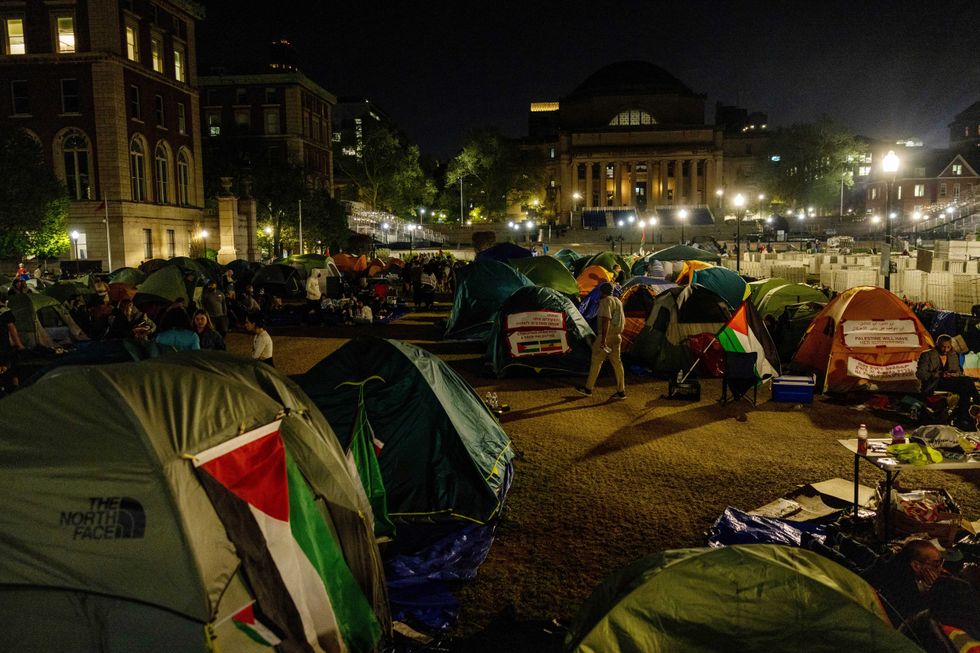 Demonstrators at Columbia University remain on the lawn in support of Palestinians in Gaza on April 29, 2024.Alex Kent/Getty Images
Columbia's handling of the demonstrations has prompted federal complaints.
A class-action lawsuit on behalf of Jewish students alleges a breach of contract by Columbia, claiming the university failed to maintain a safe learning environment, despite policies and promises. It also challenges the move away from in-person classes and seeks quick court action requiring Columbia to provide security for the students.
Meanwhile, a legal group representing pro-Palestinian students is urging the U.S. Department of Education's civil rights office to investigate Columbia's compliance with the Civil Rights Act of 1964 for how they have been treated.
A university spokesperson declined to comment on the complaints.
 A group of Columbia University students, advocating for Palestinians, access the iconic Hamilton Hall building as they gather to stage a demonstration at the campus in New York on April 30, 2024.Lokman Vural Elibol/Anadolu via Getty Images
 Demonstrators supporting Palestinians in Gaza barricade themselves inside Hamilton Hall, an academic building which has been occupied in past student movements, on April 30, 2024.Alex Kent/Getty Images
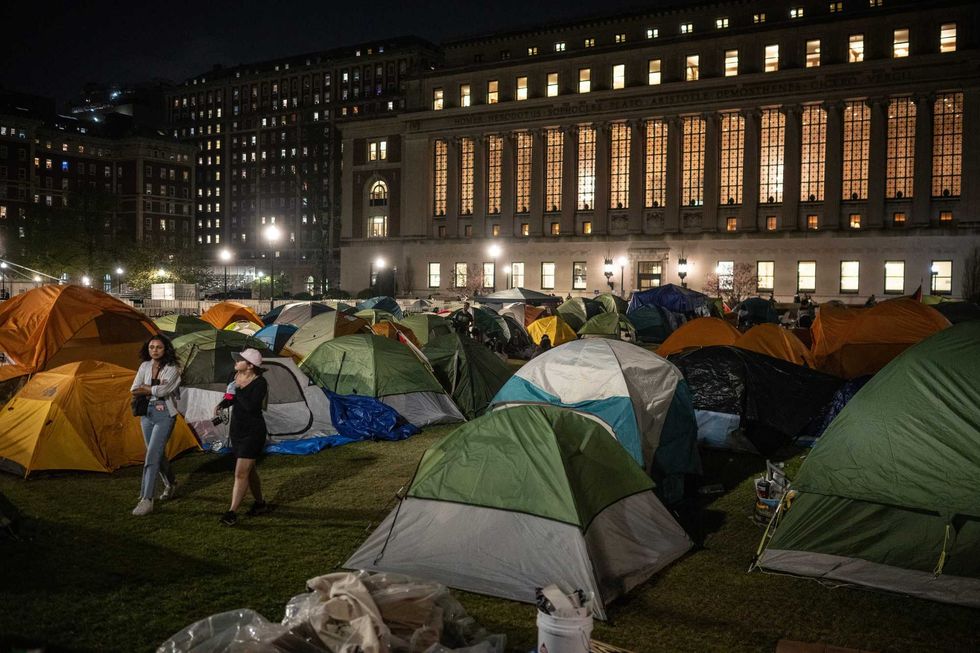 Student protesters occupy a tent camp as as they demonstrate against the war in Gaza at Columbia University on Monday, April 29, 2024.Victor J. Blue for The Washington Post via Getty Images
Meanwhile, police moved to clear an encampment at Yale University in Connecticut on Tuesday morning, but there were no immediate reports of arrests. And at the University of Connecticut, police ordered protesters to remove tents Tuesday morning, but the protesters ignored the directives; no arrests had been made. In New Jersey, more than a dozen people were arrested Monday night at Princeton University after they occupied Clio Hall, officials said.
Columbia President Minouche Shafik said Monday that the school "will not divest from Israel," as protesters had demanded. However, she said the university will "develop an expedited timeline for review of new proposals from the students" by the body that considers divestment matters. The university, Shafik said, will also make it easier for students to access a list of Columbia's direct investment holdings and increase the frequency of updates to that list.
During negotiations, the university also "offered to make investments in health and education in Gaza," which Shafik called "important ideas" that the university will "explore pursuing" in the future.
The school has said it doesn't plan to call the NYPD back onto campus, as it did on April 18, when the encampment was beginning to make headlines following Shafik's congressional testimony on antisemitism. About 108 people were arrested that day, leading to criticism from many at the school, which has a long history of student-led protest dating back to the Vietnam War era.
The Associated Press contributed to this report.


