


NEW YORK (1010 WINS) -- Mayor Bill de Blasio said Thursday that the first COVID vaccine doses are expected to arrive in New York City in less than two weeks and will be allocated in "waves" in the coming months.
"The moment we have all been waiting for is finally here," de Blasio said at his daily briefing.
The first shipments of Pfizer's vaccine are expected as early as Dec. 15, while the first shipments of Moderna's vaccine should arrive as early as Dec. 22, de Blasio said.
The city is working with the state of New York on a distribution plan.
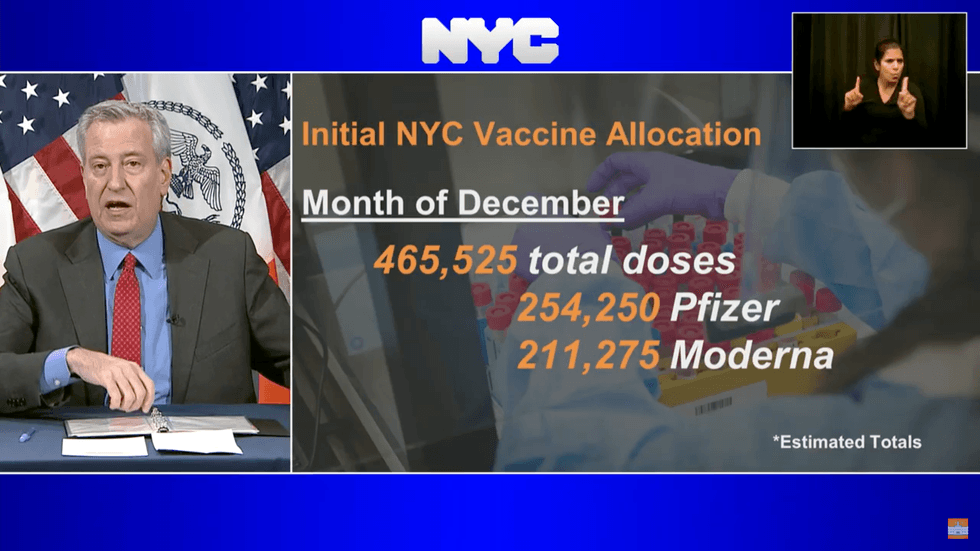
The mayor said the initial allocation for New York City in December should be 465,525 doses: 254,250 from Pfizer and 211,275 from Moderna.
 NYC Mayor
High-risk health care workers, as well as nursing home workers and residents will be prioritized first.
"It's absolutely crucial to protect those who protect all of us," de Blasio said. "And we know from a painful experience how much we have to focus on our nursing home residents and the good people who work in our nursing homes."
De Blasio said there will be enough vaccines for everyone eventually, but the city will focus on "those in greatest need" and "folks who have borne the brunt" initially, including residents of 27 hard-hit neighborhoods and people who live in public housing.
"But we're going to, throughout this process, work on the fastest and most effective distribution," de Blasio said. "Because the faster we can move, and the more we can educate people, and the more we can get people involved, the more people who will be safe."
Health Commissioner Dr. Dave Chokshi said, "The effort to vaccine millions of New Yorkers in the months ahead will be big."
"That is why we are calibrating our entire public health infrastructure to this project. This spans science, operations, data tracking, equity and public communication," he said.
Chokshi said one challenge is the fact that storage requirements vary. The Pfizer vaccine requires ultra-cold (–80°C) storage and special freezers, while the Moderna vaccine can be stored in regular freezers.
"So we're shoring up capacity for both to be prepared," Chokshi said.
The Health Department currently has the ability to receive, store and ship up to 320,000 doses of ultra-cold vaccines, as well as millions of frozen vaccines. That's in addition to capacity at hospitals.
"Over 50 hospitals have access to ultra-cold storage or will have the special ultra-cold freezer delivered very soon, for a total citywide storage capacity of at least 1.5 million doses," Chokshi said.
The commissioner said the Health Department will track in real-time the communities that may have a low uptake of the vaccine and "pivot to ensure that the vaccine is distributed equitably."
When health officials anticipate that more access is needed, they'll have the ability to create and run temporary vaccine centers, including at pre-identified schools.
At his briefing Thursday, de Blasio also announced that the city is creating a Pandemic Response Institute at the Alexandria Center for Life Science in Midtown to prepare for future outbreaks.
The center already houses the Pandemic Response Lab, which processes 20,000 individual tests a day and aims to get up to 30,000 tests a day soon.
The institute will focus on:
• Research on outbreak detection, investigation and management
• Developing best practices and training programs for pandemic response
• Piloting new community-based partnership models
The goal is to establish a long-term partner for the center by mid-2021 and to begin operations by the end of 2021.
"This will position the city as a leader in pandemic response and strengthen our infrastructure for future outbreaks," said Dr. Jay Varma, de Blasio's senior advisor for public health.
When it comes to the city's daily indicators, de Blasio said, "What we're now seeing more than we've seen in a long, long time is these three indicators all moving in the wrong direction."
De Blasio said there was a "serious increase" in the number of patients newly admitted to hospitals with suspected COVID—174 patients with a confirmed positivity level of 49.7%.
New reported cases on a seven-day average also rose to 1,962, well above the city's 550-case threshold.
De Blasio said the seven-day rolling positivity rate "has really increased" to 5.19%.
"It's quite clear at this point that this second wave, unfortunately, is right upon us," the mayor said, while noting that the stress on hospitals is nowhere near what it was during the spring peak.


