



NEW YORK (1010 WINS) – When Megumi Yamada tore her rotator cuff muscle in an aerial silks accident in 2021 — rendering her unable to perform intricate acts, and at times, get out of bed — it was a cherry tree in Prospect Park that brought her back to life.
“I got nightmares, woke up and I just cried,” Yamada said. “And I didn’t want to call my friends to tell them bad things, really heavy things.”
The cherry tree was one of her favorite spots in the city, just a three-minute walk away from her home in Crown Heights. That morning, it called to her. “It was April,” she said. “I was in pajamas, I didn’t even change. And there was a man standing under the cherry blossom tree….and I saw his face, and suddenly — ‘oh, you!’”
Yamada had run into a longtime friend. She’d been keeping how much her injury had emotionally affected her to herself, but under the tree, she broke down. In New York’s circus scene, Yamada said, survival often depends on a difficult skill for performers: letting other people see when you’re hurting.
“I felt light,” she said about the conversation.
Managing gig life
Born and raised in Kyoto, Yamada began belly dancing and training in yoga in her mid-twenties, then began training in modern dance and martial arts. But she found herself curious about “more physical work,” and the intimacy circus performance demanded.
While in Japan, she visited an aerial silks studio. The difficulty and strength required left her determined.
“I had a real goal,” Yamada said. “It had to be a job…the first step was competition.”
In 2013, Yamada won first place in the Amateur Silks Division at PPS Premier International Tournament in Hong Kong. Meeting other performers there inspired her to keep training, and she moved to New York in 2014 to perform full-time. In under a year, Yamada became a finalist in the Silks Division of the U.S. Aerial Championships. Since then, she’s soared into stilt-walking in the Macy’s Thanksgiving Parade, performed at arts festivals around the city and with the artist 50 Cent, and works as a teaching instructor in aerial silks, dance trapeze, and lyra hoop at Manhattan’s CirqeHaus. She also routinely performs with Bindelstiff Family Circus.
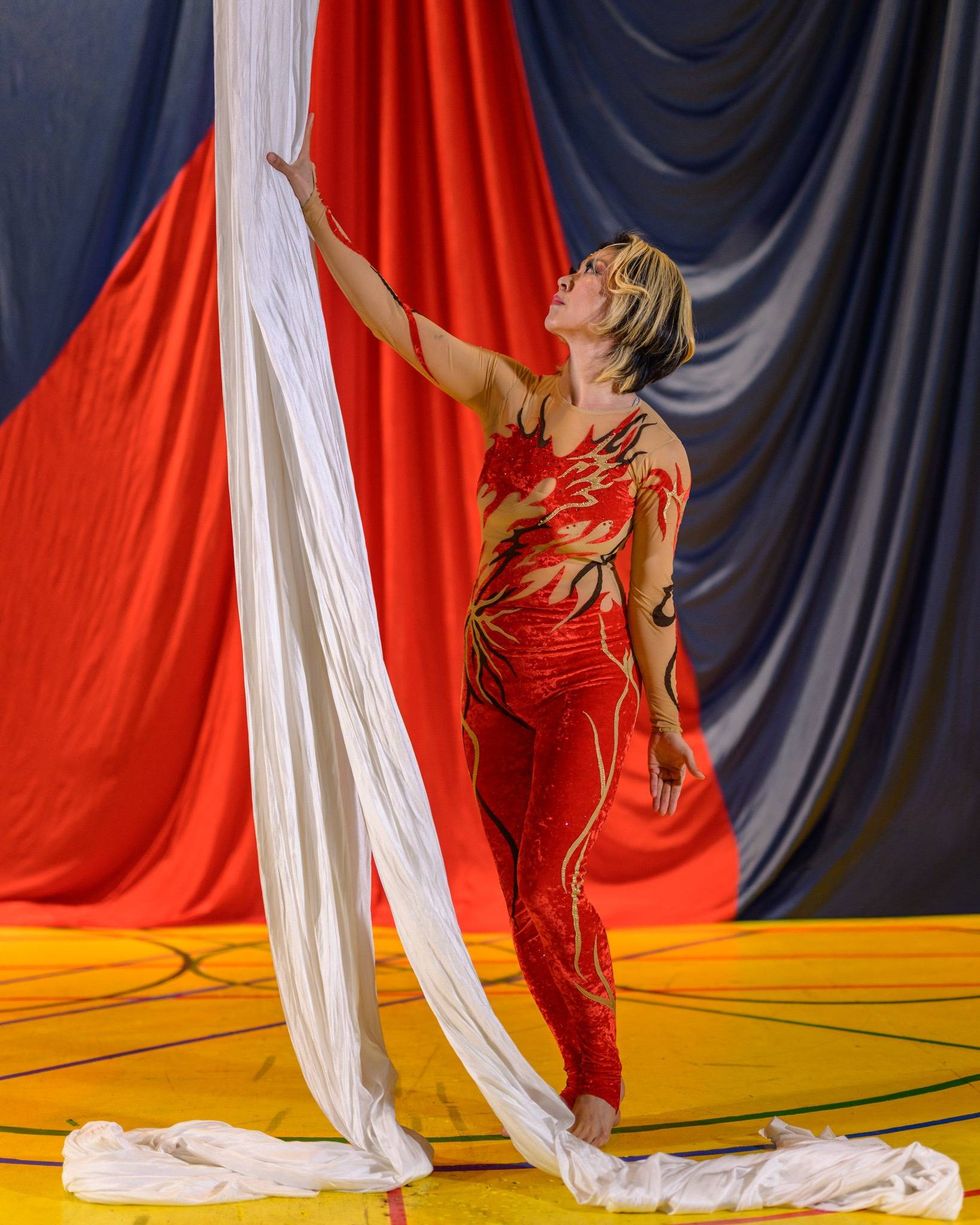 Mikhail Lipyanskiy
Gig life is busy – Yamada, fully glammed-out, will take the train with her stilts in a golf bag to an event (“people always ask what I’m carrying,” she said), then turn back around within hours for another event.
It’s also seasonal work, with most of her annual income coming in through the summer, fall and early winter. “January to April is kind of quiet,” she explained. “May, June, July and August – I have enough gigs.”
It’s a lifestyle that pushes performers out. Yamada watched friends and colleagues quit over the years, many during the pandemic, due to the up-and-down nature of the industry.
“We have to practice, and pay for the place [to practice], and everything’s going up,” she said. “I try not to get depressed when I’m not getting a lot of gigs…because if my mental is up and down, I’m tired, and not giving my full energy to the audience.”
She stressed the importance of contracts for artists in keeping stable incomes, but even then, life is never certain. “The contract will end eventually,” she said.
“Telling the story without words”
Onstage, as Yamada’s body lifts, a story lands. Audience members often approach her afterward, she said, drawn in by the connection they feel to her performances.
“We already did some sort of conversation,” Yamada explained of her relationship to the audience. “They listen to something from me. I’m bringing my energy, and basically telling the story without words.”
One of her recent routines is an aerial re-telling of the story of Princess Kaguya: a Japanese folktale about a princess discovered as a baby inside a stalk of bamboo and later called back to the moon. Her routine centers around Princess Kaguya’s return. Suspended in silk, she folds and unfurls her body through the air, moving higher and higher as the narrative takes shape.
“I want to think of new ways we can make peace for the community,” Yamada said. “I grew up in Japan. I want them to come see my performance. Not even [for] me, but just open people’s hearts to different backgrounds. Learning something from a different background – it’s so fun. Learning from others is a beautiful thing.”
Continuing to fly
Five years from when Yamada approached her favorite cherry tree in her pajamas, things are looking up: she’s healed enough to be able to soar through the air again, and is working on a new routine.
“I finally feel my body back to the same sort of level as before, and I feel confident to keep improving my skills…it definitely helped me grow,” she said.
Her work hasn’t changed; it still requires time and strength and discipline. But success also relies on the openness within the tight-knit circus community; to be able to lean on others when life gets hard. In teaching, Yamada says that she gets the most joy out of not just supporting students through their challenges, but celebrating their victories. Among her friends, peers and colleagues within the community, it’s similar.
“You have to keep training,” she said. “Not just physically, but mentally…if someone is training, we don’t disturb [them], but if someone needs to talk, we talk. We are strong, but we are very sensitive.”
—