


NEW YORK (BLOOMBERG) — For decades, the family playbook was simple: Keep the high-paying New York City job and move to the suburbs across the Hudson River, where a lower cost of living let parents stretch their paycheck. But these days, the New Jersey suburban discount for families is dwindling.
The budget required to sustain a dual-income family of four in New Jersey rose by about $40,800 between 2021 and 2026, an annual increase of 6.7%, according to the Living Wage Institute, a non-partisan public benefit corporation that tracks cost of living data, including housing, child care, food, transportation, healthcare and more. Every county in the state has seen family budgets grow faster than the 4.5% national median. In fact, New Jersey suburbs account for eight of the 20 US counties with at least 100,000 residents where family budgets have ballooned the fastest since 2021.
The costs of raising a family in New Jersey took off during the pandemic as housing prices spiked. Since 2023, the state’s childcare and healthcare cost growth has more than tripled, pushing annual family budget gains higher. In fact, families that sought refuge from pricey city living in the Jersey suburbs are now seeing their budgets grow more rapidly than in Manhattan, where expenses rose 4.6% annually over the past five years.
“Places that were more affordable have started to see their costs increase,” said Misael Galdámez, a researcher at the Living Wage Institute.
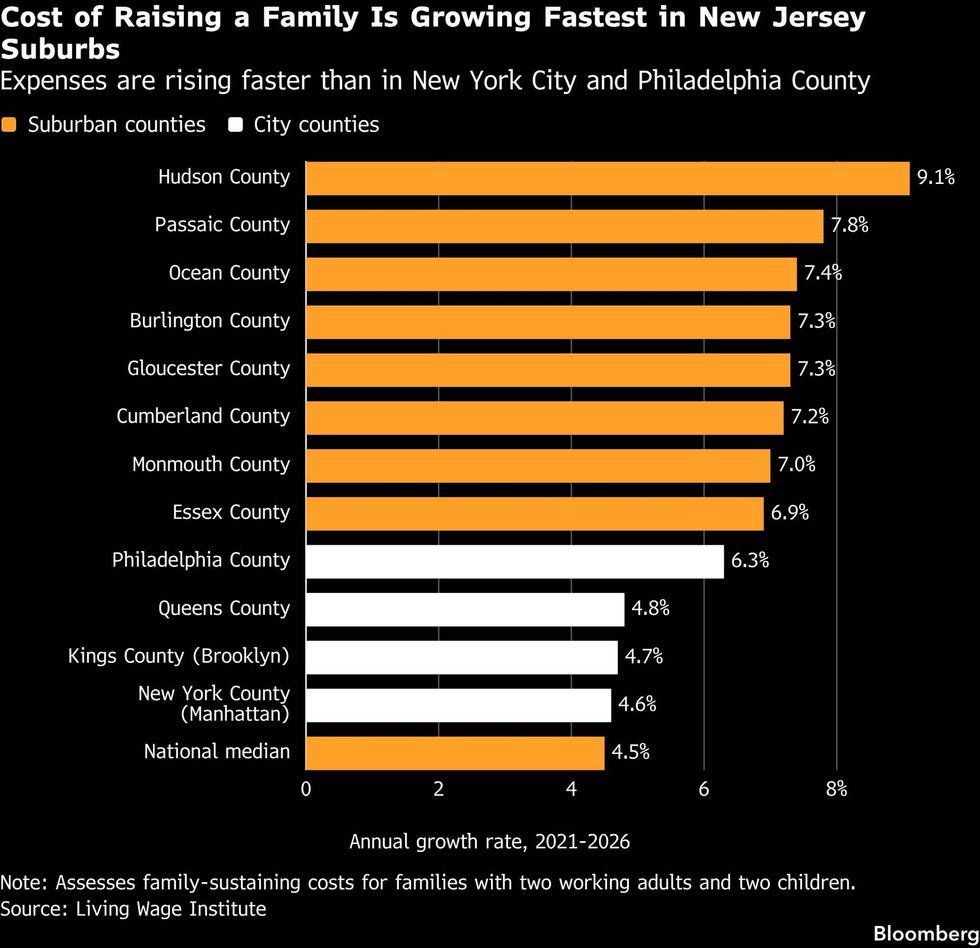 Cost of raising a family in New Jersey based on information from the Living Wage Institute.Bloomberg
Just ask Kristyna Frantz, who lived in a three-bedroom apartment in the Washington Heights neighborhood of Manhattan for 10 years with her husband before moving to Fanwood, New Jersey, in 2024 shortly after she gave birth to twins. While the couple is now closer to her in-laws who pitch in to help with daycare drop off, they’re forking over $5,000 for child care for three kids. In the city, their eldest was enrolled in a free city program.
By her math, the communications professional would be paying $1,000 less a month for child care alone if they still lived in the city — and that doesn’t include the lunches she now has to pack for the kids.
“At this phase, it’s more expensive for us to raise kids in New Jersey than New York,” she said. “We’re paying more in child care, commuting costs and our mortgage is more than our rent in the city. It’s crazy to think about the cost savings we could have had if we could have universal child care for all three kids and just pay for after-school care.”
Frantz’s experience reflects a broader squeeze on families across New Jersey’s commuter belt. In Hudson County, a popular NYC commuter area along the Hudson River that includes Hoboken and Jersey City, family-sustaining budgets have increased by an average 9.1% a year since 2021, the fastest pace of any US county with at least 100,000 residents. To be sure, raising a family is still more expensive in the city. By LWI’s measure, the after-tax income required to support a family of two working adults and two children reached $123,676 in 2026, about $12,000 shy of the $135,538 required in Manhattan.
Child care is a major reason for the rising cost of suburban New Jersey life. LWI found in Hudson County it runs $37,242 a year, roughly $5,200 more than in NYC. In the city, the burden has been eased somewhat by free pre-kindergarten and 3-K programs, which are open to families of all income levels. A 2-K program also is being rolled out.
“For many young families living in New Jersey today, child care is their biggest expense,” in some cases topping their mortgage or rent payment, said Sharon Levine, campaign director for childcare advocacy group Start Strong NJ. The group is pushing the state to expand the number of working parents and those in school who can qualify for childcare tuition assistance.
Inflation isn’t the only force behind New Jersey’s rapid run up in costs. Galdámez, from the Living Wage Institute, said an influx of new residents has added to the pressure. New Jersey’s population has been ticking up since 2023, with almost 57,000 coming from the state of New York between 2023 and 2024, according to Census data from USA Facts.
The gap in housing costs between NYC and the suburbs has also narrowed. While home-price increases across New Jersey have slowed since the pandemic, areas with quick train access to Manhattan have continued to boom as bosses call workers back to the office.
“Pre-pandemic it was affordable everywhere in New Jersey for a family to lay down roots outside of the city,” said Jeffrey Otteau, chief economist at his eponymous New Jersey real estate firm. “Today, if your household is making $150,000 or less, it’s not a safe haven for affordability.”
Scott Paer, a marketing and communications executive, and his wife moved to Westfield, New Jersey, in 2025 looking for more space than their two-bedroom apartment in Manhattan could offer for their toddler son. Since three-bedrooms in Manhattan were exorbitant, they looked across the river for a home within commuting distance to the city. In the Garden State, they were outbid on 11 properties in commuter towns before buying a home in Union County, about 25 miles from NYC.
“We certainly didn’t save any money,” Paer said. “We spent more,” mostly because of mortgage and other homeownership-related costs.