

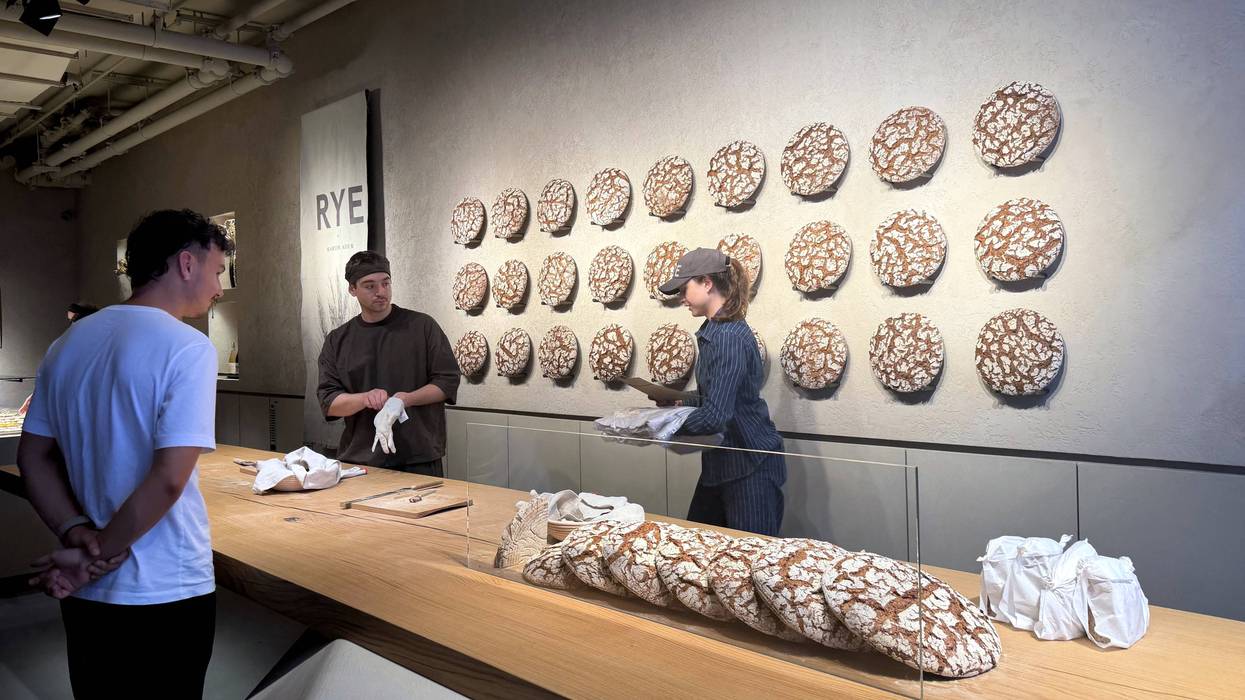

NEW YORK (BLOOMBERG) -- Have you heard about the new shop in downtown Manhattan that only sells one type of bread? It’s been written up by Grub Street, The Infatuation, the New York Post, Fox News and more. It’s all over Instagram and TikTok. And if you know one thing about the product, you’ll know this: At RYE by Martin Auer, the bread costs $60 per loaf.
Is it special? Eh. It tastes like rye bread. New York City has many bakeries that serve up perfectly good bread; this is one of them. If you bite into this loaf expecting an experience commensurate with the price, you will be disappointed.
That goes double for locals. If you’re a New Yorker and you’ve lived in the city for a while, it won’t be hard for you to find better bread. (You know a spot, I’m sure.) The RYE loaf’s crust isn’t particularly crusty, the crumb can be a bit gummy, and the sourdough tang can be subtle to the point of undetectability. Still, it’s better than supermarket bread — a notch above the $10 sourdough loaf at Wegman’s, up the street, which is not exactly cheap.
If you’re not a New Yorker — if all you know of the town is what you’ve been seeing on social media — then it’s easy to see why you might want to try this bread. There’s no shortage of stores here that get by fine on tourists alone, and Auer’s bakery has been catnip to influencers, who, on the two times I visited, made up the majority of the customers in store.
Auer attracted those content creators in an elegantly simple way, just by charging a ridiculous price for his product. (See also: Meadow Lane, the absurdly expensive Tribeca grocery store with a strikingly similar interior design philosophy that opened to similar viral hype last year.) It wasn’t enough for his bread to be merely expensive; New Yorkers are used to paying double digits for a loaf, and the days of artisanal bakers taking pride in affordability are definitively over. The first-rate rye loaf from Danish chain Ole & Steen will run you about $12, which is more or less the same price that Auer’s sourdough rye costs in his hometown of Graz, Austria.
Ironically, one of the bakers still taking pride in affordability is Auer himself, back in Austria: He has a store on Mariahilferstrasse in Graz that sells yesterday’s bread at half price and gives all the proceeds to charity. Since the rye lasts for a week or more, that’s a very effective way to feed the price-conscious and to honor the tradition of the Martin Auer bakery, which dates back to when his grandfather, Martin Auer IV, set up the business in 1936. Today there are 43 locations, mostly in and around Graz, including a 70,000-square-foot custom-built headquarters featuring not only a massive bakery but also a grain mill, coffee roaster, office and employee academy.
When planning his New York outpost, Auer decided to charge far, far more than Austrian prices — enough so that the price has become the loaf’s defining feature. In conversation, it’s always “the $60 loaf of bread” rather than “Martin Auer’s sourdough rye” or anything else.
The theory behind his gambit dates back at least as far as 1899, when Thorstein Veblen published The Theory of the Leisure Class and posited the existence of a class of goods for which demand rises as the price goes up. A Ferrari Testarossa or a crocodile Birkin is desirable because it’s expensive: To have one is to communicate to people that you have the wherewithal to spend lots of money.
Can a loaf of bread play that role? It’s a bit of a stretch, but it’s not impossible. Auer’s rye loaf has an idiosyncratic crust: It looks a bit like a massively upsized sugar cookie. If you have one sitting out on your waterfall kitchen island, there’s a decent chance your guests will recognize it. Alternatively, if you’re just buying the bread for your own personal consumption, $60 is almost a reasonable amount to pay for the frisson of splurging on something — roughly the price of a blowout, or a high-end glass of Champagne. To knowingly overspend can counterintuitively provide catharsis when times are tough. And for the many very rich denizens of downtown, including those who inhabit the $18 million apartments in the same building as the bakery, $60 is something they’d barely notice.
If you look at this loaf of bread as a loaf of bread, you’re making a category error. The thing that people are spending their $60 on doesn’t belong under goods, it belongs under services. You’re here for the experience, not the rye, which remains unavailable on DoorDash or Grubhub.
The Martin Auer experience is undeniably high-end, with space and light reminiscent of a $3,000 Aman hotel room. At Wegman’s, you have to hunt for an unsliced loaf and then check yourself out at a machine. At Ole & Steen, you’ll stand in a line and get rung up by a bored shop assistant. At RYE by Martin Auer, you’ll enter an ethereal world of luxury greige and be greeted by an assistant who will give you the whole spiel — where the flour comes from, how much time it takes to bake a single loaf, how many years (57) the same sourdough starter has been going. If you order a half loaf or a quarter loaf it will be cut on the counter in front of you, with a Martin Auer branded bread knife, on a Martin Auer branded bread board. It will be wrapped in lovely paper and sealed with a white-on-white Martin Auer sticker. It will be placed in a gorgeously designed heavyweight brown paper bag. It will be reverently transported to the checkout, where you will be rung up after you decide whether you’d also like to order a glass of Austrian wine, or maybe some kombucha on tap.
The problem is that the model doesn’t really lend itself to repeat business. Lots of influencers come once, thanks to the bakery’s demonstrated ability to drive content views. Few, however, are likely to come twice: they’ve already got what they came for. As for the bread-curious, after they’ve tried it once, they’re unlikely to become devoted. ($60 per loaf makes for an expensive habit.) Besides, everyone seems to be cutting back on carbs.
Perhaps the sourdough rye itself just isn’t special enough to become some kind of international phenomenon. Auer told Grub Street that he came to New York because his grandmother had always dreamed of immigrating here; that may prove to be an insufficient basis for a successful business model.
Outside the store is a set of stanchions holding up the Martin Auer version of a velvet rope — this one’s roughly-hewn, made from raw hemp. The idea is that no one wants the store to get overcrowded, so it’s better for would-be patrons to wait in line. So far, however, that hasn’t been a problem. The stanchions remain purely aspirational.
More stories like this are available on bloomberg.com.