


NEW YORK (BLOOMBERG) -- It cost Arnette Scott almost a thousand dollars to get her car’s headlights working again.
The lifelong Manhattan resident assumed it was something minor, but no matter what she tried, Scott could not get the lights to turn on. “I thought I needed a new bulb, so I just kept getting bulbs,” she said. “Come to find out that the rats have eaten the wires.”
Scott, 51, parks her 2014 Toyota Corolla on the street when she goes to work in Alphabet City and said she’s had to repair the car three times because of rat damage. She now calls it the “Rat-mobile.”
Encounters with the metropolis’s most unloved rodent are a familiar story for New Yorkers, who live in a city some estimate has one rat for every three people. But the rats, by at least one measure, are losing ground.
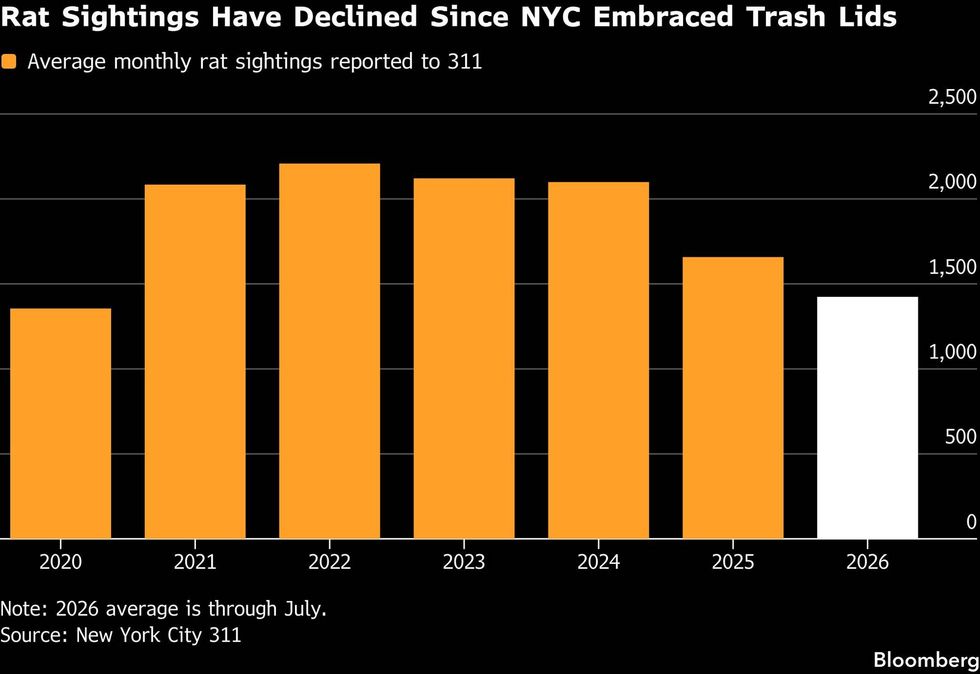
New York City is on track to record the fewest reported rat sightings since the pandemic. Rat sightings have dropped 22% in the first seven months of 2026 compared with the same period last year, according to data from 311, the non-emergency service portal used to report rodents and request inspections. Sightings typically peak in the summer months, before declining through fall and winter.
The reports have fallen year-over-year every month since November 2024. The city’s Sanitation Department credits the decline to a push started by former Mayor Eric Adams, who declared a “war on rats” in 2022 and began efforts to starve the city’s rodent population of food.
The city installed around 1,100 Empire Bins – large on-street trash bins – in Manhattan Community Board 9, which includes West Harlem, as a pilot program in 2025. The Sanitation Department’s First Deputy Commissioner Javier Lojan said the pilot’s budget was $2.1 million during a City Council committee hearing in March.
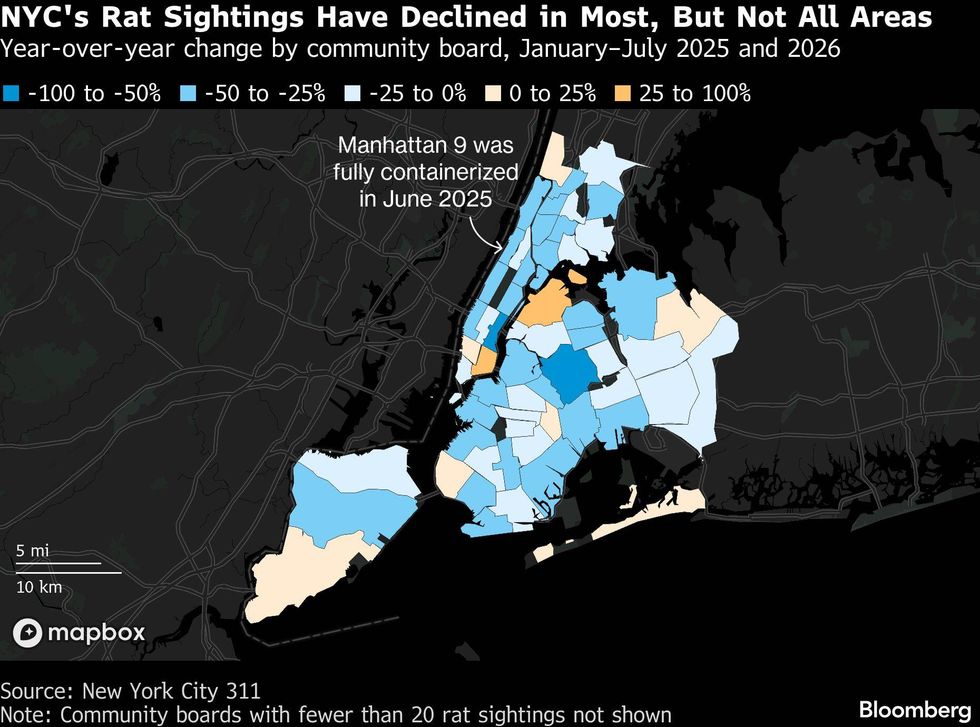
The area’s trash has been fully containerized since June 2025, and reported sightings fell 34% in the first seven months of 2026 compared with last year. Residents say the bins have had a major impact. Juan Colmenares, 57, said he no longer sees “a line of trash going up and down the street” just from his building. He said he’s seen fewer rats, too.
“There are less on the street walking around,” he said. “But that doesn’t mean that there are less rats inside the buildings in their nests.”
Rats are known to carry diseases, cause property damage and pose public health risks. As a result, controlling their population has been a priority for local governments across the globe, including in New York.
 Bloomberg
In November 2022, Adams and then-Sanitation Commissioner Jessica Tisch launched the “Get Stuff Clean” initiative, which invested $14.5 million in cleaning up neglected areas and combatting litter across New York City. Adams also appointed Kathleen Corradi as “rat czar” in 2023, and charged her with permanently reducing the city’s rat population. She stepped down in September 2025 and wasn’t replaced.
The centerpiece of Adams’ anti-rat campaign was a push to get trash bags off the curb. The effort, dubbed the “Trash Revolution,” involved gradually rolling out requirements for containerization, or placing garbage in lidded bins for pickup rather than leaving bags piled up on the sidewalk.
The rules took effect for all businesses in March 2024 and for low-density residential buildings in November 2024. Those buildings produce roughly 70% of the city’s trash, according to the Sanitation Department.
Robert Corrigan, a rodentologist who advises the city’s Health Department, said he felt “very positive” about the city’s containerization effort. Putting bags in containers prevents rats from being able to access garbage, their favorite food, he said, calling lids “the true hero of rat management.” He added that more data needed to be collected before speculating about whether the effort was successful.
Mayor Zohran Mamdani said in April that he planned to continue Adams’ efforts on garbage. He pledged that the city would have 100% trash containerization by the end of 2031.
Though overall rat sightings are down so far this year, it’s not uniform across community districts. Brooklyn 2, which includes parts of DUMBO and Brooklyn Heights, is down 48% this year, while Manhattan 3, which covers the Lower East Side, East Village and Chinatown, saw rat sightings climb 38%.
The overall decline may be explained by citywide garbage policies as well as public awareness of the need for proper trash disposal, said Corrigan, the rodentologist. “People are more aware that it’s a really strong relationship between doing the trash in some way with containerization versus just putting it out in bags.”
 Bloomberg
Scott, who lives on the Lower East Side in Manhattan 3, said she avoids walking on the sidewalk because it belongs to the rats. “I know how I feel about uninvited guests, so I just stay in the middle of the street,” she said.
She attributes the increase in rat sightings to construction, which disturbs the rodents’ burrows and drives them into the open. And she doubts better garbage disposal will be enough to curb the growing rat population. “I still think that they find ways to eat, especially buildings that have first floor restaurants,” Scott said.
Joshua Goodman, a Sanitation Department spokesperson, called Manhattan 3 an “interesting statistical anomaly.” He said the increase in sightings was driven by three specific blocks in the district and is “potentially reflective of issues inside the individual buildings rather than on the street.”
“So even when you look at the small areas that might appear to show an increase, it’s really an outlier, and the citywide number is the real story,” Goodman said.
The city announced plans in April to fully containerize six additional community boards. Brooklyn 2 had already been announced as the program’s next target, and is expected to have Empire Bins installed this fall.
Mamdani’s executive budget, released in May, included a $14.8 million investment in waste containerization for fiscal year 2027. The amount will grow to $162.2 million by 2031.
More stories like this are available on bloomberg.com.