

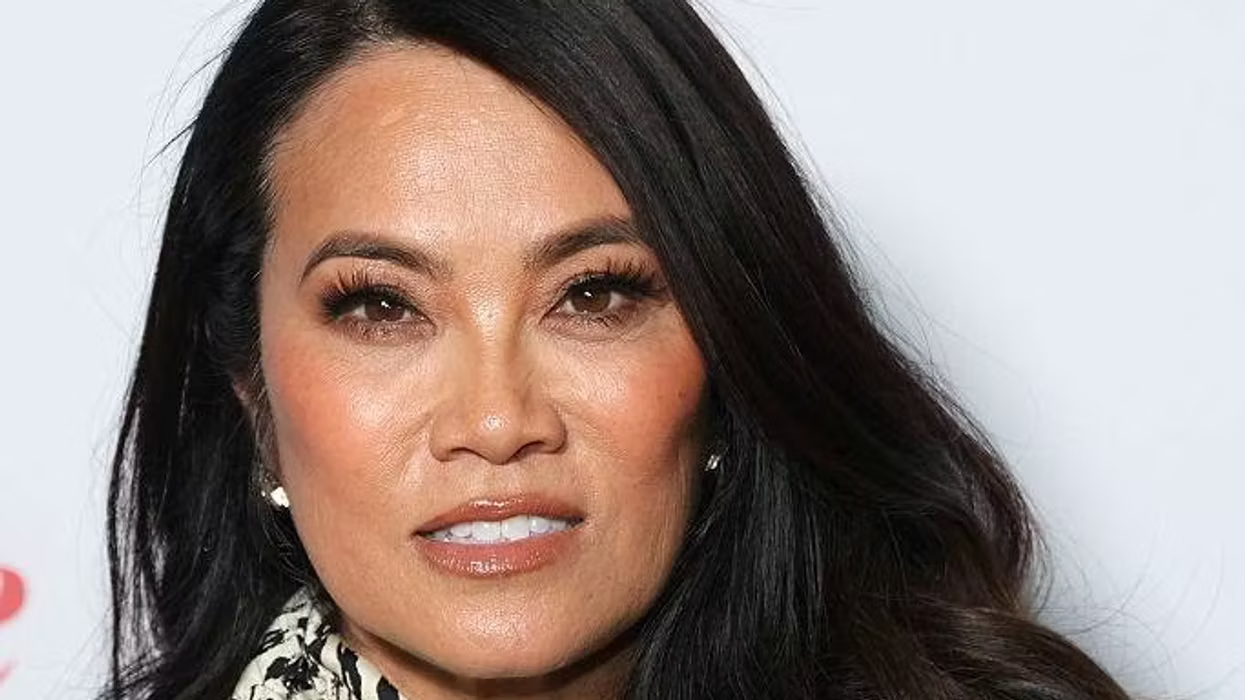

A new season of “Dr. Pimple Popper: Breaking Out” starts next Monday on Lifetime and its star, Dr. Sandra Lee, has a new lease on life after suffering from a stroke.
According to the U.S. Centers for Disease Control and Prevention, someone in the U.S. has a stroke every 40 seconds, and every three minutes and 14 seconds someone dies from a stroke. Around 87% of strokes are ischemic, the type that Lee suffered from last year.
“I want to think about it as a blessing in disguise. Because it reminds you to take better care of yourself,” she told People magazine in an exclusive interview published this week.
Lee, 55, is an alum of a UCLA and Drexel University College of Medicine. Before her show first debuted on TLC in 2018, she began posting patient procedures on YouTube, with her patients’ permission. She told People that people watch her procedures for a variety of reasons – it calms some down, while others take it in like a scary movie.
“I’m not a natural pop-aholic [someone who loves watching extractions],” Lee explained. “I feel really lucky that I get to actually see how what I do transforms somebody’s life.”
Last November, Lee was filming the show at her practice in Upland, Calif., when she had what she thought was a hot flash. She got very sweaty and felt strange. When they wrapped for the day, she went to her parents’ home nearby.
That evening, Lee felt restless, had shooting pain in one leg and had trouble sleeping. Then, she got up to get something to eat and noticed that it was difficult to get down the stairs. Things were even worse the next morning.
“I would hold my hand out, and it would just slowly collapse. I noticed that I had a tough time articulating and just enunciating,” said Lee. “I thought, ‘Am I having a stroke?’”
Lee’s father, a fellow dermatologist, told her to go to the emergency room right away. She did, and an MRI showed that she had suffered an ischemic stroke.
“An ischemic stroke occurs when blood clots or other particles block the blood vessels to the brain,” according to the CDC. “Fatty deposits called plaque can also cause blockages by building up in the blood vessels.”
A second type of stroke, hemorrhagic strokes, are much rarer than ischemic strokes. Those occur when an artery in the brain leaks blood or breaks open, resulting in the leaked blood putting too much pressure on brain cells and damaging them.
“High blood pressure and aneurysms – balloon-like bulges in an artery that can stretch and burst – are examples of conditions that can cause a hemorrhagic stroke,” said the CDC.
Even though she knew something was wrong, Lee said she was in shock when she received her diagnosis.
“As a physician I couldn’t deny that I had slurred speech, that I was having weakness on one side, but I was like, ‘Well, this is a dream, right?’” she told People.
The American Stoke Association offers some guidance for recognizing some of the stroke warning signs Lee mentioned. It’s the BE FAST acronym. B stands for balance loss, E stands for eye and vision changes, F stands for face drooping, A stands for arm weakness, S stands for speech difficulty, and T stands for time to call 911.
Lee explained to People that part of her brain died during the stroke.
Strokes do cause parts of the brain to become damaged or die, the CDC said. In some cases, they can cause lasting brain damage, long-term disability, or death. They are also a leading cause of disability in the U.S., per the CDC. Stroke-related costs in the U.S. came to nearly $56.2 billion between 2019 and 2020, including costs for health care services, medicines to treat stroke, and missed days of work.
“To work properly, your brain needs oxygen. Your arteries deliver oxygen-rich blood to all parts of your brain,” said the CDC. “If something happens to block the flow of blood, brain cells start to die within minutes, because they can’t get oxygen. This causes a stroke.”
Dr. May Kim-Tenser of USC’s Keck medical school, Lee’s neurologist, said that high blood pressure is the top risk factor for strokes. She also said there is a nearly 15% increase in stroke prevalence for patients between age 45 and 64.
“My blood pressure and my cholesterol were not under control, and I have a lot of stress in my life, dealing with my patients and the show,” said Lee, looking back on the time leading up to her stroke. Following the incident, she halted filming for two months of recovery that included physical and occupational therapy to regain balance and movement.
“I don’t like that I don’t have total control of my left hand or the grip wasn’t as strong. If I feel like I’m not at my best it’s very scary,” said Lee, who shares two adult sons with her husband, dermatologist Jeffrey Rebish, 53. In addition to physical therapy, Lee is also taking blood thinners.
Tenser said that Lee’s healing has gone well: “She’s lucky. Her symptoms are pretty much resolved.”
Still, Lee was nervous to get back to work in January.
“It was very scary for me,” said Lee, who was worried about performing some of her more intricate surgeries and has enlisted the help of her staff and a former dermatology co-resident. “There’s a lot of PTSD because it happened while I was filming the show.”
Lee also said it was stressful to open up about the ordeal, but that she thinks it is important.
“In Asian cultures in particular they don’t tell people they’ve had a stroke because it can be seen as a sign of weakness,” she says. “I want to get the word out that if you have symptoms like I had, make sure you see your doctor. Take care of yourself.”
Earlier this year, the American Heart Association announced “The 2026 Guideline for the Early Management of Patients With Acute Ischemic Stroke” that includes “key advances in stroke treatment,” as well as “the first detailed recommendations for diagnosing and treating stroke in children.”