MINNEAPOLIS (AP) — As anger and outrage spilled out onto Minneapolis’ streets over the fatal shooting of a woman by an Immigration and Customs Enforcement officer, a new shooting by federal officers in Oregon left two people wounded, sparked additional protests and elicited more scrutiny of enforcement operations across the U.S.
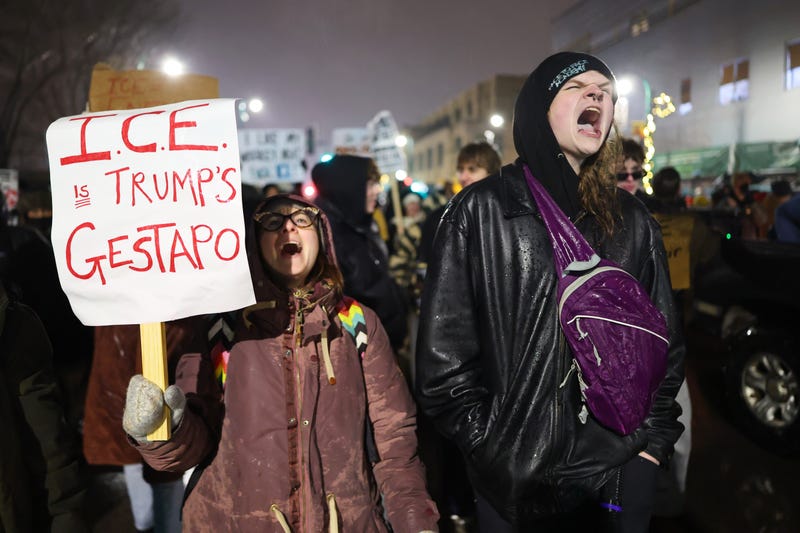
Hundreds of people protesting the shooting of Renee Good marched in freezing rain Thursday night down one of Minneapolis’ major thoroughfares, chanting “ICE out now” and holding signs saying, “killer ice off our streets." Protesters earlier vented their outrage outside a federal facility that is serving as a hub for the administration’s latest immigration crackdown on a major city.
Early Friday, city crews removed makeshift barricades made from debris including garbage cans and Christmas trees that blocked streets in the area of Wednesday’s shooting to keep streets open, but Minneapolis officials said they would not remove the memorial the community created there. An estimated 15 tons (13.6 metric tonnes) of debris including metal and tires were removed, officials said.
The shooting in Portland, Oregon, took place outside a hospital Thursday afternoon. A man and woman were shot inside a vehicle, and their conditions were not immediately known. The FBI and the Oregon Department of Justice were investigating.
Portland Mayor Keith Wilson and the city council called on ICE to end all operations in the city until a full investigation is completed. Hundreds protested Thursday night at the ICE building. Early Friday, Portland police reported that a handful of arrests were made after officers asked protesters to move to the sidewalk, as traffic remained open in the area.
Just as it did following Wednesday's shooting in Minneapolis shooting, the Department of Homeland Security defended the actions of the officers in Portland, saying it occurred after a Venezuelan man with alleged gang ties and who was involved in a recent shooting tried to “weaponize” his vehicle to hit the officers. It was not yet clear if witness video corroborates that account.
Homeland Security Secretary Kristi Noem, President Donald Trump and others in his administration have repeatedly characterized the Minneapolis shooting as an act of self-defense and cast Good as a villain, suggesting she used her vehicle as a weapon to attack the officer who shot her.
Vice President JD Vance said the shooting was justified and Good, a 37-year-old mother of three, was a “victim of left-wing ideology.”
“I can believe that her death is a tragedy while also recognizing that it is a tragedy of her own making,” Vance said, noting that the officer who killed her was injured while making an arrest last June.
But state and local officials and protesters rejected that characterization, with Minneapolis Mayor Jacob Frey saying video recordings show the self-defense argument is “garbage.”
An immigration crackdown quickly turns deadly
The Minneapolis shooting happened on the second day of the Trump administration's immigration crackdown on the Twin Cities of Minneapolis and St. Paul, which Homeland Security said is the biggest immigration enforcement operation ever. More than 2,000 officers are taking part and Noem said they have made more than 1,500 arrests.
It provoked an immediate response in the city where police killed George Floyd in 2020, with hundreds of people turning up to the scene to vent their outrage at the ICE officers and the school district canceling classes for the rest of the week as a precaution.
Good’s death — at least the fifth tied to immigration sweeps since Trump took office — has resonated far beyond Minneapolis, as protests took place or were expected this week in many large U.S. cities.
Who will investigate?
The Minnesota agency that investigates officer-involved shootings said Thursday that it was informed that the FBI and U.S. Justice Department would not work with the it, effectively ending any role for the state to determine if crimes were committed. Noem said the state has no jurisdiction.
“Without complete access to the evidence, witnesses and information collected, we cannot meet the investigative standards that Minnesota law and the public demands,” said Drew Evans, head of the Minnesota Bureau of Criminal Apprehension.
Minnesota Gov. Tim Walz demanded that the state be allowed to take part, repeatedly emphasizing that it would be “very difficult for Minnesotans” to accept that an investigation excluding the state could be fair.
Deadly encounter seen from multiple angles
Several bystanders captured video of Good's killing, which happened in a neighborhood south of downtown.
The recordings show an officer approaching an SUV stopped across the middle of the road, demanding the driver open the door and grabbing the handle. The Honda Pilot begins to pull forward and a different ICE officer standing in front of it pulls his weapon and immediately fires at least two shots at close range, jumping back as the vehicle moves toward him.
It is not clear from the videos if the vehicle makes contact with the officer, and there is no indication of whether the woman had interactions with agents earlier. After the shooting, the SUV speeds into two cars parked on a curb before crashing to a stop.
Officer identified in records
The federal agent who fatally shot Good is an Iraq War veteran who has served for nearly two decades in the Border Patrol and ICE, according to records obtained by AP.
Noem has not publicly named him, but a Homeland Security spokesperson said her description of his injuries last summer refers to an incident in Bloomington, Minnesota, in which court documents identify him as Jonathan Ross.
Ross got his arm stuck in the window of a vehicle whose driver was fleeing arrest on an immigration violation. Ross was dragged and fired his Taser. A jury found the driver guilty of assaulting a federal officer with a dangerous weapon.
Attempts to reach Ross, 43, at phone numbers and email addresses associated with him were not successful.
___
Associated Press reporters Steve Karnowski and Mark Vancleave in Minneapolis; Ed White in Detroit; Valerie Gonzalez in Brownsville, Texas; Graham Lee Brewer in Norman, Oklahoma; Michael Biesecker in Washington; Jim Mustian in New York; Ryan Foley in Iowa City, Iowa; and Hallie Golden in Seattle contributed to this report.