


WASHINGTON (AP) — When Chinese leader Xi Jinping arrived in Washington for a state visit in 2015, he sought to calm the growing unease among the Americans about his country's rapid ascent.
Xi largely succeeded, shaking hands with then-President Barack Obama to deepen economic ties and expand cooperation. In the Rose Garden, Obama declared that the U.S. “welcomes the rise of a China that is peaceful, stable, prosperous and a responsible player in global affairs.”
Those days are over.
Returning to the U.S. capital Wednesday for the first state visit in over a decade, Xi — more confident than ever — is seeking stability even as the globe's two largest economies compete over everything from artificial intelligence to space ambitions and global influence. Xi is expected to urge cooperation with the U.S. for the sake of the world.
“In 2015, China was a rising power still, profoundly and quickly rising, but rising undeniably,” said Mira Rapp-Hooper, a visiting fellow at Brookings Institution's Center for Asia Policy Studies. Now, “China is risen.”
Both economies have grown remarkably over the decade, and while the U.S. still maintains a strong edge, what's important is that Beijing has gained the capabilities to check the U.S. and “the will to use those capabilities,” said Sun Yun, director of the China program at the Stimson Center, a Washington-based think tank.
That was on display last year when China matched President Donald Trump's whopping 125% tariffs, nearly freezing trade and leveraging a near-monopoly in processing critical minerals — crucial for products from smartphones to fighter jets — to force the U.S. to stand down.
“In the past, China was disadvantaged in terms of strength, and it was not an equal to the U.S.,” Sun said. “But now it is considered a near-peer.”
US and Chinese leaders have shifted tones since the last state visit
In 2015, the U.S. raised myriad concerns: a level playing field for American companies in China, protection of intellectual property, cyberthreats, and freedom of navigation in the South and East China Seas.
Xi told Obama that “China is making all-around efforts to deepen comprehensive reform, to build law-based governance, to enforce strict party discipline.” Xi said Beijing would manage differences in the South China Sea “through dialogue” and told Obama that “China does not intend to pursue militarization” there.
Now, Xi remains in office after purging political rivals, abolishing presidential term limits and consolidating power. In the U.S., voters brought Trump back to the White House.
Most issues from 2015 either remain unresolved or have worsened: U.S. companies are still seeking market access, the Chinese have become more aggressive in cyberattacks, and the tensions in the South China Sea have only risen with the increasing Chinese military presence.
Xi made no mention of Taiwan in his Rose Garden remarks in 2015. But when hosting Trump in Beijing in May, Xi warned of “clashes and even conflicts” if the U.S. should mishandle the self-governed island that Beijing claims as its own. This week, Xi is expected to press Trump to further delay an arms sales package to Taiwan.
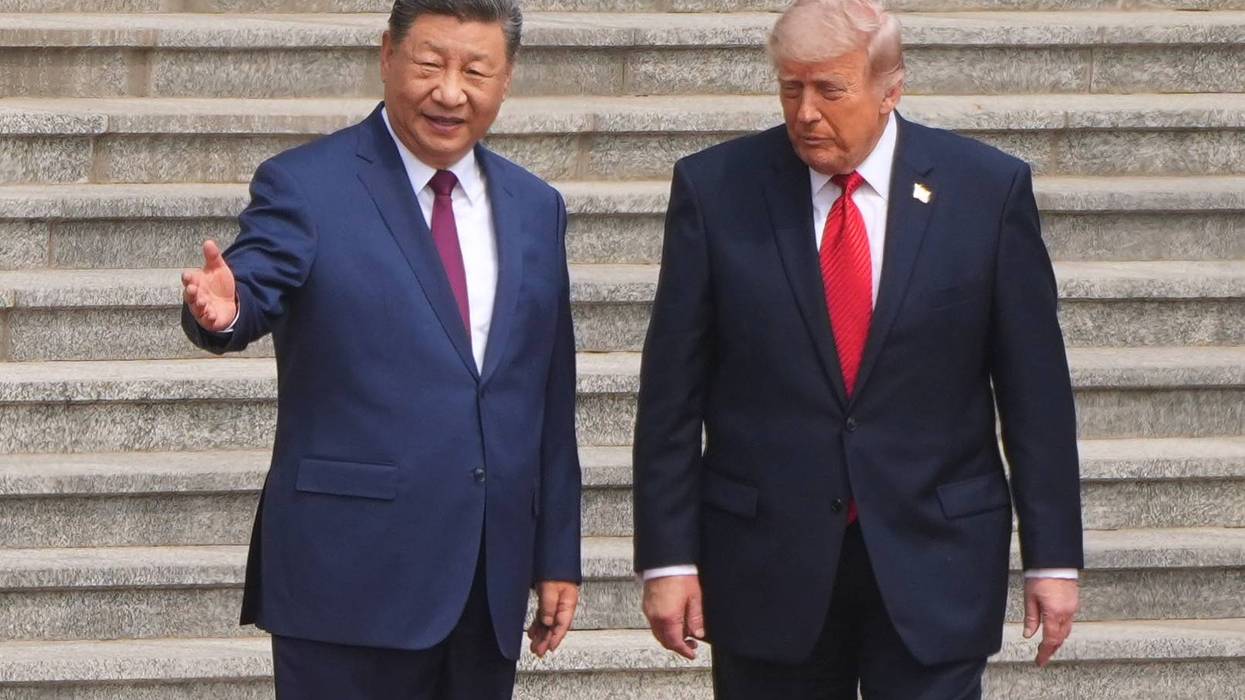
On the U.S. side, Trump will be welcoming Xi on Wednesday evening on the tarmac at Joint Base Andrews, a rare move that deviates from the typical protocol of waiting for leaders to drive up to the White House.
China reduces its economic reliance on the US, but the US is still dependent on China
The U.S. was China’s largest export market in 2015, accounting for nearly one-fifth of its $2.3 trillion in exports. Today, the U.S. remains China’s top export destination, but its share has slipped to 11% of China’s global exports, which rose to more than $3.7 trillion in 2025.
That’s because the U.S. is buying less from China due to higher tariffs, while the Asian country is shipping more goods to additional markets around the world to soften the blow of Trump’s trade war.
And China has moved up on the global value chain in manufacturing, widening the gap with the U.S.
In 2015, China launched a national strategy to pursue advanced manufacturing by investing in key sectors. It has helped China reduce dependency on imports in areas such as memory chips and medical devices, and it made Chinese companies competitive globally in industries from drones to electric vehicles, clean technologies and shipbuilding, according to an analysis last year by Rhodium Group, a research provider that tracks China's economy and policy.
“There’s an undeniable sense of China’s progress on the global stage,” said Kurt Campbell, a former veteran U.S. diplomat who is now chair of The Asia Group, a strategic advisory firm. “China is not arriving. It has arrived.”
Beefing up industry has meant China's military now poses a threat to the US
Beijing's manufacturing clout has turned into military strength.
Its shipbuilding power has allowed China to build the world's largest fleet by number of vessels, including a sophisticated aircraft carrier and advanced amphibious assault ships, said Matthew P. Funaiole, a senior fellow for the China Power Project at the Center for Strategic and International Studies.
But the U.S. Navy still has an advantage in overall tonnage and weapons systems, he said.
China has developed fifth-generation fighter jets and expanded the fleet to hundreds — it had none in 2015, according to a RAND report.
In 2019, China became the first country to land spacecraft on the far side of the moon, and it is operating one of the two space stations in orbit. It is the only other country besides the U.S. to have a space force.
China's military buildup “has made the U.S. homeland increasingly vulnerable,” according to the latest Pentagon report on China's military powers. “China maintains a large and growing arsenal of nuclear, maritime, conventional long-range strike, cyber, and space capabilities able to directly threaten Americans’ security.”
That was not the picture in 2015, when the Pentagon warned that “China’s military modernization has the potential to reduce core U.S. military technological advantages.”
Secretary of State Marco Rubio told reporters hours before Xi arrived that the two leaders must interact because the U.S. and China are “the two largest economies in the world” and “probably the two most powerful militaries in the world.”
And Trump, while he has slammed Democrats as communists in a tactic ahead of November’s midterm elections, now is looking to wow Xi, the leader of the world's most powerful communist country, in Washington.
Trump is greeting Xi planeside because of their “great relationship,” first lady Melania Trump told Fox News Channel’s “Fox & Friends.”
“He’s coming on our soil, and we need to welcome them with the most respect,” she said.
___
Associated Press journalist Kevin Vineys contributed to this report.