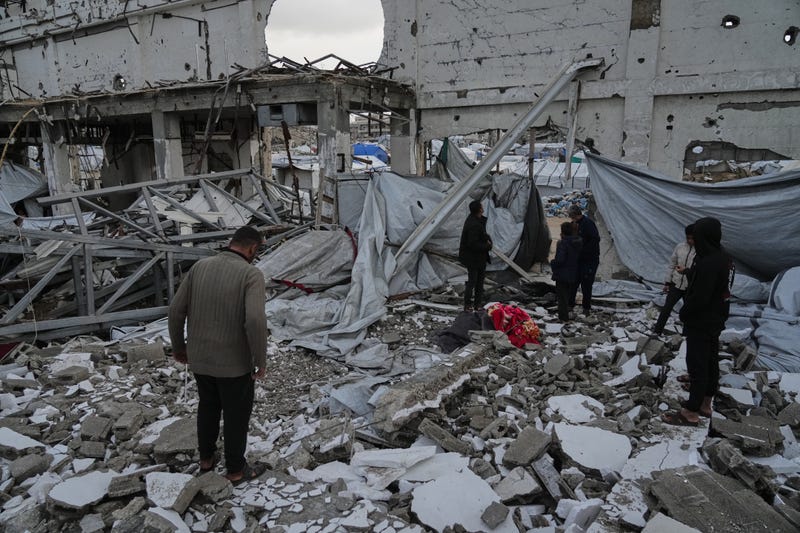
DEIR AL-BALAH, Gaza Strip (AP) — At least four people were killed overnight in Gaza after walls collapsed onto their tents from strong winds that lashed the Palestinian coastal territory, hospital authorities said Tuesday.
Dangerous living conditions persist in Gaza after more than two years of devastating Israeli bombardment and aid shortfalls. A ceasefire has been in effect since Oct. 10. But aid groups say that Gazans broadly lack the shelter necessary to withstand frequent winter storms.
The dead include two women, a girl and a man, according to the Shifa hospital, Gaza City’s largest hospital, which received the casualties.
Three of the dead were from the same family — 72-year-old Mohamed Hamouda, his 15-year-old granddaughter and his daughter-in-law. They were killed when an 8-meter-high (26-foot-high) wall collapsed onto their tent in a coastal area along the Mediterranean shore of Gaza City, the hospital said. At least five others were injured in that collapse.
Their relatives arrived Tuesday morning to remove the rubble and begin rebuilding the tent shelters for the survivors.
“The world has allowed us to witness death in all its forms,” Bassel Hamouda said after the funeral for his relatives. “It’s true the bombing may have temporarily stopped, but we have witnessed every conceivable cause of death in the world in the Gaza Strip.”
The second woman was killed when a wall fell on her tent in the western part of the city, the hospital said.
In the central town of Zawaida, Associated Press images showed inundated tents Tuesday morning, with people trying to rebuild their shelters.
Yasmin Shalha, a displaced woman from the northern town of Beit Lahiya, stood against winds that caused the tarps of tents to flap around her as she stitched hers back together with needle and thread. She said that it had fallen on top of her family the night before, as they slept.
“The winds were very, very strong. The tent collapsed over us,” the mother of five told the AP as she was sewing a sheet torn apart by the winds. “As you can see, our situation is dire.”
Mohamed al-Sawalha, a 72-year-old man from the northern refugee camp of Jabaliya, criticized the conditions that most Gazans endure.
“It doesn’t work neither in summer nor in winter,” he said of the tent. “We left behind houses and buildings (with) doors that could be opened and closed. Now we live in a tent. Even sheep don’t live like we do.”
The majority of Palestinians live in makeshift tents since their homes were reduced to rubble during the war. When storms now strike the territory, Palestinian rescue workers warn people against seeking shelter inside damaged buildings, saying they could fall down on top of them.
Aid groups say not enough shelter materials are entering Gaza during the truce.
Israel’s bombing campaign has reduced entire neighborhoods to rubble and half-standing structures. Residents aren't able to return to their homes in Israeli-controlled areas of the Gaza Strip.
The Palestinian territory's population of more than 2 million people have been struggling to keep the cold weather, including rain and severe storms, at bay, amid shortage of humanitarian aid and Israel’s ban of caravans that are badly needed during the winter months. It's the third winter since the war between Israel and Hamas started on Oct. 7, 2023, when militants stormed into southern Israel and killed around 1,200 people and abducted 251 into Gaza.
As of Monday, at least six children as young as seven days, died of hypothermia since the start of winter, according to the health ministry.
The ministry, part of the Hamas-run government, said that 442 people were killed by Israeli fire and their bodies brought to hospitals since the ceasefire went into effect just over three months ago. The ministry maintains detailed casualty records that are seen as generally reliable by U.N. agencies and independent experts.
___
Samy Magdy reported from Cairo.