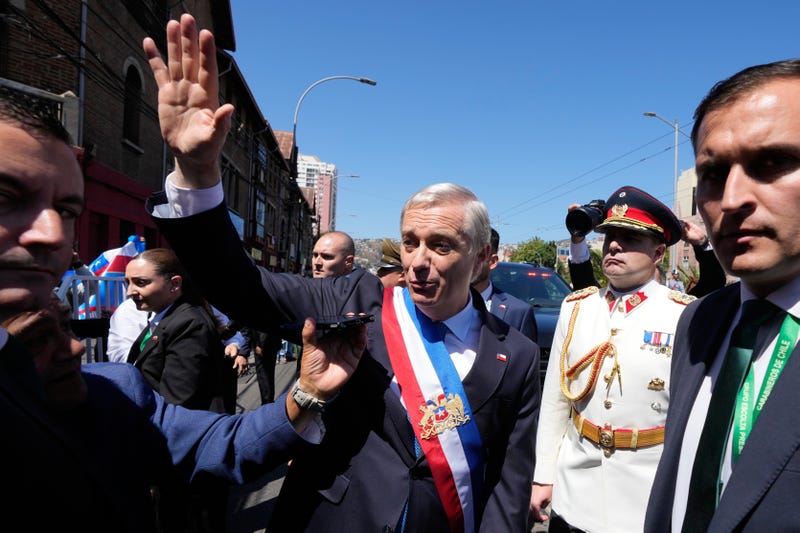
VALPARAÍSO, Chile (AP) — Far-right leader José Antonio Kast was sworn in as Chile’s new president on Wednesday, marking the Latin American nation’s most pronounced shift to the right since the return of democracy in 1990.
In a ceremony at the National Congress in the coastal city of Valparaíso and attended by dozens of heads of state, Kast and his Cabinet took the oaths of office after a landslide victory in the 2025 elections.
Among those attending the ceremony were Argentina’s President Javier Milei, Panama's President José Raúl Mulino, Ecuadorian President Daniel Noboa, and Spain’s King Felipe VI. Other guests included Nobel Peace Prize laureate María Corina Machado.
There were several high-profile absences, including Presidents Luiz Inácio Lula da Silva of Brazil and Nayib Bukele of El Salvador. A modest U.S. delegation was led by Deputy Secretary of State Christopher Landau.
After the newly appointed Senate President Paulina Núñez placed the presidential sash on Kast, the new Cabinet was sworn in. José Francisco Pérez Mackenna took the oath as chancellor, while María Trinidad Steinert became the minister of security and Fernando Rabat assumed office as minister of justice and human rights.
Gabriel Boric, a left-winger who in 2022 became Chile’s youngest president at 36, has left office as the worst-rated president since 1990, according to a survey published this week by the polling firm Cadem. More than half of those surveyed (53%) considered his government to be the worst since the return of democracy.
Kast, a Trump-inspired political veteran, won a landslide victory in December against government-backed communist candidate Jeannette Jara with the promise of fighting crime and curbing illegal immigration, a project that holds similarities to policies adopted by his U.S. counterpart.
A friend of Washington
Chile is the latest Latin American country to vote out an incumbent government, with voters backing right-wing leaders from Argentina to Bolivia as President Donald Trump looks to assert U.S. dominance in the Western Hemisphere, in many cases punishing rivals and rewarding allies.
While Kast has avoided commenting on controversial issues at home and abroad, he has made overtures to the Trump administration and praised the U.S. operation that culminated in the capture of former Venezuelan President Nicolás Maduro.
These signals intensified recently when Kast abruptly ended the transition process following a clash with outgoing Boric over a project to install a submarine cable to connect Chile and China. The project drew intense criticism from the U.S. and further deepened the diplomatic tensions between the Boric administration and Washington.
Relations between Chile and the United States have deteriorated significantly under the second Trump administration. Boric was a vocal critic of his U.S. counterpart, even characterizing the Republican’s leadership style as that of a “new emperor.”
Trump has openly signaled his preference for Kast over Boric, notably inviting Kast, then president-elect, to last weekend’s “Shield of the Americas” summit in Miami, which brought together several right-wing leaders in the region, including Bukele and Milei.
Organized crime and immigration in the spotlight
Kast narrowly lost the presidency in 2021 to Boric in the runoff election. At that time, his opposition to abortion and same-sex marriage — along with his praise of the legacy and figure of former dictator Gen. Augusto Pinochet — were largely rejected by Chileans.
Four years later his hard-line stance on crime and immigration won the support of about 60% of voters in a country hit by a rise in organized crime and disappointed by the great expectations that Boric raised but left unfulfilled.
Kast has praised the crime-fighting tactics of Bukele, even touring El Salvador's 40,000-capacity mega prison last year. He has also vowed to criminalize illegal immigration, intensify mass deportations and install “fences and walls” along Chile's borders.
First 100 days are key
Experts suggest the new administration’s responsiveness will be key in determining the government’s course for the next four years, as it will have to deal with a divided Parliament to ensure governability and advance its main projects.
“If there is volume, traction and a clear direction in the first 100 days, the political establishment generally seeks alignment or at least avoids hindering the administration’s priorities,” said Mariano Machado, an analyst with risk intelligence company Verisk Maplecroft. “If that clarity isn’t seen in the first 100 days … the opposite happens.”
___
Follow AP’s coverage of Latin America and the Caribbean at https://apnews.com/hub/latin-america