

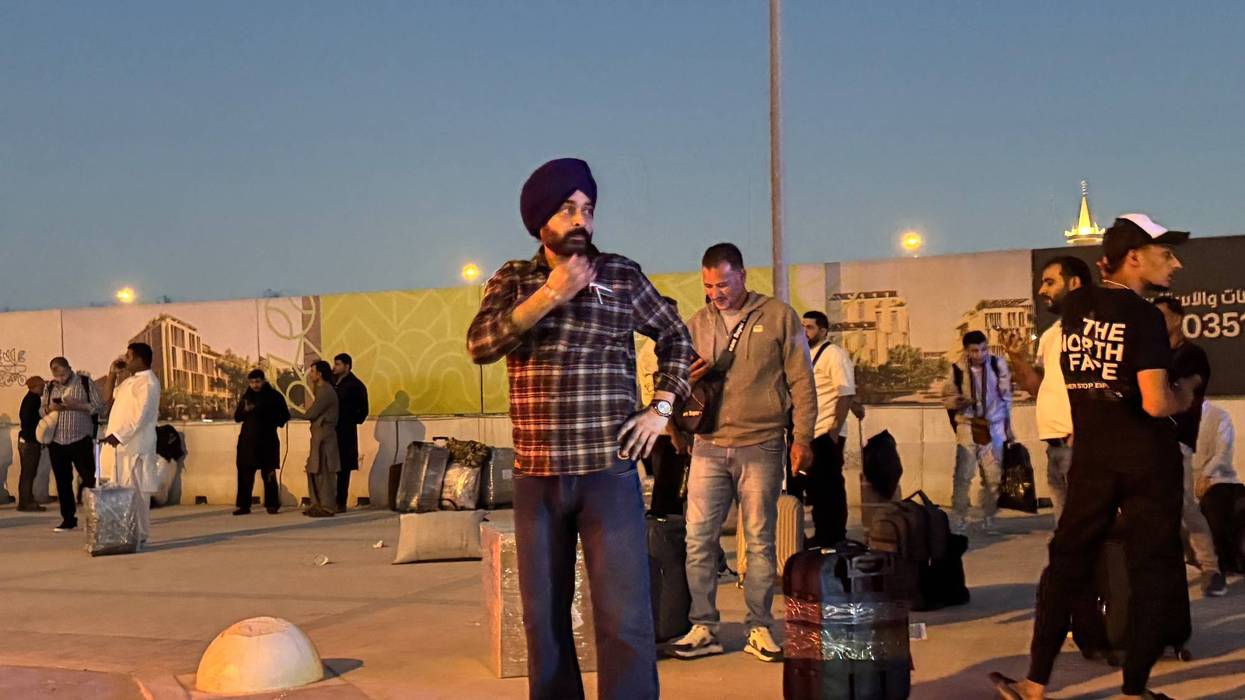

CAIRO (AP) — Saudi Arabia on Sunday extended the closure of its main international airport as Houthi rebels threatened airstrikes across the kingdom, a day after a missile attack killed 12 people and wounded more than 300.
Saturday’s strike on the Riyadh airport marked a major escalation of the war between Yemen’s Iran’s-backed Houthis and the kingdom. President Donald Trump said he was considering whether to join Saudi strikes against the rebels, a scenario that could prompt the Houthis to halt shipping through a crucial waterway and further restrict the flow of oil out of the Persian Gulf.
As international leaders spoke out condemning the attack Sunday, the Houthis reported that two airstrikes hit Yemen's capital, Sanaa, blaming Saudi Arabia. There was no immediate comment from Saudi authorities or reports of casualties.
The Houthi-run Health Ministry says 91 Yemenis have been killed and 168 injured by the Saudi-led coalition in five weeks. It said that 60% of those killed were women and children.
Houthis renew threats to Saudi Arabia
As Saudi authorities extended Saturday's airport closure until at least 9 p.m. Sunday, according to Flightradar24, the Houthis said the kingdom's airports were attack targets.
Brig. Gen. Yahya Saree, the group's military spokesman, urged “everyone to take our warnings seriously."
The latest attack on the Saudi airport drew condemnations from Arab countries, including Iraq, Lebanon and Syria, as well as U.N. Secretary-General Antonio Guterres and European Commission President Ursula von der Leyen.
“Attacks by Iran’s proxies are pushing the region into a spiral of violence," Von der Leyen wrote Sunday on X. “They are destabilizing crucial global transport and energy nodes."
Attack killed people of different nationalities
The attack struck an airport complex housing terminals 3 and 4 for domestic flights, a regional official said, speaking on condition of anonymity because they weren’t authorized to speak to the media.
The Saudi statement said the dead included four Saudi citizens, two Bangladeshi nationals, a Palestinian, a U.S. citizen, an Egyptian, a Jordanian, a Syrian and a Sudanese. It said several hospitals were treating the injured.
U.S. Secretary of State Marco Rubio acknowledged in a social media post that an American citizen had been killed in the attack, which he condemned.
The Egyptian woman was a flight attendant identified as Azza Ramzy, 28, who worked for the Saudi airline Flybas, according to the Egyptian state-run Al-Qahera New television.
Trump said he would consider joining strikes against rebels
The attack is expected to increase Saudi pressure on allies, including the United States, to provide military support for the kingdom.
Shortly after the attack, Trump said he was evaluating whether the U.S. should join Saudi strikes against the rebels. “We may. We’re going to look at it,” he said. “We just found out about the recent attack. So we’ll make a decision. We move very quickly.”
Trump said later Saturday he planned to speak with Crown Prince Mohammed bin Salman. Asked if the U.S. might get involved, Trump responded, “We’ll find out.”
The Houthis claimed attacks earlier in the week on King Khalid International Airport that killed three Saudis, including a pilot. The airport has no military facilities.
The surge in attacks, including against other Saudi airports, military facilities and oil infrastructure, has come in the week since a Saudi-led coalition launched a major military offensive against the Houthis.
Iran can use Houthis to pressure key US ally
Until recently, the Houthis had been largely on the sidelines of the Iran war. Now, the rebels are a way for Tehran to pressure a key U.S. ally. Houthi attacks, along with their control of the Bab el-Mandeb waterway, also threaten to add new disruptions to the flow of oil from the region.
The Saudis and the Houthis began fighting in 2015 when the kingdom entered Yemen’s civil war on behalf of the internationally recognized government.
Relative calm after a 2022 ceasefire ended in July when the Houthis resumed attacks, saying the Saudis fired on the Sanaa airport as a plane from Iran was trying to land. That revived anger over the Saudi-led blockade that has largely isolated Houthi-run areas.
Now fighting has escalated, with the Saudi-led coalition providing air support for Yemeni government forces attempting to reverse recent Houthi gains along the Red Sea. Those gains gave the rebels better surveillance of shipping on the Bab el-Mandeb, a corridor that is a crucial alternative to the Strait of Hormuz, where Iran has been attacking ships.
Saudi Arabia is running low on missile interceptors and has asked France, Britain, Pakistan and Egypt to deploy air defense support to the region, regional officials told The Associated Press last month, with one noting that the U.S. has seen its own stock dwindle during the war with Iran.
___
This report has been corrected to show that the Egyptian killed in the strike was a woman, not a man.
___
Associated Press writers Victoria Eastwood in Cairo, Collin Binkley in Washington and Sally Abou AlJoud in Beirut contributed to this report.