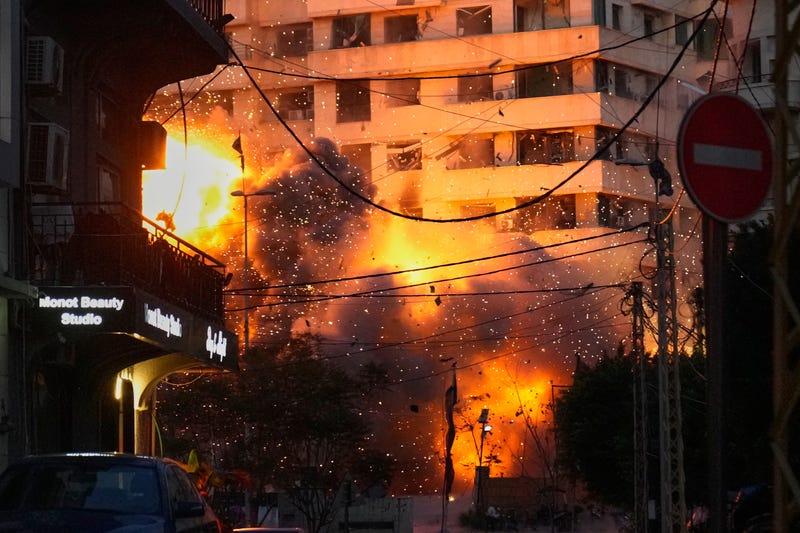
The Israeli military killed Iranian Intelligence Minister Esmail Khatib, the latest in a series of high-profile deaths of Iranian leaders that have worked to destabilize the nation’s institutions and industry. Israeli forces have also killed the nation’s top security official and the head of the paramilitary Revolutionary Guard’s all-volunteer Basij force.
Iranian Supreme Leader Mojtaba Khamenei expressed condolences for the killing of Larijani, according to a written statement published in Iranian media, saying, “All blood has its price that the criminal murderers of the martyrs must pay soon.”
The price of oil surged another 6% to over $109 per barrel on international markets, increasing the cost of gasoline and other goods, putting pressure on consumers and economies worldwide. Iran has made navigation through shipping channels in the Strait of Hormuz virtually impossible. The U.S. Treasury Department has eased sanctions on Venezuela in an attempt to boost world oil supplies.
Facilities associated with Iran’s massive offshore South Pars natural gas field came under attack Wednesday, state media reported. Qatar, which shares the gas field with Iran, later blamed Israel for the attack.
Top Trump administration national security officials are facing back-to-back congressional hearings starting Wednesday, where they are expected to be pressed on the war in Iran.
The U.S.-Israeli war with Iran has killed at least 1,300 people in Iran, more than 900 in Lebanon and 14 in Israel, according to officials in those countries. The U.S. military says 13 U.S. service members have been killed and about 200 wounded.
Here is the latest:
Israel strikes 2 more bridges in southern Lebanon
Israeli Defense Minister Israel Katz claimed Hezbollah was using the bridges over the Litani River to move fighters and smuggle weapons.
Wednesday’s strikes come as the Israeli military has sent more ground forces to the border with Lebanon.
Last week, Israeli strikes cut major roads and bridges in southern Lebanon, and Israel’s hard-line finance minister has threatened to make Beirut’s southern suburbs look like Gaza. The World Bank estimated the previous Israel-Hezbollah war cost Lebanon $6.8 billion in damage to physical structures.
Iran’s new supreme leader issues a rare statement offering condolences after Larijani’s killing
Ayatollah Mojtaba Khamenei’s written statement was published in Iranian media on Wednesday, a day after Israel said it killed Iran’s top security official.
“Undoubtedly, the assassination of such a person shows the extent of his importance and the hatred of the enemies of Islam towards him,” he wrote. “All blood has its price that the criminal murderers of the martyrs must pay soon.”
This is only the second statement issued in Khamenei’s name since he became supreme leader to replace his father, who was killed at the start of the war. Israeli and U.S. officials believe the younger Khamenei was wounded in that initial wave of attacks on Iran.
Death toll in Lebanon rises to 968
The number of people killed by Israeli strikes in Lebanon since the renewal of hostilities between Israel and Hezbollah has risen to 968 Wednesday, up from 912 the day before, Lebanon’s Health Ministry said.
The death toll includes 116 children and 77 women. More than one million people have been displaced in Lebanon by the conflict.
The Iran-backed Lebanese militant group Hezbollah launched missiles across the border into Israel on March 2, two days after the U.S. and Israel attacked Iran, triggering the widening war in the Middle East. Israel has responded with widespread bombardment and a ground incursion.
UAE denounces apparent Israeli attack on Iran’s gas field as ‘a dangerous escalation’
In a statement issued by the Foreign Ministry, the United Arab Emirates stressed that the targeting of energy infrastructure represents “a direct threat to global energy security.”
Vance says Trump officials are obligated to make president’s decisions as ‘successful as possible’
Vice President JD Vance made the comment in response to a question about the resignation of Joe Kent, the director of the National Counterterrorism Center.
Vance says Trump “welcomes differences of opinion” from everyone. “That said,” Vance said, “whatever your view is, when the president makes a decision, it’s your job to help make that decision as effective and successful as possible.”
If you can’t do that, Vance said, “then it’s a good thing for you to resign.”
The attack on Riyadh is a rare strike on the Saudi capital
Most previous Iranian strikes have hit in eastern Saudi Arabia, close to Iran and home to major Saudi oil installations.
The kingdom’s air defenses have intercepted most of the incoming missiles, but strikes have killed at least two migrant workers and an American soldier at an air base in Al Kharj.
UK says allies ‘nowhere near’ a plan to open Strait of Hormuz
A senior British defense official says a credible plan to ensure ships can safely pass through the Strait of Hormuz is still a long way off.
Iran has effectively shut the vital oil route since the U.S. and Israel launched attacks last month. Trump has veered between demanding other countries send ships to open the strait and saying the U.S. does not need allies’ help.
The British government says it is talking to allies around the world about options, and has sent a team of military planners to U.S. Central Command, which oversees military operations in the Middle East. But officials say discussions are at an early stage and focus on maintaining security after fighting has subsided.
U.K. Armed Forces Minister Al Carns said Wednesday the threat to shipping from Iran includes mines, fast attack boats, ballistic missiles, drones and other “asymmetric threats.”
He said it presents “a “significant military challenge” that requires “a multinational solution. We’re not anywhere near that at the moment.”
Vance: No risk that Trump would get US into long-term quagmire
Vice President JD Vance says there is no risk that Trump would get the U.S. into a long-term conflict in response to a question about the consequences of the war in Iran.
Vance gave the answer to a reporter after delivering remarks in Auburn Hills, Michigan, on Wednesday.
He said, “I guarantee that the president of the United States is not interested in getting us in the kind of long-term quagmires that we’ve seen in years past.”
He says he knows how Trump thinks about national security. “That is not a risk with this president at all.”
US national intelligence director puts Iran ‘imminent threat assessment’ on Trump
U.S. National Intelligence Director Tulsi Gabbard danced around questions from a Democratic senator about whether there was an imminent threat of a nuclear attack from Iran. She told Sen. Jon Ossoff that it wasn’t the intelligence community’s job to determine what is an imminent threat against the U.S. and put that responsibility on Trump.
“The only person who can determine what is and is not an imminent threat is the president,” Gabbard said.
Ossoff accused her of avoiding a direct answer “because to provide a candid response to the committee would contradict a statement from the White House.”
2 big explosions are heard in the capital of Saudi Arabia
The sky lit up over the Riyadh late Wednesday and an interceptor missile flew overhead.
There were no immediate reports of damage or casualties.
US drivers see gas prices jump to their highest level since 2023
“It’s pretty hard. I mean, times are tough for everybody right now,” Amanda Acosta, a Louisiana resident, told The Associated Press while filling up her car’s tank this week. “I’m getting way less gas and paying way more money.”
She isn’t alone. Pain at the pump has been one of the most immediate economic impacts of the conflict.
The U.S. is now a net exporter of oil, but that doesn’t mean America is immune to price spikes. And other parts of the world that rely more heavily of fuel imports from the Middle East, notably Asia, have seen starker energy shocks amid the war.
While the steep cost of crude oil is the top driver of gas prices today, a handful of other factors are also on the table.
Tensions flare along the Israel-Lebanon border
Plumes of smoke rising from Lebanese villages hit by Israeli bombardment could be seen from Israel’s side of the border Wednesday afternoon. Within Israeli territory, tanks massed in muddy lots near fields of yellow flowers.
The tense situation has remained largely unchanged from the day before. Overnight, a wave of Israeli strikes hit several neighborhoods in central Beirut and killed 10 people, the Lebanese Health Ministry said.
Unlike the last war with Hezbollah, most of the residents of northern Israel have stayed put, while in Lebanon, more than a million people have been displaced by Israeli strikes and evacuation orders. Hezbollah has fired waves of rockets and drones into Israel, sometimes with little or no warning.
A ship captains’ group says seafarers are ‘pawns’ in Iran conflict
The head of an international shipmasters’ organization says seafarers must not be used as “pawns in a geopolitical conflict,” as international diplomats meet to discuss the plight of thousands of vessels trapped by the Iran war.
The U.N.’s International Maritime Organization says more than 3,000 vessels and 20,000 seafarers are stuck in and around the Strait of Hormuz. At least seven crew members have been killed since the conflict broke out last month.
Capt. Andrew Cook, secretary general of the International Federation of Shipmasters’ Associations, said seafarers are “sitting on board a steel box, basically imprisoned, because they can’t get off the ship and the ship can’t move.” He said those on tankers are “surrounded by oil and gas. And some of them are being targeted by missiles. So it isn’t a great place to be right now.”
The International Maritime Organization is holding a two-day meeting in London to discuss the crisis.
CIA director doesn’t confirm that Iran could have threatened US with a missile in 6 months
CIA Director John Ratcliffe told lawmakers at a Senate hearing Wednesday that an unencumbered Iran could have developed missiles with a range of 3,000 kilometers (1,864 miles) that could strike Europe.
Ratcliffe also said Iran would have developed the ability to threaten the U.S. if it had continued to work on its booster technologies.
But the CIA director did not directly answer a question from Republican Sen. Tom Cotton of Arkansas regarding whether Iran could have had a missile to threaten the U.S. “in as few as six months.”
Ratcliffe told Cotton he was “right to be concerned.” But the CIA director did not provide a time frame for when Iran could have threatened Europe or the U.S. with a missile.
Days after launching the war, Trump administration officials told congressional staff in private briefings that U.S. intelligence did not suggest Iran was preparing to launch a preemptive strike against the U.S.
US national intelligence director avoids saying whether she warned Trump about fallout from attacking Iran
U.S. Director of National Intelligence Tulsi Gabbard dodged when asked by senators during a hearing about whether she had warned Trump about the likelihood of Iran attacking other Gulf nations and threatening ships in the Strait of Hormuz.
“I have not and won’t divulge internal conversations,” Gabbard said in response to questions from Democratic Sen. Mark Warner. “I will say that those of us within the intelligence community continue to provide the president with all of the best objective intelligence available to inform his decisions.”
Warner was clearly frustrated with Gabbard’s lack of a clear response and pointed repeatedly to Trump’s remarks that suggest he did not expect Iran to launch attack on other Gulf nations or close the Strait of Hormuz, which is vital for oil exports from the region.
Israel says 3 private aircraft were damaged in recent days by fragments of intercepted Iranian missiles
The aircraft at Israel’s Ben Gurion International Airport were damaged by shrapnel from the missile interceptions, according to Israel’s airports authority.
Airport traffic has been severely curtailed since the war started.
Iran confirms killing of intelligence minister
Iranian state television confirmed the killing of Khatib, who the U.S. sanctioned in 2022 for alleged cyber-related activities against the U.S. and its allies. Iranian President Masoud Pezeshkian calling Khatib’s killing “an unfair assassination.”
White House says Trump will waive Jones Act requirements for 60 days
It applies to goods shipped between U.S. ports to be moved on U.S.-flagged vessels. The 1920s law, designed to protect the American shipbuilding sector, is often blamed for making gas more expensive.
The moves highlight the increased pressure the Republican administration is under to ease soaring oil prices as the United States, along with Israel, wages a war with Iran without a foreseeable end date. Global oil prices have since spiked as Iran halted traffic through the narrow Strait of Hormuz, where one-fifth of the world’s oil typically passes through from the Persian Gulf to customers worldwide.
US eases Venezuela oil sanctions as Trump seeks to boost world oil supply during Iran war
U.S. companies will be allowed to do business with Venezuela’s state-owned oil and gas company after the Treasury Department eased sanctions, with some limitations, Wednesday as the Trump administration looks for ways to boost world oil supplies during the Iran war.
The Treasury issued a broad authorization allowing Petróleos de Venezuela S.A, or PDVSA, to directly sell Venezuelan oil to U.S. companies and on global markets, a massive shift after Washington for years had largely blocked dealings with Venezuela’s government and its oil sector.
The move highlights the increased pressure the Republican administration is under to ease soaring oil prices as the United States, along with Israel, wages a war with Iran without a foreseeable end date. Global oil prices have since spiked as Iran halted traffic through the narrow Strait of Hormuz, where one-fifth of the world’s oil typically passes through from the Persian Gulf to customers worldwide.
German leader says he doesn’t want war to burden trans-Atlantic relations
Chancellor Friedrich Merz told German lawmakers Wednesday “we’re speaking at all levels with Washington” and “seeking trans-Atlantic agreement.”
He stressed that Germany shares many U.S. aims “but we can’t and won’t shy away from telling our partners honestly where we see things differently and where we have different interests.”
Merz said he still has questions about the war in Iran and there is still “no convincing concept for how this operation could succeed.”
He noted that Washington “didn’t consult us and said European help wasn’t necessary … we would have advised against pursuing this road the way it has been pursued at present.”
Germany is among the countries that say they won’t contribute to a military mission in the Strait of Hormuz as long as the war continues.
Iran’s military vows to respond with force following attack on South Pars offshore natural gas field
“Targeting fuel, energy and gas infrastructure in the aggressor country is our legitimate right and we will respond with force as soon as possible,” Iran’s Khatam al-Anbiya Central Headquarters said in a statement.
US stocks fall under pressure from rising crude oil prices
U.S. stocks are slipping as another rise in oil prices raises worries about inflation, which may have already been primed to worsen even before the war with Iran began.
The S&P 500 fell 0.4% in early trading Wednesday and was on track for its first loss this week. The Dow Jones Industrial Average fell 237 points, and the Nasdaq composite fell 0.4%.
Stocks fell under the pressure of a 2% climb for the price of a barrel of U.S. crude. The Federal Reserve is widely expected to hold interest rates steady when its latest policy meeting wraps up later Wednesday.
White House calls Iranian intelligence minister’s death ‘a good thing’ for the US
Trump’s chief spokesperson, Karoline Leavitt, said Iranian Intelligence Minister Esmail Khatib was a “known terrorist.”
“Of course, this man is no longer with us here on earth,” she said during a morning appearance on Fox News Channel. “And that’s a good thing for the United States. And it’s a good thing for the American people who have long been threatened by this rogue terrorist regime.”
Israeli Defense Minister Israel Katz announced Wednesday that its military had killed Khatib.
Grossi says a return to US-Iran negotiations is unlikely while the conflict continues
International Atomic Energy Agency chief Rafael Grossi says he doesn’t believe Iran would be willing to return to nuclear negotiations with the United States until there’s a ceasefire and a halt to U.S.-Israel military operations and Iranian retaliation.
“It is not a moment to consider that as an immediate possibility,” Grossi told reporters in Washington on Wednesday. “For as long as there is a military campaign ongoing, I don’t think that there would be negotiations.”
Grossi took part in portions of the last round of Oman-mediated talks between the U.S. and Iran that were held in Geneva, Switzerland, shortly before the war began. He declined to comment on the substance of those talks.
IAEA chief says damage to Iran’s Bushehr nuclear site seems not ‘very significant’
The head of the UN’s nuclear watchdog says damage to Iran’s Bushehr nuclear site appears not to be ‘very significant’ and that a strike on the facility may have hit a small building containing a laboratory.
International Atomic Energy Agency chief Rafael Grossi told reporters in Washington on Wednesday that the IAEA had received information about the incident from Iran and from Russia that Bushehr was hit by a drone. He said it did not hit the actual power plant but landed on the premises.
“The reactors have not been affected and there are no casualties,” he said, adding that his agency had not yet been able to independently confirm the damage.
“We are looking at images but it doesn’t seem to be very significant,” he said. “At the same time, any attack on any nuclear facility should always be avoided.”
Qatar blames Israel for the attack on the natural gas field it shares with Iran
Qatar on Wednesday blamed Israel for an attack on an offshore natural gas field it shares with Iran.
The accusation came from Majed al-Ansari, a spokesperson for Qatar’s Foreign Ministry. The Iranian side of the field, the South Pars field, came under attack Wednesday and was burning.
Al-Ansari called the attack “a dangerous & irresponsible step amid the current military escalation in the region.”
“Targeting energy infrastructure constitutes a threat to global energy security, as well as to the peoples of the region & its environment,” he wrote on X.
“We reiterate, as we have repeatedly emphasized, the necessity of avoiding the targeting of vital facilities. We call on all parties to exercise restraint, adhere to international law, & work toward de-escalation in a manner that preserves the security & stability of the region.”
Iranian women’s soccer team returns to Iran after several sought asylum in Australia
Iranian media reported Wednesday that the national women’s soccer team has returned to the Islamic Republic after several of the players had sought asylum in Australia.
The outlets shared footage of the women entering Iran after landing in Turkey and taking a bus to the border. They were greeted by some officials at the border.
Two Iranian female players, Fatemeh Pasandideh and Atefeh Ramezanisadeh, chose to remain in Australia. Others who initially sought asylum later changed their minds.
Iran threatens energy assets in Saudi Arabia, Qatar and the UAE after attack on its gas facilities
Iran’s state television published a threat Wednesday, saying the Islamic Republic would be attacking oil and gas infrastructure in Qatar, Saudi Arabia and the United Arab Emirates.
The threat resembled other attack warnings put out by Iran during the war, copying the style used by the Israeli military.
Iran specifically threatened Saudi Arabia’s Samref Refinery and its Jubail Petrochemical Complex. It also threatened the UAE’s Al Hasan Gas Field and the petrochemical plants and a refinery in Qatar.
It comes after Iran said its South Pars gas field and associated infrastructure came under attack earlier Wednesday.
Iran wants to move its World Cup matches from US to Mexico. FIFA is sticking to its schedule
The public wrangling between Iran, FIFA and U.S. President Donald Trump over the narrative of playing in the World Cup shifted on Tuesday to Mexico where President Claudia Sheinbaum seemed open to a suggestion by Islamic Republic diplomats that Iran’s games in June be moved to her country.
The Iranian ambassador and embassy in Mexico City said the country was negotiating with FIFA to move Iran’s three group-stage matches from the United States to Mexico after Trump last week discouraged the team from attending the 48-nation tournament, citing safety concerns.
It was already unclear whether such talks were even happening before FIFA said such unprecedented changes in World Cup history weren’t planned to a match schedule agreed three months ago.
President Donald Trump will attend second dignified transfer in 3 weeks
He’s set to pay his respects on Wednesday at a Delaware military base when the remains of six U.S. service members killed in the crash of a refueling aircraft are returned to their families.
It will be the second time since launching the war on Iran on Feb. 28 that the Republican president will attend the solemn military ritual known as a dignified transfer, which he once described as the “toughest thing” he has had to do as commander in chief.
All six crew members of a KC-135 Air Force refueling aircraft were killed last week in a plane crash over friendly territory in western Iraq while supporting operations against Iran. They were from Alabama, Indiana, Kentucky, Ohio and Washington state.
The crash brought the U.S. death toll in Operation Epic Fury to at least 13 service members. About 200 U.S. service members have been injured, including 10 severely, the Pentagon has said.
UAE says 13 missiles and 27 drones fired on the country
The United Arab Emirates has reported 13 ballistic missiles and 27 drones fired Wednesday on the oil-rich nation.
Iranian state media says natural gas facilities attacked
Facilities associated with Iran’s massive offshore South Pars natural gas field came under attack Wednesday, state media reported.
Iranian state television and the state-run IRNA news agency reported on the attack targeting facilities at Asaluyeh in Iran’s southern Bushehr province.
They did not immediately elaborate.
Iran shares the offshore field in the Persian Gulf with Qatar, which it has repeatedly attacked during the war along with other Gulf Arab nations.
It wasn’t clear if Israel or the United States had carried out the attack, however the U.S. has been operating primarily in southern Iran.
The U.S. previously attacked Iran’s Kharg Island in the Persian Gulf, its main oil terminal.
At least 8 killed in Iran courthouse airstrike
At least eight people were killed in an airstrike on a courthouse complex in Iran’s Larestan County on Wednesday, according to Iran’s official judiciary news agency Mizan.
The head of the Fars province judiciary told Mizan that one lawyer, six clients and a member of the judicial staff were killed, but the agency reports the exact number of those killed and wounded is not yet known.
Israel says strikes targeted Hezbollah-linked financial institution
The Israeli military said it hit branches of al-Qard al-Hasan, a Hezbollah-linked microfinance institution that Israel says is being used to fund the group’s military wing.
A wave of Israeli strikes overnight hit several neighborhoods in central Beirut and killed 10 people, the Lebanese Health Ministry said.
Israel also said its navy targeted Hezbollah militants in Beirut.
French envoy bashes Hezbollah and Israel
France’s special envoy for Lebanon, Jean-Yves Le Drian, speaking to the France Info radio station Wednesday, said the Iran-backed Lebanese militant group Hezbollah “bears full responsibility for the resumption of fighting in Lebanon” but “Israel’s response has been disproportionate and counterproductive, as it unites various actors against Israel.”
He criticized Israel for mass evacuation orders that have driven the displacement of more 1 million people in Lebanon and for spurning offers by the Lebanese government to enter into negotiations.
Israel and the U.S. have criticized the Lebanese state for failing to disarm Hezbollah after the last Israel-Hezbollah war ended with a ceasefire in November 2024. Le Drian said the state had taken steps toward disarmament.
“Israel occupied Lebanon for many years and did not succeed in eliminating Hezbollah’s military capabilities,” Le Drian said. “It cannot now demand that the Lebanese government achieve this in three days under bombardment.”