


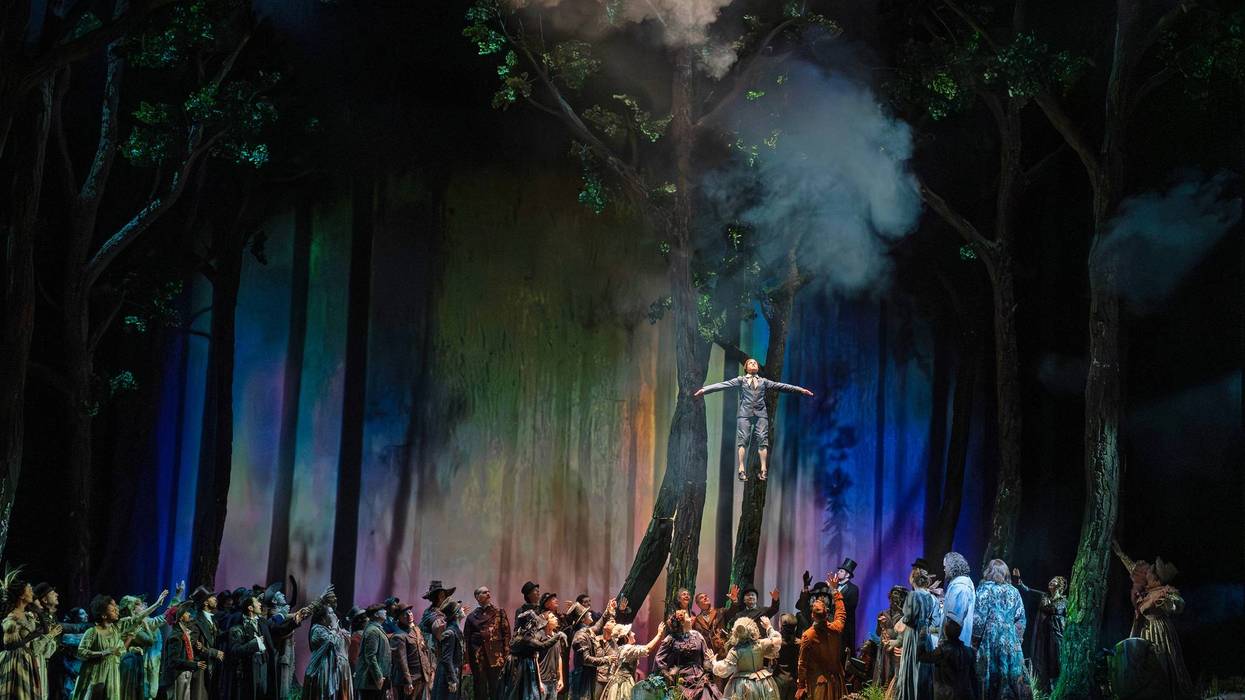

NEW YORK (AP) — The setting is a graveyard. Almost all the characters are dead. And then there’s Abraham Lincoln, alive but paralyzed by grief over the death of his 11-year-old son.
If that capsule description makes “Lincoln in the Bardo” sound like a grim night at the opera, it’s actually far from that, according to its creators.
“It does seem quite heavy,” said Royce Vavrek, who crafted the libretto for composer Missy Mazzoli from George Saunders’ Booker Prize-winning novel. “But it’s also so effervescent, quite hilarious at times. There’s such heartbreak, and such joy.”
The inspiration behind both the novel and the opera is the concept of the bardo, which in Tibetan Buddhism is the period between physical death and rebirth.
They're dead, but they don't know it
The ghosts populating Georgetown’s Oakhill Cemetery refuse to accept the circumstances — often abrupt or violent — that ended their lives.
They refer to their coffins as “sick-boxes,” and only when they are able to acknowledge their true state can they find peace, vanishing in a spectacular explosion of fireworks for which Saunders (in what he calls “a little bit of a nod to James Joyce”) invented the term “matterlightblooming.”
Through the course of the opera we learn many of the characters’ life stories, which range from inspiring to tragic to ridiculous.
“The opera honors that life is not all doom and gloom,” said Lileana Blain-Cruz, who is directing the work for its world premiere at the Metropolitan Opera. “People have desires and hungers, and we’re silly and we’re funny. There’s something wonderful about encountering the fullness of life in all these characters.”
Into this netherworld come Willie Lincoln, a victim of typhoid fever, and his distraught father, who pays a late-night visit to his son’s crypt and cradles the boy’s body in his arms. By the end of the opera, Willie has accepted the fact that he is dead, and Lincoln leaves the cemetery, ready to take up his burden guiding the nation through the Civil War.
Writing music for a dead child
For Mazzoli, the biggest challenge in composing the score was the fact that it deals with the death of a child.
“When I’m writing, there’s a period of years where I’m alone with these characters,” she said. “I really tried to inhabit the character of this boy, but it’s hard to enter that place every day.”
She solved the problem by focusing on the end of the story, when Willie realizes that since he is dead he is freed from earthly constraints.
“He sings this incredible aria where he says ‘all is allowed me now,’” Mazzoli said. “‘Now that I’m dead I can go down to the party, I can fly out the window, I can hang from the chandelier, I can drink rum.’
“He’s found this beautiful way of looking at it, and he sort of awakens the other dead people in the cemetery to this,” she said. “I had to find this positive slant so I wouldn’t be crushed by the sadder parts of the story.”
A first for soprano Christine Goerke
The opera opens Oct. 19 with Met music director Yannick Nezet-Seguin conducting and will run for nine performances. Baritone Peter Mattei stars as Lincoln, and, in a bit of gender-switching, soprano Christine Goerke is the Reverend and counter-tenor Anthony Roth Costanzo is Miss Elise Traynor.
Goerke, one of her generation’s leading dramatic sopranos in operas by Wagner and Richard Strauss, said she was thrilled when Mazzoli told her she had her in mind to play the Reverend.
“I have waited my whole life to have a role written for me,” she said. “It’s the most meaty, spectacular role.”
Vocally, it encompasses her full range (“There’s a moment where I go from high C down two octaves!” she said.) And it’s dramatically challenging as well. Unlike the other ghosts, the Reverend knows he is dead but resists his fate because he’s had a vision that he’s doomed to eternal damnation. In the end, he makes a heroic sacrifice that may redeem him.
Mazzoli’s score has its moments of playfulness, starting with the prologue in which the chorus members blow into kazoos.
“I’m interested in non-virtuosic instruments in virtuosic settings,” she said. “I’m sure there are people who are really good at the kazoo, but anybody can pick it up and blow into it and make a noise. And I like that in the context of the Met, and in combination with really skillful singing.”
Blain-Cruz and her production team have made sure there’s plenty for the eye to feast on, from pyrotechnics to puppetry, to a black mustang named Zeus who carries a Lincolnesque figure back toward the White House at the final curtain.
This is the sixth collaboration between Vavrek and Mazzoli and comes close on the heels of the world premiere of “The Galloping Cure,” which got rave reviews in Edinburgh and will have its U.S. premiere in San Francisco next season. Met general manager Peter Gelb promises there will be more Mazzoli at the Met in years to come.
As for Saunders, he’s not quite done with “Lincoln.” He’s written the screenplay for a feature film version directed by Duke Johnson that combines live action and stop motion and will star Tom Hanks in the title role.