




CLEVELAND, Ohio — The Cleveland Cavaliers entered Friday night’s matchup with Milwaukee focused on one thing: generate more scoring chances from three-point range.
If the game were only 24 minutes, the Cavaliers would have succeeded admirably after connecting on eight first half triples and taking a 63-60 lead into the half.
But the Bucks surged in the fourth quarter, dominating the Cavaliers in the rebounding department on their way to a 123-105 win on Friday night at Rocket Mortgage Fieldhouse.
“We made some mistakes and we put our heads down,” Cavaliers head coach J.B. Bickerstaff said. “What we’re learning and understanding is you watch them play, if you score on them they get the ball out quickly and they move on to the next possession. They score on us, the ball bounces, head down. We play slowly out of the gate.”
Cleveland connected on eight of 19 three pointers I n the first half and went 11-for-32 for the game one night after launching just ten 3s against the Clippers on Wednesday night. The Cavaliers knew they could be in for a shootout against Milwaukee, who came into Friday night’s matchup hitting 21 three-pointers in each of their past two games.
“In the second half we went back to some of those tougher twos,” Bickerstaff said. “But I thought overall we did a better job generating those 3s. We didn’t make as many in the second half but I thought we generated them the right way and I thought they were good shots.”
However, it was Milwaukee that struggled out of the gate. The Bucks missed their first seven 3s, marking the first time the Bucks failed to knock down a triple in the first quarter all season. Milwaukee’s first shot from downtown didn’t come until the 7:26 mark of the second quarter. The Bucks shot just 31.8 percent (7-for-22) from three point range on the night.
While the Bucks struggled from deep, they more than made up for it from close range. Milwaukee scored 74 points in the paint and out-rebounded the Cavaliers 55-36 on the night.
“You’re playing against a championship caliber team who understands the importance of each possession in pressure filled moments,” Bickerstaff said. “They limit their mistakes, they attack the paint and the rim more.”
The Bucks collected 14 offensive rebounds and translated that edge to 18 second chance points.
Still, the Cavaliers entered the fourth quarter within striking distance, trailing by five points.
But the Bucks, and more specifically their two-time MVP Giannis Antetokounmpo gradually wore the Cavs into submission.
Collin Sexton paced the Cavaliers with 19 points and Andre Drummond added 18 points and nine rebounds. Jarrett Allen and Isaac Okoro each added 13 points.
“I think they broke our spirit. That was what I saw,” Bickerstaff said. “They made us pay for mistakes and they keep coming. I thought we lost some of that determination in the fourth quarter.”
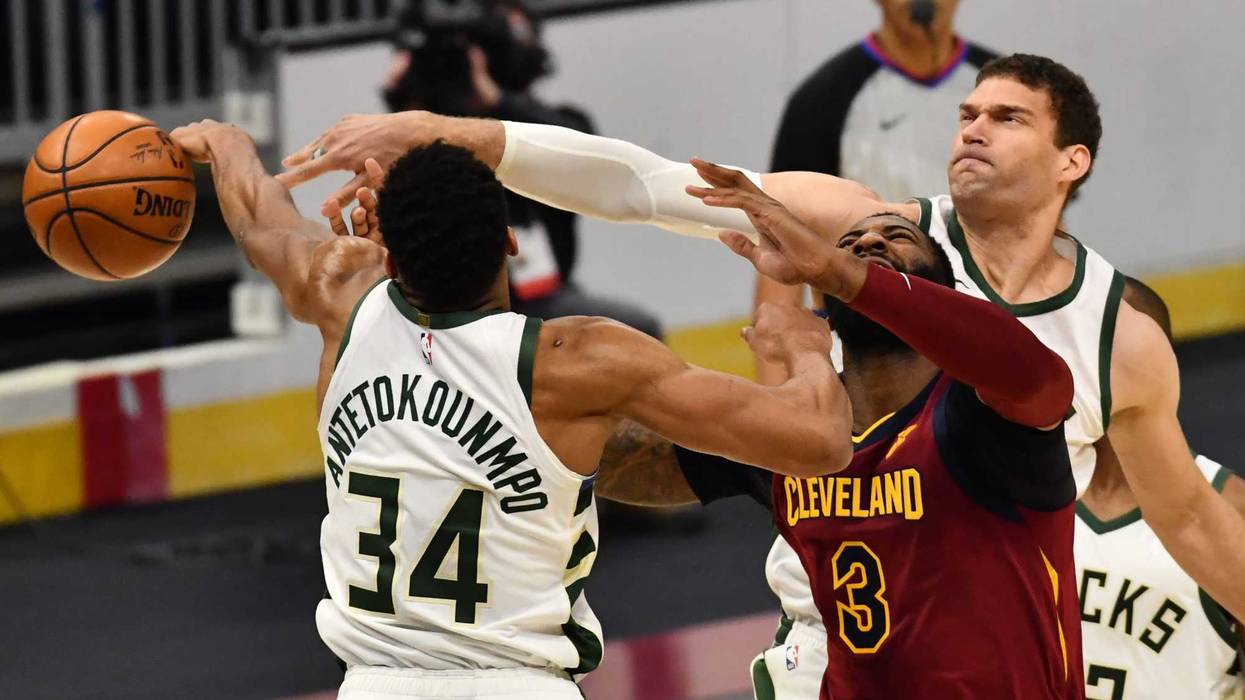
Milwaukee’s slow start mirrored their superstar. Giannis collected three early fouls and had 11 points at halftime. But the man colloquially known as the Greek Freak poured in 22 of his game-high 33 points the second half. Asserting his dominance with a sequence in the third quarter that saw him stuff a shot attempt by Andre Drummond and immediately follow it up with a dunk at the other end of the floor.
“I feel like tonight we worried too much about mistakes,” Sexton said. “Once they scored it took forever taking the ball out. If they score, let’s hit the baseline and let’s go.”
Collectively, the Cavaliers struggled to shake off the Bucks consistent attack.
“We start trying to make home run plays. That’s the best word for both ends of the court. We try to make the home run switch, block steal or pass,” Allen said. “I think if we just slow it down and play our game that we were playing in the first three quarters, that will (continue) to the end.”
Giannis left the game late in the third quarter because bleeding from his right leg. He came back in with 8:59 left in the fourth quarter and immediately knocked down a three.
The Bucks pulled away from there.
“We had the process right. We came in knowing exactly what we needed to do. We came in executing what we needed to do,” Allen said. “There’s still a lot of things we need to work on, we need to implement those. We have a lot of the full picture drawn in, we just need to sketch the rest of it.”