


THE NFL DRAFT REPORT PRESENTS
THE 2019 NFL DRAFT QUARTERBACK ANALYSIS - PART 1
This is The NFL Draft Report’s series dealing with the 2019 National Football League Draft Quarterback Class. Part One provides readers with a bit of draft history at the position. The NFL has placed a great reliance on developing quarterback talent over the years, with 1,065 signal callers being drafted since the draft's inception in 1936, including 166 passers who enjoyed hearing their names called during the first round.
Part Two will closely examine some of the higher rated quarterbacks projected as potential first two days of draft round selections. It also features a look at the quarterback talent in the major Power-Five conferences. Part Three will take a look at a group of sleepers who could be nice finds during the third and fourth days of the draft procedure.
The spread offense is more prevalent than ever before in college football and as a result, evaluating the quarterback position has become increasingly more difficult than in the past. Scouts must poke and prod to project how a player will acclimate to the pro game and (usually) a significant system change. It’s also important to note that young signal callers are getting less time than ever to prove they are capable of leading an NFL offense.
THE NFL’S QUARTERBACK DRAFT INFATUATION
Among the 1,065 quarterbacks to be drafted, that figure included 703 signal-callers entering training camp since the two leagues officially merged in 1970 and 759 chosen since both leagues agreed to hold a universal draft beginning in 1967. Since the turn of the century in 2000, 236 of these quarterbacks have heard their names called on draft day.
That group of passers includes 166 first round choices used since 1936, with 113 coming after the merger (1967) and 53 joining the league since the year 2000. Within that opening round collection, 34 have been the top overall selection during their respective draft year, including four that earned Hall of Fame distinction.
Twenty other quarterbacks were the second choice in their respective drafts, sixteen others were taken with the third pick, eleven were the fourth selection and ten were the fifth player taken in their respective drafts, followed by eight with the seventh pick, three with the eighth choice, two with the ninth and seven with the tenth selection.
Among the first round quarterbacks are thirteen that eventually ended up earning Hall of Fame honors, including eight that were chosen within the first four selections. The measuring stick for elite quarterbacks – at least in the first round – has been Peyton Manning. Taken with the top pick in the 1998 draft by the Indianapolis Colts, among all first round quarterbacks, he leads that group in games played (266), games started (265), most victories (189), most pass completions (6,125), most pass attempts (9,380), most touchdown passes (539) and most yards passing.
John Hadl (tenth pick in the 1962 draft by Detroit) holds the dubious honor for throwing the most interceptions (268) among the first round passers - Manning ranks fifth on that chart with 251. Only nineteen first round quarterbacks have completed 2,500 passes during their career, while only eleven have attempted at least 5,000 throws. Ten signal-callers accounted for 250 touchdown tosses, but outside of Manning, only Miami’s Dan Marino (27th choice in 1983) has reached the 400-TD level (420).
Twelve of those first round quarterbacks have accounted for at least 40,000 yards passing. However, outside of Manning (71,940) and Marino (61,361), the only other first round picks to tally at least 50,000 aerial yards are Denver’s John Elway (51.475 yards; 1983-98), the top overall choice by Baltimore in 1983 before forcing a trade to the Broncos; Pittsburgh's Ben Roethlisberger (56,194; 2004-present), the Giants' Eli Manning (55,981; 2004-present) and the Chargers' Philip Rivers (54,565; 2004-present). Those three 2004 first round draftees have combined for 166,831 yards passing.
Fifteen of these passers have recorded at least 200 interceptions. Behind Hadl, the only other quarterbacks with at least 250 interceptions are Manning (251), Marino (252), Norm Snead (1961 second overall pick by Washington, 257 thefts) and Vinny Testaverde (Tampa’s top pick in 1987, 267).
As for mobile quarterbacks, Michael Vick (top pick by Atlanta in 2001) leads the first round group with 6,109 yards rushing. Carolina's Cam Newton (2011-present) leads all first round passers with 58 touchdown runs, followed by Hall of Famer, Otto Graham (fourth choice in 1944 by Detroit; played from 1946-55)), who reached the end zone 44 times on the ground.
Being a first round quarterback does not lead to entitlement. Excluding the six quarterbacks selected in the opening round of the 2018 draft, twenty-two first round choices at the position played no more that fifteen games before their careers ended, including five that appeared in less than ten contests and two that never reached the playing field – Harry Agganis, the 12th overall pick by Cleveland in 1952, and New York Titans’ fifth overall choice in 1962, Sandy Stephens.
Whether he gets another chance to play in this league, or not, perhaps the most polarizing first rounder in recent years is Cleveland’s castoff, Johnny Manziel, the 22nd pick in the 2014 draft. His off-field issues left him with a 2-6 record as a starter, throwing for seven touchdowns and seven interceptions before getting the boot. He later appeared for two teams in the Canadian Football League in 2018, but was recently banned from playing up North due to violations from the agreement he signed in order to compete.
Don Allard was the fourth overall pick by Washington in 1959, but he appeared in just five games and never threw a pass before quitting after the 1962 season. San Francisco guru, the late Bill Walsh, missed the target badly with his first round selection of Jim Druckenmiller in 1997. In two season, the Virginia Tech grad had one touchdown and four interceptions in six appearances.
Rich Campbell went to Green Bay with the sixth pick in 1981, but never started the seven games he played in through the 1984 schedule. Bobby Garrett appeared in nine games and gained 143 yards passing after he was the top overall choice by Cleveland in 1954. Outside of Druckenmiller, the other first round quarterbacks to start only one game during their careers were the Rams’ Terry Baker )top pick in 1963), who lasted eighteen games as a reserve through three seasons and Stan Heath, the fifth overall pick by Green Bay in 1949 who appeared in twelve contests during that lone season in the league.
The first round quarterback to perform in at least 100 games with the least amount of starts was Rice’s King Hill, the top overall pick in the 1958 by the Chicago Cardinals. He moved with the team to St. Louis before playing in Philadelphia and Minnesota. He compiled a 7-22-1 record as a starter, generating 5,553 yards passing that included 37 touchdowns and 71 interceptions from the 1958-69 seasons. In Part Three of the Quarterback Position Analysis, I will examine the top performers to enter the draft at each of the other rounds.
DELVING INTO THE 2019 NFL DRAFT CONTROVERSY
NEVER DOUBT THE 6-FOOT QUARTERBACK
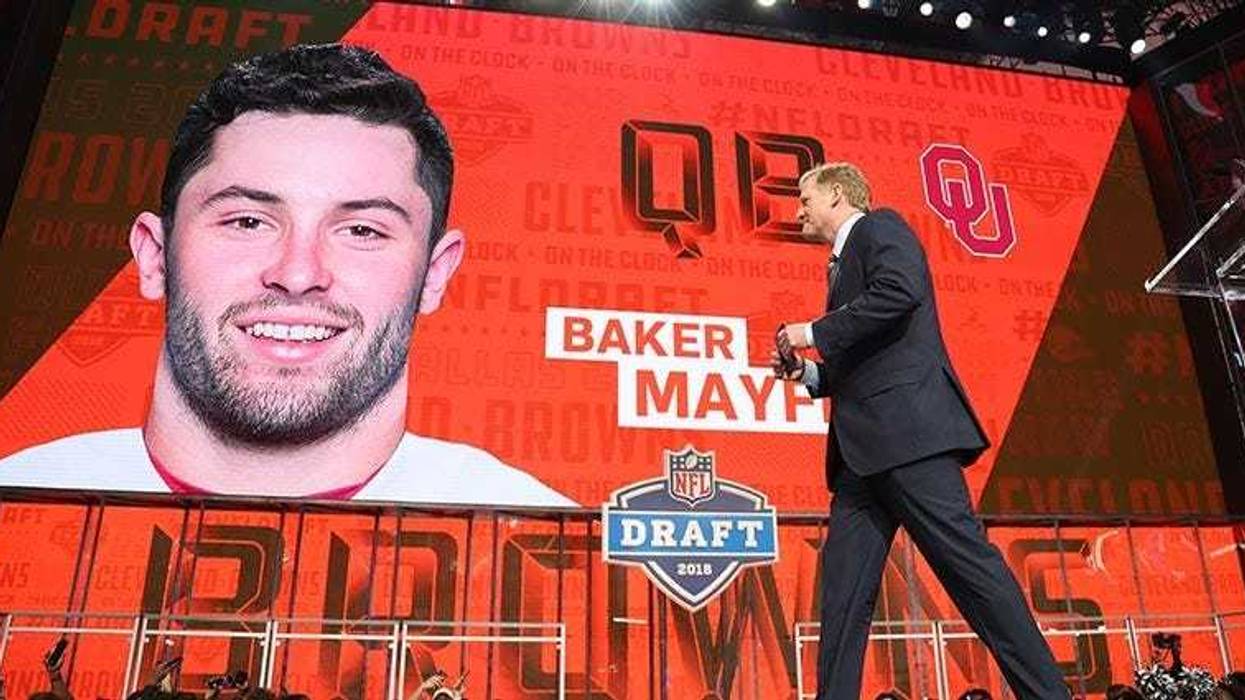
For the football fan following the draft, more often than not, he will hear a reporter talking about a quarterback's "measurables" that seem to hold more water in evaluating players at the position, rather than that athlete's production. For college quarterbacks that measure under six-feet, two-inches, they will also see pro scouts who are generally wary of their height. What Baker Mayfield accomplished by being the top overall pick in the 2017 is not unprecedented (see Michael Vick), it is also extremely rare to see a short quarterback become the first-round selection.
How rare? In the last thirty years, NFL teams selected sixty-nine quarterbacks in the first round. Only four were listed at six-feet, one-inch or shorter: UCLA’s Cade McNown (6:01 in 1999), Virginia Tech’s Michael Vick (6:0 in 2001), Florida’s Rex Grossman (6:0 in 2003) and Texas A&M’s Johnny Manziel (6:0 in 2014). Shorter quarterbacks don’t often get much love in the middle or later rounds, either. In the last decade, NFL teams selected 118 quarterbacks overall, only ten of whom were six-feet, one-inch or shorter.
The most successful under 6:01 quarterback from that list is Seattle's Russell Wilson. A third round choice in 2012, the 5:11 mobile passer has 96 starts and a Super Bowl victory to his credit. In 2011, Baltimore drafted current Cleveland Browns starting quarterback, Tyrod Taylor in the sixth round. The 6:01 passer was later sent to Buffalo and takes over first unit duties for the Browns boasting 43 starting assignments as a pro. 6:01 Colt McCoy was a third round choice in 2010, but later left the Browns for Washington, where he is currently a back-up, but has twenty starting assignments. The others? Out of the league or holding on to a roster spot as a third-string hopeful.
THE TALE OF THE TAPE FOR OKLAHOMA'S KYLER MURRAY
Perhaps the most polarizing player in the 2019 draft class, the Heisman Trophy winner has received a fair amount of praise for his performance in 2018, but he has also seen quite a few join those criticizing Kyler Murray, more so for what he has done away from the football field than on it.
Prior to the June 2018 Major League Baseball Draft, Murray assured general managers that he was fully committed to playing professional baseball. The Oakland Athletics believed the then back-up
quarterback was going to bypass the gridiron for a career on the baseball diamond, selecting him with the ninth overall pick. The outfielder had shown potential, batting .296 with ten home runs, 47 RBI and 10 stolen bases that season, a vast improvement from his 2017 college season, when he struggled to a .122 average through twenty-seven games.
Most other baseball organizations discounted the possibility of Murray ever playing the sport professionally, especially after he announced that he would return to school in 2018 to become the starting quarterback, and eventual Heisman Trophy winner, for Oklahoma. A's decision maker Billy Beane believed that Murray's desire to play baseball in the future had raised his draft stock from being a mere flyer to a serious prospect, as Beane surprised most observers by taking him so high.
Not everyone was convinced he was truly bent on giving up football, after being one of the top players in the country since his high school days.
However, within a couple of days of drafting him, the A's announced that the two sides had agreed on contract demands. A's scouting director Eric Kubota explained his team's decision to draft him thus: "I think, as a staff, we just felt like Kyler was a unique talent, and it's something that you come across rarely in what we do. The risk of the football was, in our opinion, outweighed by the upside on the baseball field."
Murray had reached that "sports crossroads" in the past, as he decided to not enter the 2015 MLB draft while coming out of high school to concentrate on playing football. At Allen (Tex.) High School, the consensus five-star recruit led his team to three straight state titles, as he never lost a game as a starting quarterback (43-0). He rolled up 14,500 rushing and passing yards and totaled 186 touch-downs in his three seasons. He went on to become the first player ever selected to play in Under Armour All-American games for both football and baseball.
Murray first enrolled at Texas A&M, the university where his father, Kevin, starred as a running back
(1983-86) and finished career holding virtually every season and career passing record. Kevin was also inducted into Texas A&M Athletic Hall of Fame in 1999 and the Cotton Bowl Hall of Fame in 2012. His son lasted eight games at the school, starting three of the eight games he appeared in during the 2015 season.
That year, Murray connected on 59.5% of his tosses (72-of-121) for 686 yards, five touchdowns and seven interceptions, adding 335 yards and a score on 63 carries (6.3 ypc). He then transferred to Oklahoma, sitting out the 2016 campaign before backing up 2017 Heisman Trophy winner, Baker Mayfield.
With Mayfield having been selected first overall by Cleveland in the 2017 draft, the Oakland A's granted him permission to return to school and play football in 2018. He would go on to have a banner season, as the consensus All-American completed 260-of-377 passes (69.0%) for 4,361 yards, 42 touchdowns and seven pass thefts. He also rushed for 1,001 yards and twelve scores, joining Clemson's Deshaun Watson (4,104 yards passing, 1,105 rushing in 2015) as the only players in NCAA Football Bowl Subdivision annals to pass for at least 4,000 yards and run for at least 1,000 yards in the same season.
Having ease some concerns about his height and weight at the 2019 NFL Scouting Combine (checked in at 207 pounds and measured 5:10.1), Murray breaks the mold for teams that generally feel a tall quarterback was designed by the football gods. The Sooner has shown good long ball accuracy, as he led the nation with an average gain of 11.58 yards per pass attempt. Among the draft eligible passers, he ranks seventh with an average depth-of-target gain of 11.66 yards.
Only late round/free agent, Taryn Christion (107.9) recorded a better passer rating than Murray's 103.3 when under pressure, as the Sooner completed 37-of-66 of those attempts with six scoring strikes. Like Penn State's Trace McSorley, Murray did not fare as well when having to air the ball out, as he ranked 18th in the deep passing category, hitting on just 49.35% of those chances (38-of-77) for 1,468 yards and sixteen touchdowns, but five of his seven interceptions came from tossing the long ball. Working with much more inferior receivers, McSorley only completed 20-of-59 deep passes (33.89%).
Murray is a shorter quarterback prospect with adequate bulk on his frame, but it is his athleticism that truly stands out. He has that blazing speed and impressive elusiveness to escape pressure and create big plays running through tight quarters. He is no by a strong athlete, but more like a speedy outfielder, but that burst allows him to accelerate well once he gains a step. With over 1,000 yards rushing, he can certainly create with his legs once he gets into the open field.
Murray also displays enough short area quickness to make things happen, but his lack of bulk and power could lead to injury issues vs. massive NFL defensive linemen. For his size, he showcases a solid arm, as he can spin a clean football, snap his wrist to generate torque and can get the pigskin down the field. His deep ball troubles begin when he fails to keep a natural base.
Size issues are evident vs. a big defensive line, forcing Murray to bounce up and down in order to see over the line of scrimmage. When he does have a clean throwing lane, he's very accurate with the football, showcasing natural rhythm for the passing game. Known for his ability to be a creative passer on the move, he will miss on his long throws and his accuracy will suffer when he doesn't stay balanced with his base.
When Murray is pressured, he has the ability to gain huge chunks of yardage on the ground (averaged 7.1 yards as a collegian). He's also conscious of protecting the ball, turning it over via fumbles just twice last season. When he looks for the "home run," he can be effective, but there are times, mostly due to his height, that he struggle to find secondary receivers in their routes. He does exhibit a good feel for twists and stunts, keeping his eye level down the field to side-step pressure without much effort and he's also a tough cookie who will deliver the throw in the face of a rush.
THE TALE OF THE TAPE FOR PENN STATE'S TRACE McSORLEY
Fortunately for Penn State's Trace McSorley, he has that rare skills that teams want from their signal caller - mobility - when the arm can't deliver, it is "feet, don't fail me now" as a scrambler running out of the backfield. Much like 2001 draft top pick, Michael Vick, and Seattle's Russell Wilson, McSorley is a valid weapon as a runner. He’s slippery enough when flushed from the pocket, but you also see that Drew Brees-like pinpoint accuracy when he has to move the chains.
McSorley has a gift for sensing pressure, escaping and resetting elsewhere before delivering an accurate pass. That ability to create new passing windows helped, as he was not playing behind one of the better offensive lines in the game the last two seasons. His ability to secure the ball and head up field, or roll out and throw on the run saw him deliver great success against the bigger opposing defenders.
While McSorley's running skills are obvious, he is not another Michael Vick. He shows patience and the flare for spotting the impossible window opening to get the ball to his receivers, much like Drew Brees, who is closing in on nearly two decades of success. Thanks to Brees and Wilson, they have proven that a short pro-style passer can succeed in the league. “Good players figure it out,” Denver Broncos coach Vance Joseph said of Brees.
Like Mayfield, McSorley has an NFL-caliber arm, just not one that will go for the "home run" on every play. He is a quick decision-maker who get the ball out quickly and has every bit of the toughness a pro club would want from its quarterback. Beyond that, he possesses one of the most important traits of a great quarterback: accuracy.
While speaking with NFL.com’s Albert Breer for his story “Searching For the Next Great QB,” Atlanta Falcons offensive coordinator Steve Sarkisian recalled talking shop with legendary San Francisco 49ers coach and noted quarterback guru Bill Walsh once when Sarkisian was a Pete Carroll assistant at USC. Walsh hinted that personnel execs sometimes fall in love with a prospect’s measurables at the expense of his most desirable skills.
“Everyone goes to the (combine), they tell me how tall he is, they tell me how much he weighs, they tell me how big his hands are, how long his arms are,” Sarkisian recalled Walsh saying. “They tell me how high he jumps and how fast he runs. I go into these meetings with our scouts, and they tell me how strong his arm is, they tell me about the offense they had. And all I want to know is, when he throws the ball, does he throw it where the receivers catch it?”
After three productive seasons at Penn State, McSorley continues to prove his doubters wrong. Yes, his height might not be ideal, but it’s obviously not a disqualifier. It all comes down to the perfect fit, one that suits the Nittany Lion's many skills - the West Coast scheme, which is centered around a quarterback's ability to quickly assess and deliver accurate midrange throws. Just ask Joe Montana (6:01), or Steve Young (6:00) how Bill Walsh put that scheme in place for his future Hall of Famers.
Young even commented on his stature during a recent interview. "I’m only six-feet tall," the former 49er noted. "My football card says 6-foot-2, and in shoes I really am 6-2, but it was a dream to be 6-2 because “6-foot” and “quarterback” don’t go together well in the NFL because everybody else is 6-5, 6-6, 6-7. Many times I would drop back to pass, look for Jerry Rice, and see nothing but bodies in front of me. So I would start to run around to get visibility. And then, inevitably, I would be tackled and sacked for a loss. And the coach would say, “Steve, Jerry Rice was open. You were protected. Why didn’t you throw the ball?”
“Couldn’t see him.” And then the great comment back: “You’d better start seeing him.” It was really all about perspective, or lack of perspective, and how I had to learn to throw it blind. I wasn’t going to grow. I couldn’t put springs on my feet. There were no stilts, no high heels. The perspective was what it was. So I dealt with it by saying to myself, “I just saw Jerry Rice. I know where he’s going. I’m going to throw it anyway.”
The insistence of prototypical height and weight at the quarterback position has always been of grave interest, in a sort of macabre, self loathing sort of way. We all know the score. 6:04, check. 225 pounds, check. Big hands, check. Let’s draft him! Many quarterbacks have probably missed out on having a shot at the NFL, purely because of their height. Of course, NFL scouts are known for the thorough approach to identifying talent, so putting it all on how tall a guy is probably a bit obtuse, but I think it will be interesting none the less.
In a recent organizational study, every league quarterback who has started at least sixteen games in the last three years were examined in these categories; Tall (6’4" or more); Medium (6’2"-6’3"); Short (6’1" and under). Taking into consideration their season averages for pass completion percentage; touchdown pass made; interceptions thrown; amount of times they were sacked; times they turned the ball over via fumbles, the study revealed;
Short (6'01" and under)...57.0% completion, 15.3 touchdowns/10.7 interceptions, 23.1 sacks, 7.1 fumbles for an average
Medium (6'02" to 6'03")...61.2% completion, 18.6 touchdowns/12.6 interceptions, 25.8 sacks, 6.4 fumbles for an average
Tall (6'04" and over)...62.2% completion, 18.6 touchdowns/11.7 interceptions, 28.2 sacks, 8.1 fumbles
BUILDING THE PERFECT QUARTERBACK
Every team seems to have a different view of what they envision happening behind center. Most general managers will tell you a strong arm, impressive size and bulk, along with decent mobility is what they want as their starting quarterback. West Coast schemes seem to veer away from the pro-style passer, preferring a savvy leader with great feet to escape pressure. These are the chain-moving types, with less mistakes than those that live, or die, by the deep passing game.
Instincts are the key ingredient for any successful passer and if you can find one with highly functional intelligence, like the Saints' Drew Brees, you have a quick-decision type of field leader who can efficiently move the chains. Much like Brees, Russell Wilson and Baker Mayfield are making team decision makers notice one trait - size is not really an issue - if you can escape pressure and think on the fly.
Still, a quarterback with a strong thinking process can usually create something out of nothing. The ability to run a pro-style offense, setting protections and making the right progression reads "trumps" those that simply rely on a big, strong arm. Of course, while you want a decisive quarter-back, you also want an accurate one. Just because an athlete is blessed with a strong arm, it does not mean he can be consistent hitting his receivers in stride and be creative when the plays break down.
Peripheral vision is also critical, as the quarterback must be alert to not only his receivers coming open, but also recognize pressure and have the ability to avoid it. The success that Patrick Mahomes displays is because of his ability to know when to step out of the pocket. Some of his no-look passes and his ability to vary his arm angles has made him the new "measuring stick" for teams trying to locate their next franchise quarterback.
The Chief's creativity and ability to throw running out of the pocket made him just one of three quarterbacks to ever throw for 5,000 yards and fifty touchdowns in a season. A mobile quarterback with the ability to make plays under duress - whether with his arm or feet - has made Mahomes one of the most successful and creative passers in the industry.
Coming In Part 2 of the 2019 Quarterback Class Analysis - the Quarterbacks expected to be drafted during the first three rounds.
NFL draft analysis provided exclusively to 92-9 The Game courtesy of The NFL Draft Report...