


THE NFL DRAFT REPORT PRESENTS
THE 2019 TIGHT END CLASS
The tight end position has evolved over the years, thanks to ingenious offensive minds like Weeb Ewbank and Al Davis who incorporated it into their offenses in the early days of the American Football League. The New York Giants, with Joe Walton, the Chicago Bears, with Mike Ditka and Ewbank's Baltimore Colts, with John Mackey, were the first to bring the position to the forefront in the NFL in the late 1950s, but it was Davis' penchant for the "big man" catching the ball with the Silver & Black that added an exciting fan element to the game.
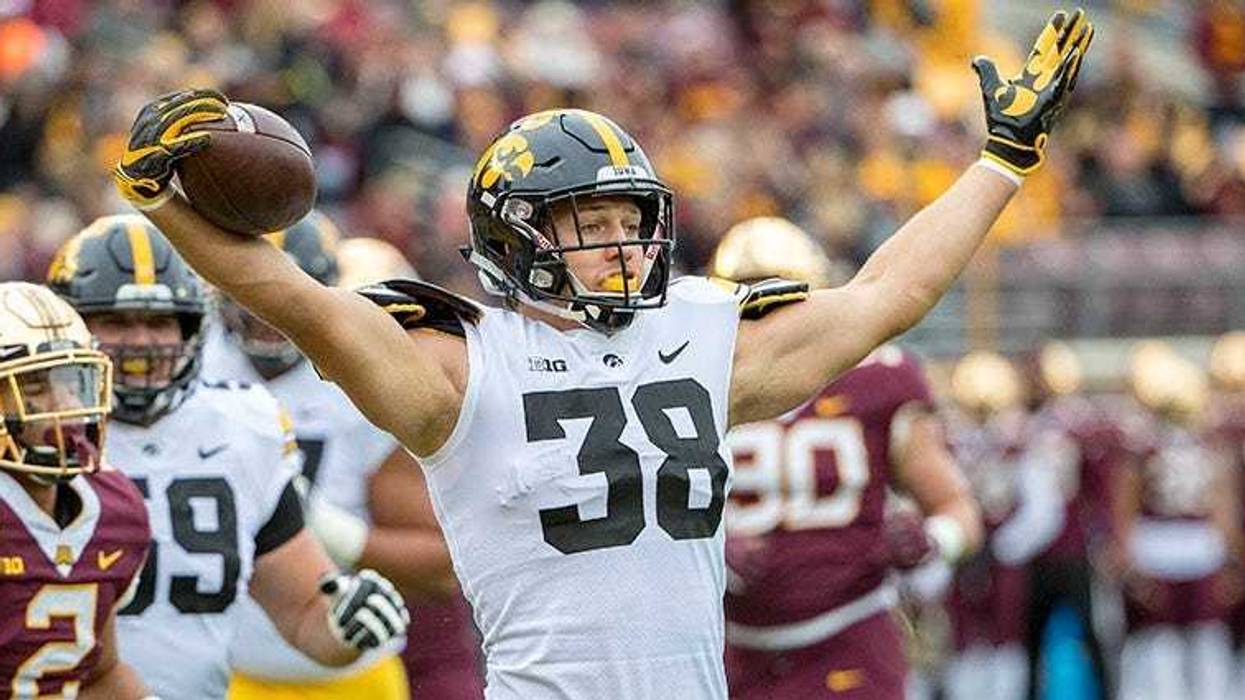
Mackey, often called the "complete tight end," has been honored as such, as one of the most prestigious awards in college is named in his honor, given to the top tight end in the NCAA. It has been my honor to serve on the committee that selects the player to be given that honor. This year's recipient, T.J. Hockenson of Iowa, is not only the highest rated offensive draft prospect on The NFL Draft Report's overall ratings chart, but he is regarded by our staff as the finest tight end to come out of college since the turn of the century.
THE TIGHT END LEGEND
While Mike Ditka gained more popularity, as any old-time football executive to name the best tight end in the game and they will say John Mackey. Modern era favorites at the position saw Tony Gonzalez become the new benchmark, but before he suited up for the Kansas City Chiefs and Atlanta Falcons, a certain New York native was the position's measuring stick.
Mackey was drafted from Syracuse University by the Baltimore Colts in the 1963 NFL Draft. He went on to play a total of ten NFL seasons as tight end, and became known for his size and speed. He played his first nine seasons with the Colts before leaving the team in 1971. He enjoyed his final season with the San Diego Chargers, retiring at the end of the 1972 season. Although a knee injury forced him into early retirement, Mackey only missed one game in his whole career. During his ten seasons in the NFL, Mackey scored 38 touchdowns and caught 331 passes for 5236 yards.
Mackey played in Super Bowl V on January 17th, 1971. He was involved in a famous game-changing play where he caught a record-setting 75 yard pass from quarterback Johnny Unitas after the ball was deflected twice, once by fellow Colts player Eddie Hinton and once by opposing Dallas Cowboys defenseman Mel Renfro. Baltimore won the game 16–13, following a 32-yard field goal by Jim O'Brien with five seconds left.
During his playing career, Mackey played in five Pro Bowls, including in his rookie season. He was also named All-NFL three times. In 1992, Mackey was inducted into the Pro Football Hall of Fame, becoming only the second pure tight end to be awarded this honor. He has been included in several lists of great NFL players. In 1999, The Sporting News ranked Mackey at 48 on their list of "The 100 Greatest Football Players." He also placed at number 42 on the NFL Network's list of the "Top 100 Football Players" in 2010.
In 2001, the John Mackey Award was established by the Nassau County Sports Commission. The award is given yearly to the top college tight end. On September 15, 2007, Mackey's alma mater, Syracuse University, retired number 88 in his honor.
In 1970, Mackey became the first president of the National Football League Players Association following the merger of the National Football League and the American Football League. Although the NFL and AFL each had a candidate for president in mind, Mackey emerged as the leader both sides could agree on. Mackey held the position of president until September 1973.
In his first year as president, Mackey organized a strike following a lockout by owners, with NFL players seeking additional pension contributions and insurance benefits, as well as higher pre- and post-season pay. The strike resulted in increased fringe benefits for NFL players totaling more than $12 million. According to former teammate Ordell Braase, Mackey "had a vision for that job, which was more than just putting in time and keeping the natives calm. You don't get anything unless you really rattle the cage." In 1972, Mackey became the lead plaintiff in a court action which led to the overturning of the so-called "Rozelle Rule," which limited a player's ability to act as a free agent. In 1976, the Rozelle Rule was ruled to violate antitrust laws in Mackey v. NFL.
THE BIRTH OF THE TIGHT END POSITION
According to Wikipedia, the advent of the tight end position is closely tied to the decline of the one-platoon system during the 1940s and '50s. Originally, a rule (derived from the game's evolution from other forms of football) limited substitutions. Consequently, players had to be adept at playing on both sides of the ball, with most offensive linemen doubling as defensive linemen or linebackers, and receivers doubling as defensive backs. At that time, the receivers were known as either ends or flankers, with the end lining up wide at the line of scrimmage and the flanker positioned slightly behind the line usually on the opposite side of the field.
As the transition from starters going "both ways" to dedicated offensive and defensive squads took place, players who did not fit the mold of the traditional positions began to fill niches. Those who were good pass catchers and blockers but mediocre on defense were no longer liabilities; instead, a position evolved to capitalize on their strengths. Many were too big to be receivers yet too small for offensive linemen. Innovative coaches such as Paul Brown of the Cleveland Browns saw the potential of having a larger receiver lined up inside, developing blocking techniques and passing schemes that used the unique attributes of the tight end position.
Greater use of the tight end as a receiver started in the 1960s with the emergence of stars Mike Ditka and John Mackey. Until then most teams relied on the tight end's blocking as almost a sixth offensive lineman, rarely using them as receivers. In addition to superb blocking, Ditka offered great hands receiving and rugged running after a completion. Over a 12-year career, he caught 427 passes for over 5,800 yards and 43 touchdowns. Mackey brought speed, with six of his nine touchdown catches in one season being breakaways over 50 yards.
Starting in 1980 the Air Coryell offense debuted tight end Kellen Winslow running wide receiver-type routes. Tight ends prior to Winslow were primarily blockers lined up next to an offensive lineman and given short to medium drag routes Winslow was put in motion to avoid being jammed at the line, lined up wide, or in the slot against a smaller cornerback.
Former Chargers assistant coach Al Saunders said Winslow was "a wide receiver in an offensive lineman's body." Back then, defenses would cover Winslow with a strong safety or a linebacker, as zone defenses were not as popular. Strong safeties in those times favored run defense over coverage speed. Providing another defender to help the strong safety opened up other holes.
Winslow would line up unpredictably in any formation from a three point blocking stance to a two point receiver's stance, to being in motion like a flanker or offensive back. Jon Gruden referred to such multi-dimensional tight ends as "jokers", calling Winslow the first ever in the NFL. Bill Belichick notes that the pass-catching tight ends that get paid the most are "all direct descendants of Kellen Winslow", and there are fewer tight ends now that can block on the line.
In the 1990s, athletic Shannon Sharpe's prowess as a route-runner helped change the way tight ends were used by teams. Consistently double-covered as a receiver, he became the first tight end in NFL history with over 10,000 career receiving yards. Tony Gonzalez and Antonio Gates pushed the position toward near wide receiver speed and power forward basketball skills.
At 6-feet, 6-onches, Rob Gronkowski brought height, setting single-season tight end records in 2011 with 17 touchdowns—breaking Gates' and Vernon Davis' record of 13—and 1,327 receiving yards, surpassing Winslow's record of 1,290. Jimmy Graham that season also passed Winslow with 1,310 yards. Six of the NFL's fifteen players with the most receptions that year were tight ends, the most in NFL history. Previous seasons usually had at most one or two ranked in the top.
In the Arena Football League the tight end serves as the third offensive lineman (along with the center and guard). Although they are eligible receivers they rarely go out for passes and are usually only used for screen passes when they do.
However, in Canadian football, tight ends are, in general, no longer used professionally in the CFL, but is still used at the college level in U Sports. Tony Gabriel is a former great tight end in Canadian football. There remain some tight ends in use at university level football; Antony Auclair, formerly a tight end for the Laval Rouge et Or, was a contender to be selected in the 2017 CFL Draft or possibly receive a tryout in the NFL. He was drafted by the CFL's Saskatchewan Roughriders in 2017, but instead signed with the NFL's Tampa Bay Buccaneers as an undrafted free agent that same year.
THE TIGHT END BOOK OF LISTS
Since the draft's inception in 1936, teams did not officially draft a tight end until the 1949 phase, when Joe Ethridge from Southern Methodist was selected in the sixth round with the 54th overall pick by Green Bay. In his lone season with the Pack, he played in twelve games, starting twice, but never caught a pass.
The next player to be designated as a tight end in the draft was Thurlow Cooper of Maine, a 16th round choice by Cleveland in 1956. However, he never played in the NFL, joining the New York Titans (later called the Jets), where he appeared in 41 games from 1960-62, making 36 catches for 491 yards and eight touchdowns.
Currently, NFL teams have utilized 978 draft selections to select players at the tight end position, as 740 of them eventually appeared in an NFL game. 83 of those drafted appeared in less than ten games. Of those drafted, two second- and third-round choices, six fourth-rounders, 11 fifth-round selections, 17 six round picks and thirty seventh round choices never appeared in an NFL game. The rest of the non-participants were chosen in rounds eight through twenty.
The latest round that a tight end was drafted was in the 20th round of the 1961 draft, when Philadelphia took Colgate's Jaque MacKinnon. He would play from 1961-70, seeing the field in 118 games that included 32 starting assignments. He finished with 86 carries for 381 yards and a pair of scores while also snaring 112 passes for 2,109 yards and twenty more touchdowns.
The latest pick used on a tight end was in 1976, when Cal Poly-San Luis Obispo's Ray Hall went in the 17th round to Green Bay with the 467th selection. In fact, 34 tight ends have been selected from picks #400-467. One of those plus-400n selections is actually in the Hall of Fame, in Cooperstown. In 1973, in the 17th round, Minnesota used the 429th overall pick to take Minnesota native Dave Winfield as a tight end. Another sport required that he wear a batting helmet rather than a football one.
Among that group, just Bobby Nichols of Boston University (#440 in 1967 by the AFL's Boston Patriots; appeared in fifteen games from 1967-68, catching one pass for 19 yards), Boy Brown of Alcorn State (#432 in 1974 by Denver, playing in 46 games from 1974-77, but had just one catch for 14 yards) and Jerry Zawadzkas of Columbia (#401 in 1967 by Detroit, playing in two games with no catches that year).
Throughout NFL history, eleven tight ends have appeared in at least two hundred games, including Hall of Famers, Tony Gonzalez (270, second on the list), Jackie Smith (210) and Shannon Sharpe (204). The position leader is Trey Junkin, a fourth round selection by Buffalo in 1983, he appeared in 281 contests, but started just four times before retiring in 2002. Known for his special teams coverage skills, he posted fourteen catches 144 yards and seven touchdowns.
Junkin is joined by Jeff Robinson (Denver fourth round pick in 1993, played from 1993-2009, 202 games with eighteen starts, catching 28 passes for 278 yards and eight scores) and Brian Jennings (seventh rounder by San Francisco in 2000, played in 208 games as a deep snapper, never catching a pass) as the only 200-game tight end performers with less than 200 receptions during their careers.
CHECKING THE BIRTH CERTIFICATES
Three players, age twenty, are the youngest tight ends ever drafted by an NFL team. The first was in 1972, as Dallas used the 338th overall pick (round 13) to draft Jean Fugett out of Amherst. From 1972-79, he played in 103 games, catching 156 passes for 2,770 yards and 28 touchdowns. A.J. Ofodile left Missouri to join Buffalo as a fifth round choice in 1994. He played in 24 games during three seasons, but injuries limited him to 25 yards on five catches.
That duo was joined by another twenty year-old, when the late Aaron Hernandez went to New England in the fourth round of the 2010 draft. He played until 2012, making 175 receptions for 1,956 yards and eighteen scores. On the other end of the birthday cake, Jordan Akins was the oldest tight end ever drafted. The 26-year old Central Florida prospect went to the Houston Texans as a third rounder in 2018, pulling in seventeen tosses 225 yards, but did not reach the end zone.
THE CREAM OF THE CROP
The 500-Reception Club enjoys fourteen members from the tight end class, including Hall of Fame selections Tony Gonzalez, Shannon Sharpe, Kellen Winslow and Ozzie Newsome. Gonzalez holds the tight end pass catching record with 1,352 snatches while Jason Witten (Dallas; 2003-17, 19) is the only other tight end with at least 1,000 grabs (1,152). Sharpe has 815 grabs while Greg Olson (666) of Carolina, Newsome (662) and Jimmy Graham of Green Bay (611) are the only other tight ends to inch past the 600-catch level.
A little more than being "mile-high" club members, just nine tight ends have gained at least 7,000 yards receiving, including Hall of Famers, Gonzalez - who leads the position with 15,127 yards - Shannon Sharpe (10,060 yards), Ozzie Newsome (7,980) and Jackie Smith (7,918). The only other tight end with at least 10,000 yards (12,448) is Jason Witten. Rob Gronkowski, who recently retired, gained 7,861 yards. The other three members are all currently active - Greg Olson has gained 7,847 yards, followed by Vernon Davis (7,439) and Jimmy Graham (7,436).
Twelve tight ends have registered at least fifty touchdown catches during their careers, with Gonzalez again head-&-shoulders over the rest with 111 scoring grabs. Gronkowski is a distant second with 79 touchdowns and Jimmy Graham leads all active tight ends with 71. Shannon Sharpe took 62 touchdowns with him to the Hall of Fame, where Canton resident, Dave Casper tallied 52 scores. The only others with at least sixty touchdowns are Witten (68), Vernon Davis (62) and former Redskin Jerry Smith (60).
Greg Olson is third among active tight ends with 57 touchdowns and former San Francisco 1989 second rounder, Wesley Walls, reached the end zone 54 times. Former Hawkeyes and Colts All-Pro Dallas Clark scored 53 times on 505 catches and Ben Coates tallied fifty touchdowns during a career that began with the Patriots in 1991. Except for Sharpe (seventh round), Jerry Smith (ninth) and Coates (fifth), all members of the 50-Touchdown Club went during the first three rounds of the draft.
NOT ALL FIRST ROUND SELECTIONS PAN OUT
No matter how much scouting, game film analysis and player reports placed on the general manager's desk plays importance for his decision, not every executive will hit a "home run" using their first round draft picks. Based on first round tight end selections, here is a little bit about the best and worst at this position:
Games Played...In the 1997 draft, Kansas City selected Tony Gonzalez with the 13th overall pick and to date, his 270 games played are the most for a first round tight end.
The least amount of games by a first round tight end was the twenty-nine recorded by San Francisco's seventh overall pick in 1978 - Notre Dame's Ken McAfee. He did start 25 times in two seasons, making 46 catches for 471 yards and five scores, though.
Receptions...As will be his pattern among the "most/best" in the tight end class, Gonzalez leads all first round tight ends and all at his position with 1,325 catches. The second-highest total by a first round tight end is Greg Olson's 666, followed by Ozzie Newsome at 662.
Outside of tight ends drafted in the first round of last year's draft, the first rounder with the least amount of pass catches was Cincinnati's Mike Cobb. The 22nd pick in the 1977 draft played in 62 games until 1981, but has just eleven catches for 134 yards and no touchdowns. In 1963, Tom Hutchinson from Kentucky was drafted as a tight end by the old Cleveland Browns. He was eventually moved to offensive guard, but until he retired in 1966, he had 402 yards and two scores on nineteen catches through 47 contests.
Receiving Yards...The first round benchmark is Gonzalez, with 15,127 yards, with fellow first-rounders Ozzie Newsome (7,980) and Greg Olson (7,847) the only others to gain at least 7,500 yards. Outside of Mike Cobb's worst numbers (134), Hutchinson follows with the second-worst output (409) among first round tight ends.
Touchdowns...Among first round tight ends, Gonzalez again is in sole possession for the title with 111 scores. Vernon Davis tops active first-rounders with 62, followed by Greg Olson with 57. Dallas Clark is the only other first round tight end with at least fifty touchdowns (53).
Mike Cobb is the only first round tight end to never catch a touchdown (62 games from 1977-81), but right behind him is the Giants' 14th overall pick in 1992 - Notre Dame's Derek Brown - who had one score among 43 catches for 401 yards through 105 games from 1992-99.