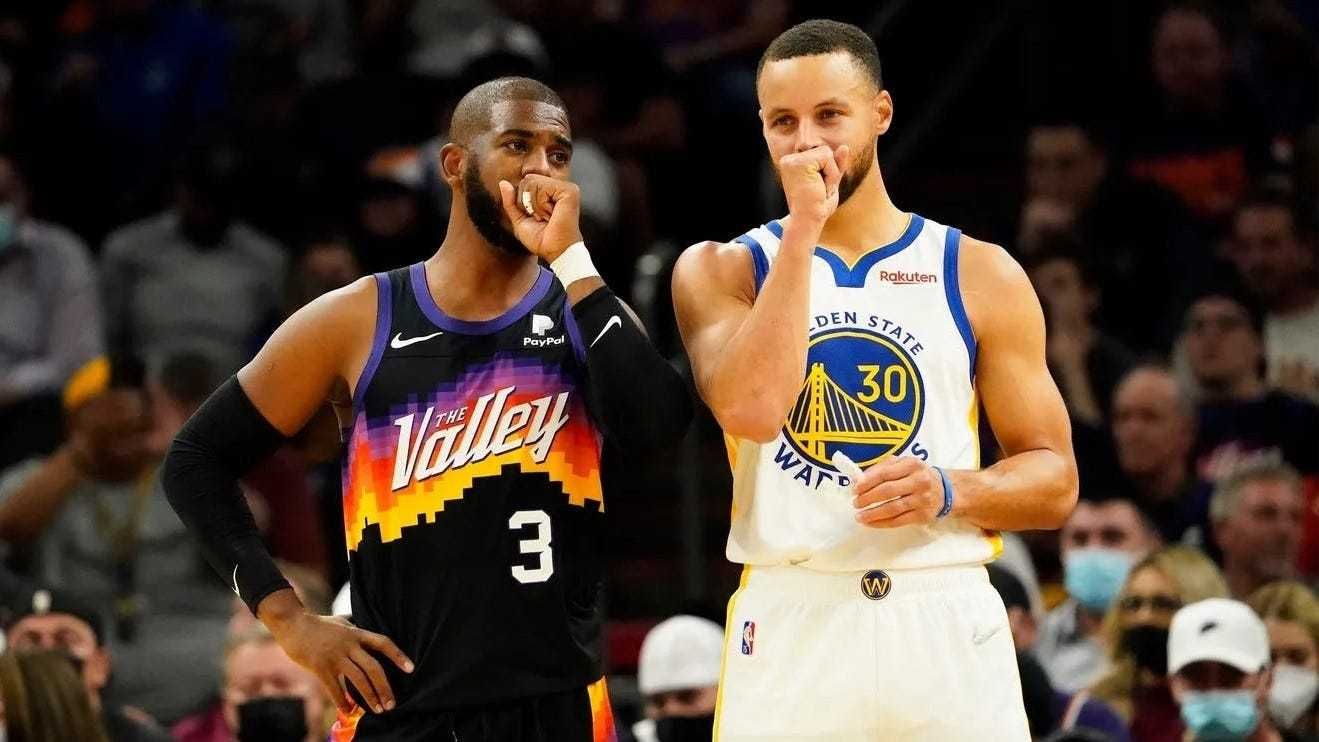


New Warriors general manager Mike Dunleavy Jr. played in the NBA for the first 12 years of Chris Paul’s career, from 2005 to 2017, so he’s familiar with CP3’s effect on a team.
When Dunleavy pulled the trigger on the big Paul-for-Jordan Poole trade there were two chief factors involved: Paul’s ability to win games and added financial flexibility for the future.
Dunleavy, who looked to be fresh off the practice court, spoke to reporters in Las Vegas on Monday afternoon for the first time since the Paul-Poole trade was made official. Anthony Slater of The Athletic shared video of Dunleavy’s media scrum from Sin City.
“Obviously looking to improve our team,” Dunleavy said. “Felt like adding Chris gives us a chance to get better. He addresses some stuff for us overall as a team but also gives us some financial flexibility moving forward. … In terms of his fit, the one thing we thought about was winning. In terms of how it’s all gonna work out, how it’s gonna fit – I just see a guy that every organization he’s gone to, he’s made better. He’s left that team in a better situation. Even at 38 years old, 18 seasons in the league, we still think he can do that. We’re excited about it.”
Earlier this year, the NBA and its players association agreed to a new collective bargaining agreement (CBA) that kicks in this season, which introduces a second tax apron $17.5 million above the luxury tax line and imposes penalties on teams who exceed it. According to @GSWCBA on Twitter, the Warriors’ payroll is now sitting at $209.1 million after the reported signing of free agent forward Dario Saric, which is $26.3 million above the $182.8 second tax apron.
ESPN’s Adrian Wojnarowski reported the penalties for teams who go above the second tax apron, writing, “teams will lose several key team building mechanisms, including the taxpayer mid-level exception, utilizing cash in trades, moving first-round picks in drafts that are seven years away, signing free agent players in the buyout market and taking on more money than is being sent out in trades.”
Without saying as much, Dunleavy and the Warriors are clearly enamored by Paul’s non-guaranteed $30 million contract for 2024-25. Instead of being locked into Poole’s four-year, $123 million contract that begins this fall with escalating annual salaries, Golden State can release Paul after one season next season.
“It was somewhat necessary,” Dunleavy said of acquiring Paul and his contract. “Not completely, because we still have a whole ‘nother year. But to get ahead of it – we’re starting to see some teams do that right now. For us basically to be able to do that and basically do what we feel like is improve our basketball team, that was the reasoning behind it. What does that allow us to do? Hard to say at this point, but to just have that optionality and flexibility, to a certain degree, where we’re not gonna be probably too propped up against that second (tax) apron.”
It’s worth noting that Klay Thompson is about to enter the final year of his current contract and will be looking for a healthy multiyear extension to stay in The Bay beyond the 2023-24 campaign.
Dunleavy also made sure to give Poole his flowers after making the decision to trade him away.
“Most of all, Jordan, can’t thank him enough for his contributions,” Dunleavy said. “We wouldn’t have a (2022 NBA championship) banner if it wasn’t for him. He gave us everything he had for four years. Really appreciate what Jordan gave us. I told him, he’ll always be a Warrior, we’ll always welcome him back. It was just one of those things. It felt like there was a little bit of a logjam in the backcourt and then you get the payroll stuff. Had to make a tough decision, but when you can get a guy like Chris Paul really was the difference for us to make that move.”