


PHNOM PENH, Cambodia (AP) — Cambodia's Supreme Court on Friday upheld the incitement conviction of a prominent opposition politician while suspending the remainder of his sentence, keeping him out of prison but unable to practice politics for years and renewing questions about the government's efforts to quash criticism.
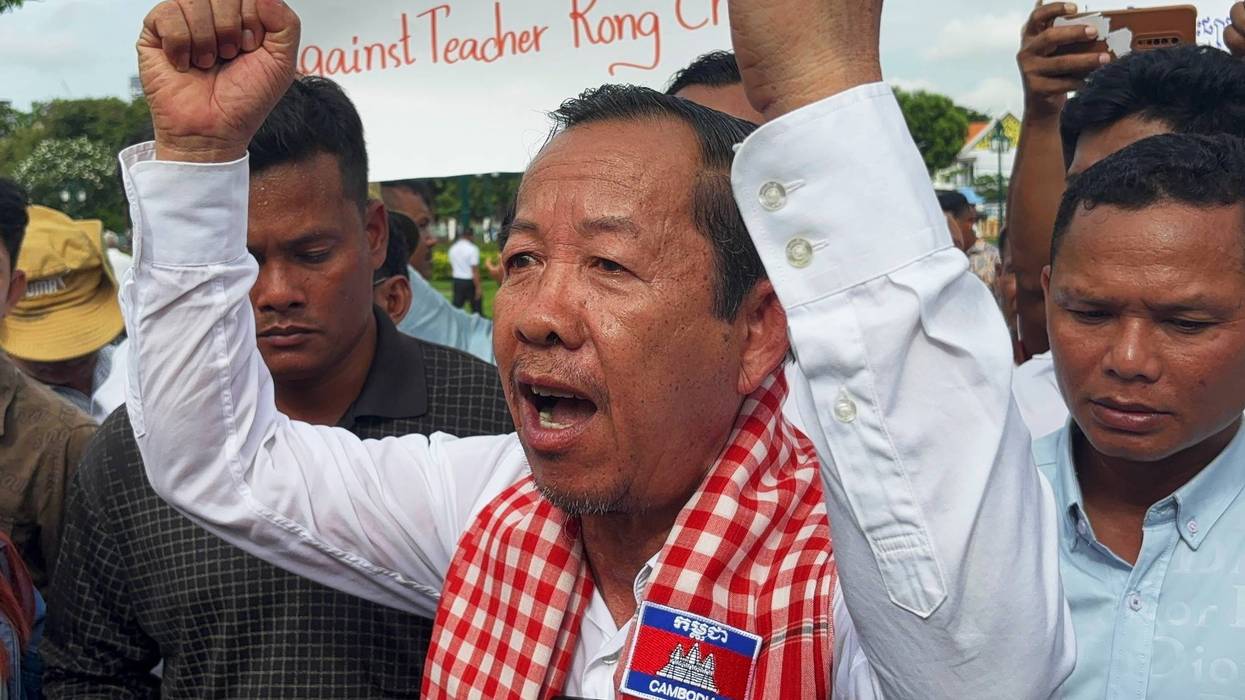
The decision against Rong Chhun, a top adviser to the Nation Power Party, was met with anger by some 300 supporters from around the country who had gathered outside the Supreme Court complex in Phnom Penh.
“Even though he is not in prison, I'm saddened that his freedom has been restricted and he has become a sub-citizen, meaning he has no right to vote or participate in politics,” said Nek Ratha, a 55-year-old from the capital.
“The verdict is hard for us to accept because he is not free, and he has done nothing wrong.”
The 56-year-old had been found guilty last year of inciting social unrest after meeting with villagers displaced by government construction projects, in what was widely seen as one of many legal moves taken by the government of Prime Minister Hun Manet to stifle criticism.
Rong Chhun told his supporters the verdict was “completely unfair” and accused the court of following orders of the government rather than the rule of law.
“If the powerful leader wants black, the court will paint it black for them,” he said. “And if the powerful wants white, the court will paint it white for them.”
Bryony Lau, deputy Asia director for Human Rights Watch, said the ruling demonstrates Cambodia's courts “lack of independence from the ruling party.”
"Hun Manet’s government should stop using the courts to silence the political opposition and instead reopen space for parties and civil society groups to operate freely ahead of next year’s election,” she said.
Cambodia’s Minister of Information Neth Pheaktra told The Associated Press that it was “not appropriate to characterize a judicial decision as an executive decision.”
“The Royal Government respects the separation of powers, the independence of the courts, and the rule of law,” he said in a written response to a query. “Any party who disagrees with a court ruling should address the matter through the legal remedies available under Cambodian law, rather than through political assumptions.”
Under almost four decades of autocratic former Prime Minister Hun Sen, Cambodia was widely criticized for human rights abuses that included suppression of freedom of speech and association. He was succeeded in August 2023 by his American-educated son, Hun Manet, but there have been few signs of political liberalization.
Sophal Ear, a Cambodian political scientist in the U.S., called the decision against Rong Chhun “evidence of continuity rather than change under the transition from Hun Sen to Hun Manet.”
“A high-profile case like this inevitably becomes a test of how much political space exists under the current leadership and whether the transition has produced any meaningful changes in governance,” he said. “Many people will conclude that the leadership transition has so far produced more continuity than reform.”
Under the decision, Rong Chhun will be prohibited from any involvement in politics for five years, including voting or standing as a candidate, and will be banned from traveling abroad for three years, the remainder of his original four-year sentence, his attorney Em Chantha told reporters. He had also been free while his appeal was pending.
Supreme Court decisions are final, but Rong Chhun said he and his attorney would study the verdict in detail to decide whether there would be a chance to ask Cambodia's King Norodom Sihamoni for a pardon.
_____
Rising reported from Bangkok. Associated Press reporter Anton L. Delgado contributed to this report from Bangkok.