


Leaders of both the U.S. and Iran have signed a memorandum of agreement on ending the war in Iran, and it “shall enter into force with immediate effect,” Pakistani Prime Minister Shehbaz Sharif said Wednesday.
The agreement calls for Tehran to, at a minimum, dilute its stockpile of highly enriched uranium and would waive but not permanently end sanctions on the country, according to U.S. officials who read the language of the memorandum on ending the war to journalists after days of secrecy.
The agreement would also open the Strait of Hormuz toll-free for two months and affirm a commitment to Lebanon’s territorial integrity in the face of Israel’s invasion against the Hezbollah militant group.
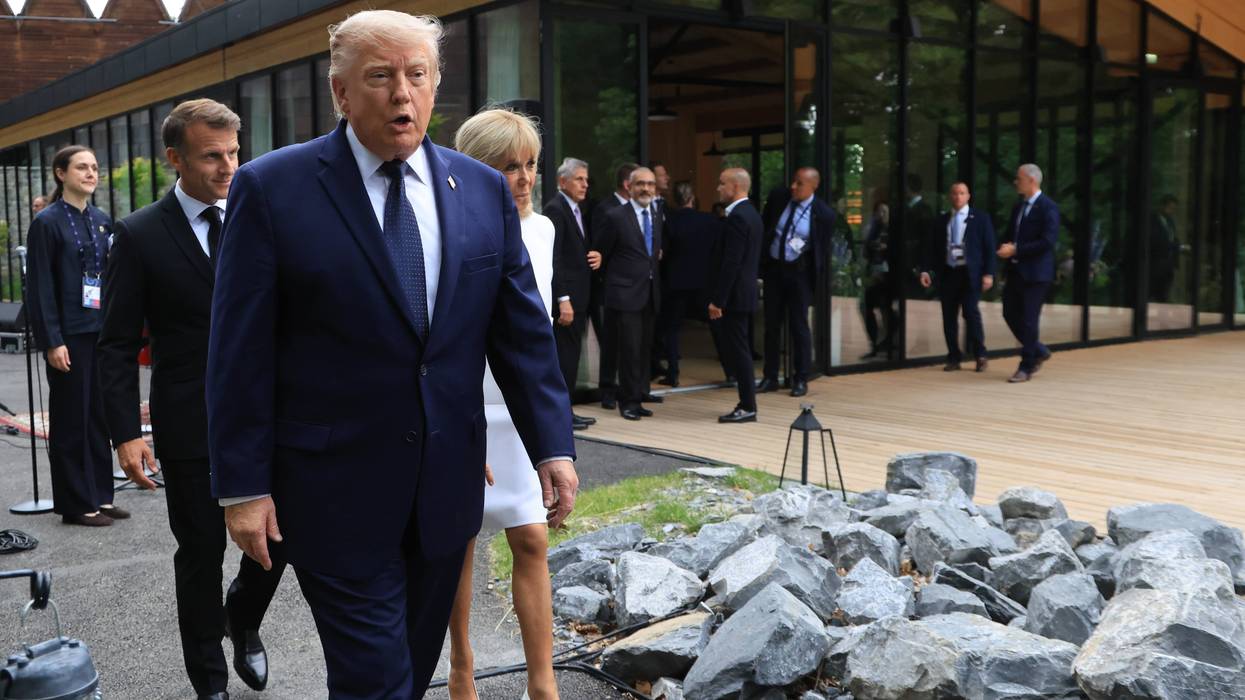
President Donald Trump meanwhile, is wrapping up his time with world leaders in France for the Group of Seven summit. Trump’s last stop in France was a glitzy dinner at the Palace of Versailles outside Paris.
Here is the latest:
Pakistan’s leader deletes post on US-Iran deal, then reposts it without a reference to Friday signing ceremony
Prime Minister Shehbaz Sharif of Pakistan had written on X that there would still be a formal signing ceremony on Friday after both sides already signed a memorandum of agreement.
Sharif briefly removed the post a short time later, however. Then, he reposted most of the same text but removed a reference to Friday’s ceremony.
That could cast doubt on whether the ceremony will happen.
Trump said he signed the agreement at the Palace of Versailles and U.S. officials had been planning for a meeting on Friday in Switzerland — but with Trump having now signed the document it wasn’t clear if that would still be necessary.
Pakistan says the deal to end the war in Iran is taking ‘immediate effect’ after both sides have signed it
Pakistani Prime Minister Shehbaz Sharif said leaders of both the U.S. and Iran had signed the agreement and endorsed him as a mediator. He said there will still be a formal signing ceremony on Friday.
He said in a post on X that the deal “shall enter into force with immediate effect and as a first step, Islamic Republic of Iran will instantly reopen the Strait of Hormuz and the United States of America will immediately lift the naval blockade.”
Sharif said Pakistan and co-mediator Qatar will still host an official signing ceremony on Friday in Switzerland. His post came shortly after Trump said he’d signed the agreement during a dinner at the Palace of Versailles.
US official says US and Iran presidents have signed agreement
Though officials had said Trump and U.S. Vice President JD Vance had digitally signed the agreement Sunday and that a ceremonial signing would be held Friday in Switzerland, a U.S. official who spoke on condition of anonymity to share details about the agreement said Trump signed the deal while at Versailles on Wednesday.
The U.S. official said Iranian President Masoud Pezeshkian also signed it Wednesday, though Iran did not immediately comment. It wasn’t immediately clear if that act started a 60-day negotiating clock to reach a final deal. It was also not clear how Trump’s signing of the deal at Versailles differed from his digital signing on Sunday.
Trump tells reporters he signed the memorandum of understanding with Iran
“It’s signed,” Trump said as he left Versailles.
“I signed it in Versailles,” Trump said. “Just signed it.”
White House says Trump signed agreement on ending war in Iran
The White House said Trump signed a memorandum of understanding on ending the war in Iran while at Versailles, though cameras weren’t present for that.
Many historic treaties have been signed at Versailles over the centuries, ending wars or territorial disputes. The most infamous was that sealed in 1919 officially ending World War I — whose harsh terms imposed on Germany are blamed by some historians for laying the groundwork for World War II.
The gilt doors of Versailles
Trump walked through the palace’s courtyard and met his hosts, posing for photographers in front of the famed golden doors.
“Versailles is not gold leaf — Versailles is the real deal,” Trump had explained to reporters earlier about why he said yes to the late dinner outside Paris after the G7.
Earlier, Macron had told reporters that “Versailles is a diplomatic tool and an instrument of influence.”
GOP senator calls Iran deal ‘worst foreign policy blunder in decades’
“Reagan is rolling over in his grave,” said Sen. Bill Cassidy of Louisiana in a post, referring to the former president.
“Iran’s nuclear ambitions were not curbed, and they have learned that threatening the Strait of Hormuz works and will undoubtedly leverage it in the future,” the Republican said.
“Before the war, the strait was open, Iran was being crushed by sanctions, and 13 service members were still alive,” Cassidy said. “Now, 13 Americans are dead, families have paid billions at the pump, sanctions will be lifted, and the bombing has stopped.”
Cassidy, who lost his primary reelection bid after Trump endorsed his challenger, has been among the rare Republicans willing to criticize the president.
“This is the worst foreign policy blunder in decades,” he posted.
Cruz says Trump is getting ‘bad advice’ on Iran
The Texas Republican, a leading hawk on Iran, heavily criticized the draft of the memorandum of agreement between the U.S. and Tehran shortly after it was released to journalists.
“Giving billions of dollars to theocratic lunatics who want to murder us is not a good idea,” Cruz told reporters. “I think the president, unfortunately, is receiving bad advice.”
Cruz was also critical of how the agreement addresses the issue of tolls through the Strait of Hormuz. The U.S. draft secures toll-free passage through the vital waterway for 60 days, but it doesn’t preclude fees in the future.
“Setting up Iran to be in charge of the Strait of Hormuz in perpetuity and to charge tolls is not in America’s interest,” Cruz said. “In my view, the Ayatollah should not reap a single penny from the free transit of the seas.”
Energy experts say deal to reopen Strait of Hormuz is welcomed, given low oil reserves
The tentative deal for Iran to reopen the Strait of Hormuz and sell its oil without restrictions will help ease supply shortages in the short term, energy experts said.
“The oil market welcomes more supply from Iran or anywhere else right now,” said Jim Krane, energy research fellow at Rice University’s Baker Institute. “Stocks are running low.”
But in the long term, there’s the chance that too much oil will come to market, Krane said, adding, “reopening the strait has come alongside investment in more oil production elsewhere, especially in the U.S. and Latin America.”
The global supply glut of crude oil that existed pre-war could return in 2027 if the peace deal holds, according to research firm Clearview Energy Partners. A report released by the International Energy Agency on Wednesday estimates a global shortfall of 0.9 million barrels of oil and petroleum products per day for 2026, which is more optimistic than other recent estimates, according to Clearview.
Senate Republican leader says MOU leaves more questions
Sen. John Thune said he doesn’t think the document that’s now been released is the final product.
“My understanding is, it’s a framework, it’s an MOU, and probably have more to come in terms of any final agreement,” Thune told reporters at the Capitol.
Congress has not yet been briefed on the emerging deal.
“I don’t think probably what you’re seeing right now represents what a final deal will look like,” he said. “I think that sounds like it’s still going to be negotiated.”
He said there are “a bunch of things” senators will have questions about.
Trump says he’s looking forward to having a ‘good time’ at Versailles
“We had an amazing day and now we’re going to Versailles for dinner with some of Europe’s great people,” he told reporters after Air Force One landed in Paris but before the drive to Versailles.
“I think we’re going to have a good time,” Trump said.
Trump arrives in Paris before Versailles dinner with Macron
Official says US or Iran could walk away at any time until they reach a final deal
The second official said the signed memorandum of understanding is final and has not been changed since it was signed electronically on Sunday. But the official said either side could walk away at any time until they reach a final deal, which they will attempt to do over 60 days.
The official referred to the plans to work with Iran to reach a final deal as a “gentleman’s agreement” and said they would find out in talks starting this weekend whether they can continue moving forward.
If talks with Iran do not seem to be working, then the U.S. could pull the plug on the effort to negotiate and return to “tightening the screws on them very, very aggressively,” the official said.
Oxfam’s withering view of the G7 gathering
A statement from the campaign group calls it the “summit of omissions” that was “defined as much by what was left off the agenda as by what was discussed.”
“Climate change, gender inequality and human rights were conspicuously sidelined to secure President Trump’s attendance. Silence became a strategy,” it said.
But the statement welcomed the G7 leaders’ call for a strong and coordinated response to the Ebola outbreak in Congo.
Trump says US isn’t giving Iran money but suggests frozen assets will be returned
He has repeatedly denied that the U.S. is sending money to Iran as part of a deal, but he said Iranian assets frozen during the war should be returned.
“It’s not our money, it’s their money, and we froze it,” Trump said. “At a certain point in time, I guess we’re going to have to give it back.”
Trump said he considered keeping the frozen assets for the U.S., but said it would hurt the strength of the U.S. dollar. “If we didn’t give it back, nobody would ever invest in the dollar again,” he said.
Trump jokes that if the Iran deal is a failure, he’s blaming Vance
Asked about the possibility of blaming the vice president if the deal with Iran doesn’t work out, Trump replied, “I like that idea, sure.”
“This way, if it works out, I’m going to take the credit. If it doesn’t work out, I’m blaming JD,” the president continued. Then, striking a more playful tone, he added, “You better be careful, JD.”
Vance has become a leading administration voice promoting the initial agreement to end the war in Iran, even as Trump has occasionally contradicted facets of the agreement that Vance has announced publicly.
The vice president is expected to be part of the U.S. delegation signing the agreement Friday in Switzerland. But Trump joked of Vance, “He’s gonna turn his plane around and get the hell out of here.”
Iranian Foreign Ministry suggests deal with US may be signed by Presidents Trump and Pezeshkian
Iran’s Foreign Ministry on Wednesday night suggested that Presidents Donald Trump and Masoud Pezeshkian could sign the deal with the United States.
Such a signing ceremony would represent a major step for the two countries, which saw diplomatic relations break off in 1980 over the U.S. Embassy hostage crisis in Tehran.
Foreign Ministry spokesperson Esmail Baghaei, quoted by Iranian state television, made the comment.
Pezeshkian became president on a promise of seeking better relations with the West. However, he’s been sidelined for months after Iran’s mass killing of protesters in January and in the war as hard-liners broadly have taken over the levers of the country’s theocracy.
US officials read memorandum of understanding with Iran to journalists after days of secrecy; Iran has not released text
Senior U.S. officials have dictated the memorandum of understanding with Iran to journalists after days of secrecy.
The officials spoke on condition of anonymity to read the draft, which Iran has not released, ahead of a formal signing ceremony set for Friday.
According to the officials, the draft agreement includes a new ‘minimum’ standard for downblending of highly enriched Iranian uranium. Also, it has provisions to ensure the ‘territorial integrity’ of Lebanon after Israel’s latest attacks against Hezbollah in Lebanese territory.
In return, the U.S. will move to waive, but not eliminate, some wide-ranging sanctions against Iran once the deal is signed.
The U.S. draft of the agreement also only secures toll-free passage of the Strait of Hormuz for 60 days, and it doesn’t preclude fees in the future, the officials said.
If Iran violates agreement, Trump says US will ‘bomb the hell out of them’
Asked how the terms of an agreement would be enforced, Trump said the threat of further bombings would be enough.
“What else am I going to do? Am I going to say, ‘I’m going to take you to court?’” Trump said. “You know, we’re going to bomb the hell out of them if they violate the agreement.”
Trump said he doesn’t think Iran will veer from the deal and said he does not want to resume attacks. But he added that “bad things happen in war — war is a nasty place.”
Trump indicates he doesn’t plan to hold US officials accountable for bombing of Iran school
Asked whether he’d hold anyone in his administration accountable for the deadly missile strike on an elementary school in Iran that killed over 165 people, the president suggested that no, he would not.
Trump said it was an odd question given that the bombing had happened so long ago, during the opening days of the war in Iran.
He also said that all war is nasty and that, in this case, mistakes might have been made, but that “Nobody did it on purpose.”
Trump also said, though, that the Department of Defense is still investigating the bombing.
During a subsequent question, he returned to the school bombing, repeating the sentiment that war was nasty: “Bad things happen in war.”
Trump hints at diplomatic visit from Lebanon, offers sympathy amid Israeli strikes
It wasn’t immediately clear who would be visiting from Lebanon — Trump first said the president and then the prime minister would be coming to Washington “over the next week or two.”
Trump repeatedly expressed sympathy for Lebanon while criticizing Israel, calling it a source of tension with Prime Minister Benjamin Netanyahu.
“I say, ‘You can do a little softer touch, Bibi. You don’t have to knock down a building every time somebody walks into it that’s from Hezbollah,’” Trump said.
Trump said he feels bad for Lebanon, adding that it was “a great culture.”
“It was an incredible culture, maybe the highest in the Middle East, for years and years, centuries,” Trump said. “And for the last 50, 60 years, they have been just trashed.”
Trump offers lengthy – and very meandering – opening comments
The president began the press conference by speaking for around 40 straight minutes – offering a steady, stream-of-consciousness-style monologue that covered everything from Iran and Ukraine to drug dealers hiding fentanyl in hubcaps.
Trump talked about not wanting to crash the U.S. economy during the Iran war and said he thought Russia and Ukraine might make a deal to end that war.
He boasted about securing the U.S.-Mexico border but said that Mexico “has lost control of that country” and suggested that smuggling cartels – which he said hid drugs in cars and car parts to move them over the U.S.-Mexico border – had Mexican President Claudia Sheinbaum “scared.”
Trump also talked about reaching a possible nuclear accord internationally, even as he suggested that he’d avoided “a nuclear holocaust.” And he said he was looking forward to admiring the golden finishes of the Palace of Versailles when he went to dinner there later Wednesday.
Trump thanks China, Russia for staying ‘neutral’
As he wrapped up his meandering opener during his press conference, the president noted that the leaders of China and Russia - often allies with Iran - largely stayed out of the conflict.
“They could’ve made it much more difficult for us,” Trump said.
China, in particular, had weapons that could “knock down airplanes,” he said.
“I said. ‘I would really appreciate your not giving or selling any of that stuff to Iran,’” Trump continued. “And you know what? For the most part, he didn’t.”
Trump again denies $300 billion reconstruction fund for Iran, traces it to Vance statement
“JD made a statement. It was a perfect statement, and they reported it in a very strange way. But that’s because that’s why it’s fake news, I guess,” Trump said.
He emphasized that the U.S. is “not investing any money” even though he said Tehran will need aid to recover.
Trump says an Iran deal will be signed ‘shortly’ and that a copy has been sent to Israel
Amid conflicting messages from Trump and top administration officials about whether an initial deal to end the war in Iran had already been signed, Trump said the agreement could be signed “maybe tomorrow” or the next day, meaning Thursday or Friday.
Trump recalled his years as a developer and said, “My whole life is all about deals,” and that sometimes “Crazy things happen with deals.”
But he added, “We are going to most likely sign a deal.” He said Iran wants “to sign a deal, and they’ve been acting very appropriately.”
Exactly what the deal entails is a matter of confusion since Trump and his administration have refuted publicly reported details without providing concrete details, they say are correct.
Trump also said a copy of the deal would be released and that the U.S. sent a copy to Israel.
Trump shifts tone on US allies, praises their support for Iran agreement
After complaining for months that U.S. allies were doing too little to help the U.S. in Iran and the Strait of Hormuz, Trump on Wednesday quickly shifted to praise for their support of a deal.
“The past two days have provided a chance to discuss the details of this historic agreement with many of our closest friends and allies, including the G7 nations and many presidents and prime ministers,” Trump said in remarks at the summit.
It comes after U.S. allies issued a statement welcoming the framework of a deal to extend the U.S.-Iran ceasefire and reopen the Strait of Hormuz.
Trump said, “They all put out statements saying they love this deal, because they want to see it over.”
Trump says negotiating an end to the Iran war buoyed the stock market
The president suggested that fears of a weakening U.S. economy were a big driver for the administration’s work to negotiate an initial deal to end the Iran war.
“Every time we talked about the possibility of peace, the stock market shot up like a rocket ship,” Trump said. “The stock market is more brilliant than anybody there is.”
Trump also said that the “one thing I didn’t want to see is, I didn’t want to see economic catastrophe.” He said that “could have happened” if the war had continued.
“The one president I did not want to be was the late, great Herbert Hoover,” Trump said, referring to the president whose policies helped exacerbate the Great Depression.
Macron defends red carpet treatment for Trump
French President Emmanuel Macron defended his decision to roll out the red carpet for Trump, including a dinner at the Palace of Versailles later Wednesday.
“Versailles is a diplomatic tool and an instrument of influence,” Macron said.
Using a soccer analogy, Macron said he approaches diplomacy like the French national team: “Whether I’m playing at home or away, my goal is to score goals. And when I host other teams, I try to give them a nice welcome.”
Macron says he has always trusted Trump
Macron said he has “always trusted President Trump” because they both have “always spoken frankly.”
That applies on U.S. tariffs issues, Macron said, after Trump threatened 100% tariff on French wines unless a European digital tax is dropped. Macron is still seeking a compromise that would avoid U.S. tariffs from taking effect.
“Partners should never impose tariffs on one another or create instability,” Macron said.
Macron says US limit on cutting-edge Anthropic AI is a ‘bad thing’
The French leader is taking aim at a Trump administration directive preventing the use of Anthropic’s latest artificial intelligence models by foreign nationals.
He said it is “a good thing” that U.S. officials recognize that cutting-edge AI models could be dangerous. “What do they fear? That these models could be used by others to attack them or attack us,” he said.
But the “very strong decision” from the Trump administration is also “a bad thing,” he said. “The reaction is in some regards strictly nationalist.”
Anthropic said it has taken its latest artificial intelligence models, known as Fable 5 and Mythos 5, offline to comply with the directive. The AI giant said it did not believe the steps taken by the government were warranted by the concern it flagged about a potential security issue.
Macron describes ‘an Evian moment’ on Ukraine
Macron said the summit, attended by Zelenskyy, helped convince Trump that Russia currently has no serious intention of negotiating peace.
It’s too early to say whether there would be a clear “before” and “after” the Evian summit, Macron said — future developments will determine its impact.
“But there was an Evian moment, certainly on Ukraine,” he said.
Macron warns of the risks of artificial intelligence
G7 leaders discussed the revolutionary technology on Wednesday, the summit’s last day.
The French leader, the summit host, called for regulation.
“No one — neither political leaders nor business leaders — can any longer ignore the impact of AI on our democracies, on our societies. That is why the possibility and the necessity of regulation have now become imperative,” he said.