


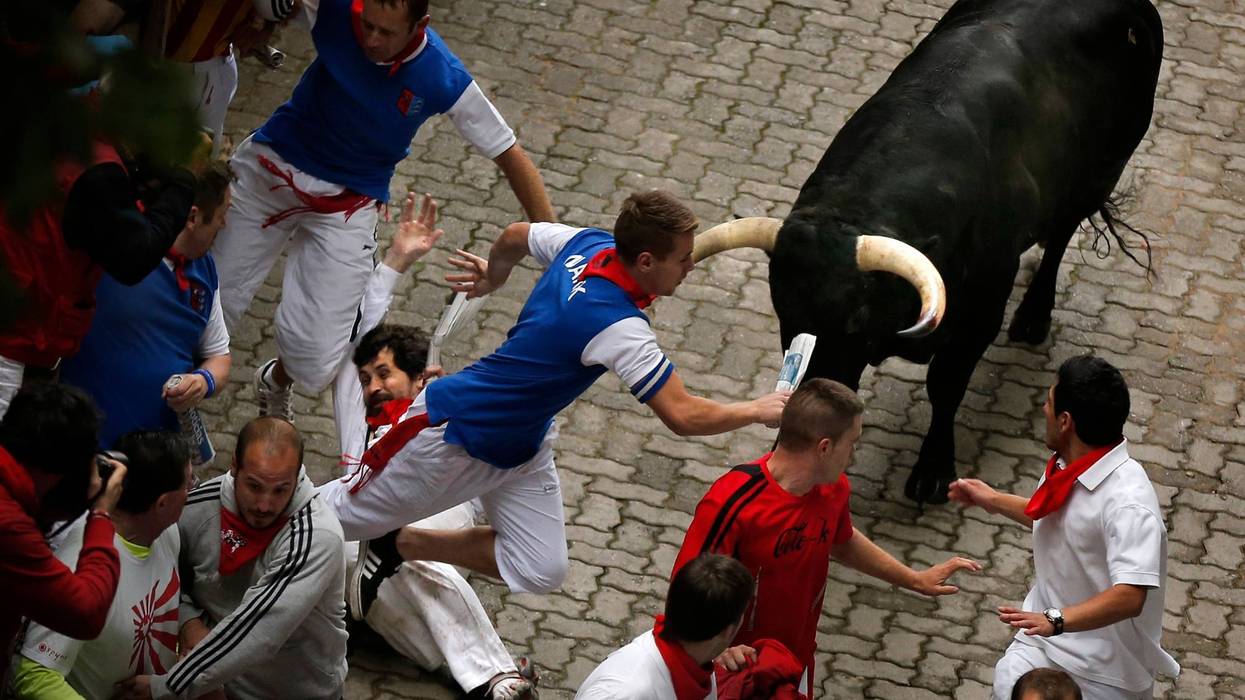

PAMPLONA, Spain (AP) — Bill Hillmann has been gored three times while running with the bulls in Spain, but he wouldn’t miss this year’s San Fermin festival for anything.
It marks the 100th anniversary of the publication of Ernest Hemingway ’s book “The Sun Also Rises” that launched the future Nobel Laureate to literary fame and put Pamplona on the map for millions of people around the world.
On Monday, the festival kicked off with a firework blast over a jam-packed plaza. The first of eight bull runs is on Tuesday.
Hemingway’s 1926 novel captivated generations of readers with its sexy Jazz Age tale of American and British bohemians trying to fill some inner void with the distractions of exotic travel, vast quantities of alcohol and the anguishing pursuit of impossible love.
Its success established “The Sun Also Rises” as a cornerstone of the American literary canon, right up there with F. Scott Fitzgerald’s “The Great Gatsby.” It also popularized the term “lost generation” to describe the tight-knit group of early 20th-century writers expatriated in Paris. Hemingway's terse style forever changed American literature. In Spanish, its title is translated as “Fiesta.”
Hillmann, who hails from Chicago, was 19 when Hemingway’s vivid depiction of the bull running festival first enthralled him, especially descriptions of average Spaniards risking their lives sprinting through the streets to guide the bulls to the bull ring during the nine-day festival.
“I sat there for about six hours, well past midnight, reading the book," Hillmann told The Associated Press in Pamplona as he looked down on the pen where the bulls are held before being set free on the cobblestoned route. “And by the time I was done with that book, I was going to be a writer and I was going to be a bull runner."
Since that literary encounter, the 44-year-old Hillmann has run with the bulls in Spain hundreds of times, counting both his trips to Pamplona and his participation in dozens more bull runs in other Spanish towns. His infatuation with Hemingway and Pamplona has never waned, even though he nearly died one time that he was gored by a bull horn.
Hillmann’s appreciation led him to earn a doctorate in English, and now it is his turn to teach “The Sun Also Rises” at East-West University in Chicago, and write about bull running.
Americans are the biggest group of foreign bull runners
Hillmann is just one of many Americans inspired to travel to Spain to see the festival firsthand. While running with bulls is a cherished local custom for Spanish daredevils, Americans are still the leading group of foreigners who run at the San Fermin festival. In 2022, 16% of the bull runners were Americans, the largest percentage among foreigners and four times more than those from neighboring France, according to Pamplona’s City Hall.
Dallas-based tour operator Bruce Anderson, whose company “Running Of The Bulls” has helped thousands of Americans attend San Fermin over the years, says that Hemingway’s work made the festival a bucket-list destination. This year, his company is bringing 1,400 people to the festival, with over two-thirds from the United States.
“There’s a lot of energy, a lot of excitement around just remembering that book and the impact that it’s had,” said Anderson, himself a lifelong Hemingway fan. He spoke in Pamplona’s art deco Café Iruña, which features heavily as a drinking spot in “The Sun Also Rises” and today houses a life-size statue of Hemingway bellying up to the bar.
And Anderson, with his thick white beard, is something of a Hemingway look-alike. Local Spaniards often call out to him: “Papa!” – a nickname for their adopted hero.
It is impossible to avoid Hemingway in Pamplona
Hemingway is etched into the landscape of Pamplona. Hotels and bars have busts of him or signs up that he was once there. Outside the Pamplona bull ring, which also has a statue of the writer, a huge banner hangs in honor of the novel, including a quote that shows how the festival left the writer speechless: “At noon of Sunday, the 6th of July, the fiesta exploded. There is no other way to describe it.”
When Hemingway made his last visits to Pamplona, he would frequent the Perla Hotel; his suite still has furniture from the 1950s when he stayed there. The room, which overlooks the bull run route, also has two glass bookcases holding dozens of copies of “The Sun Also Rises.”
“Hemingway did a lot for Pamplona because he made it known around the world,” said Fernando Hualde, who worked for four decades as a receptionist in the hotel.
Hemingway’s legacy has become complicated over time
Hemingway’s local legacy, however, is mixed.
Beside a feminist critique of his hyper masculine public persona, Hemingway has drawn criticism from the animal rights movement for his praise of bullfighters. In “The Sun Also Rises,” he spills far more ink on descriptions of their bravery than on the bull runs.
Animal welfare activist Brook Spurling said during a protest against the San Fermin bullfights that “Hemingway wrote about many, many themes that today would not be accepted into society. He writes about hunting, about war, and we don’t want to be appreciating these themes today.”
Hualde says that some Pamplona residents rue his early promotion of the festival due to the ills of overtourism the sleepy provincial city is now experiencing.
Pamplona has 200,000 residents and receives over a million more people for the festival. While most are Spaniards, around 15% of the revelers are from abroad. And many, especially the younger visitors, follow Hemingway’s example of drinking to excess.
Some locals take pride in spots that weren’t touched by Hemingway. Local literature professor Gabriel Insausti of Pamplona’s University of Navarra recalls being in a bar with a sign that read “Hemingway was not here.”
“In general, Hemingway has become a product of a franchise associated with San Fermin festival that has obscured his novel,” Insausti said. “People know who Hemingway is, but they haven’t read his novel.”
But the power of Hemingway’s English prose lives on
Hillmann said that the high percentage of inexperienced foreigners today makes the Pamplona bull runs particularly dangerous. The last death was in 2009 but gorings and other injuries are common. Novice runners can easily panic and make a wrong move that can cause a pileup or send someone into the path of a bull.
He was badly gored in 2014 when he said a bad maneuver by a fellow runner left him exposed to a bull. He thought he was dying, such was the quantity of blood gushing from his leg.
After another goring in 2017, Hillmann told the AP from his hospital bed in Pamplona that he would not stop running. “People think this is just crazy people running. There is real art. If you pay attention, you can see it,” he said then.
Hemingway's granddaughter, the actress Mariel Hemingway, recalls being treated “like royalty” when she attended San Fermin years ago. Mariel, who has written and spoken about her grandfather's battles with mental illness that led to his suicide in 1961, is convinced his work will endure.
That fascination with death is likewise timeless.
“Identity, love, purpose, and how to rebuild after profound loss ... those themes haven’t ever changed. That’s what’s great about my grandfather,” Mariel Hemingway told the AP from her home in Idaho.
“I think he captured something that will never go away.”