

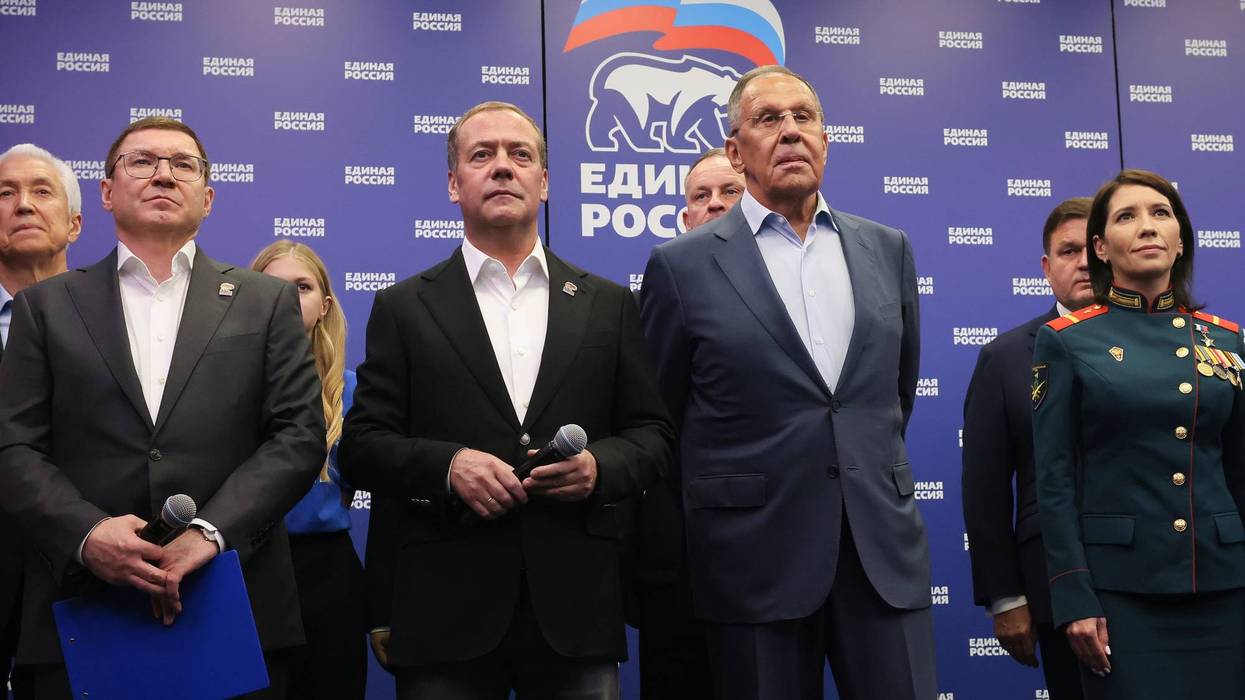

The main Kremlin party has further strengthened its already overwhelming control of parliament, according to results Monday from Russia’s first wartime parliamentary election, a tightly orchestrated vote that excluded virtually any genuine opposition.
With over 95% of the vote counted, the top Kremlin party, United Russia, stands to get more than three-fourths of the seats in the lower house, the State Duma, a record high.
It was the first parliamentary election since President Vladimir Putin launched the full-scale invasion of Ukraine in 2022, and the first to include residents of four regions of that country that were seized and illegally annexed by Moscow later that year. At a polling station in the Russian-held part of the Donetsk region, voters dropped their ballots in a box under the gaze of an armed Russian soldier.
Voting also was held in Crimea, which was illegally annexed by Russia in 2014. Kyiv denounced the voting in those regions as illegal.
The government was “able to carry out the campaign and the voting the way it wanted, with the most optimal output,” said Tatyana Stanovaya of the Carnegie Russia Eurasia Center in an online commentary.
The election followed a crackdown on dissent
The Kremlin wanted the balloting to underline public support for its military action in Ukraine, and it sought to avoid any political risks by stamping out even the slightest sign of dissent.
A massive state media campaign and tight control over the vote allowed the Kremlin to maintain and even strengthen its political dominance despite economic troubles and long-range Ukrainian drone strikes on oil refineries and warehouses belonging to top online retailers that brought the conflict home for millions.
Preliminary results indicated that United Russia would get 355 out of 450 Duma seats, according to the Central Election Commission. It polled just under 58% of the vote for the 225 seats apportioned by parties, and also won 208 single-seat races filling the other half of the chamber.
Several smaller parties representing the “systemic opposition” that vote in sync with the Kremlin's wishes on all key issues are set to fill most of the remaining seats. Just a handful will go to candidates who ran without a party affiliation.
The balloting was spread over three days from Friday to Sunday to boost turnout, which exceeded 59%, the highest for a parliamentary election in over a decade.
Electronic balloting was available in many regions and encouraged by authorities. Critics argued that it made it easier for the government to control the outcome.
Final results will be announced Friday.
Criticism of the war was silenced
The liberal Yabloko party, the only registered political entity that dared to publicly criticize the war, was removed from the ballot last month by Russia’s Supreme Court, and only had a few dozen candidates in the single-seat races.
Additionally, some anti-war politicians were imprisoned or forced to flee abroad ahead of the campaign.
Preliminary results indicated that no Yabloko candidates won a seat. Despite the failure, Yabloko pointed out that five of its candidates in Moscow came second in their races with more than 10% of the vote each. It was a sign that “demands for peace and freedom enjoy significant support,” said Ivan Bolshakov, head of the party's analytical center.
Yabloko and the Communist Party, which has criticized some aspects of government policy but carefully avoided any criticism of Putin, said many of their observers were turned away from polling stations.
Russia didn’t invite observers from the Organization for Security and Cooperation in Europe, with the Foreign Ministry accusing the group of “double standards” for its criticism of the country. OSCE Parliamentary Assembly President Pere Joan Pons said the decision was a breach of Russia’s commitments as a member of the organization.
The election came amid Ukrainian attacks
The election took place against the backdrop of incessant Ukrainian drone attacks. On Sunday, Russia's Defense Ministry reported that it downed 1,110 Ukrainian drones overnight.
Moscow Mayor Sergei Sobyanin said 450 drones were downed while approaching the city in what he described as “the largest ever” attack on the capital in a failed attempt to disrupt the vote, which damaged an oil refinery and a residential building.
Three people were killed in the wider Moscow region, Gov. Andrei Vorobyov said, and the Health Ministry reported 38 others were injured and received medical treatment.
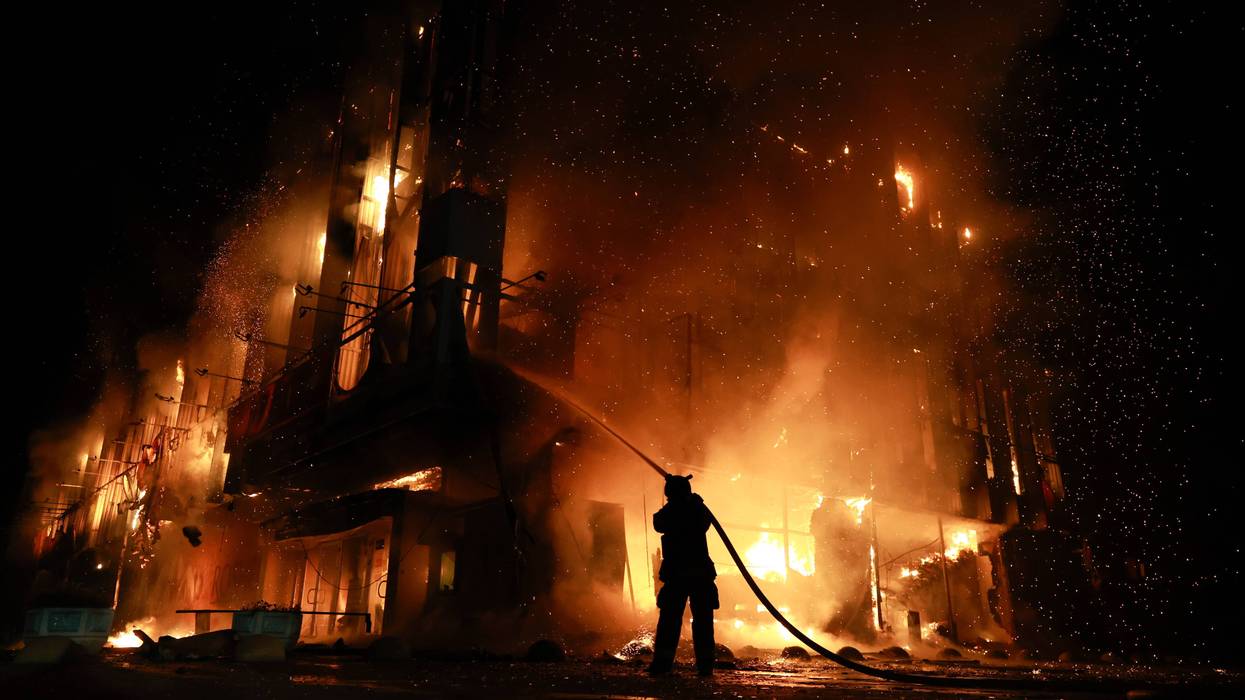
Ukraine’s long-range drone strikes over the summer pounded oil refineries, triggering a widespread fuel crisis, and set ablaze sprawling warehouses of online retailers Wildberries and Ozon.
“Putin, of course, will interpret United Russia's results as confirmation of the (public) support of the war, even though it is not the case: The overall demand for ending the war is growing,” said Stanovaya of the Carnegie Russia Eurasia Center.
“The main question is: What now? There are great concerns about mobilization, new repressions, harsher measures, and escalation," she wrote.
“I partially agree that Putin may perceive the election results as a green light for ‘anything for the victory,' but I think the role of the elections here is greatly exaggerated," she added. "Everything depends much more on the military situation, the American factor (I don’t believe new negotiations will work out), and the overall picture, where everyone is escalating.”