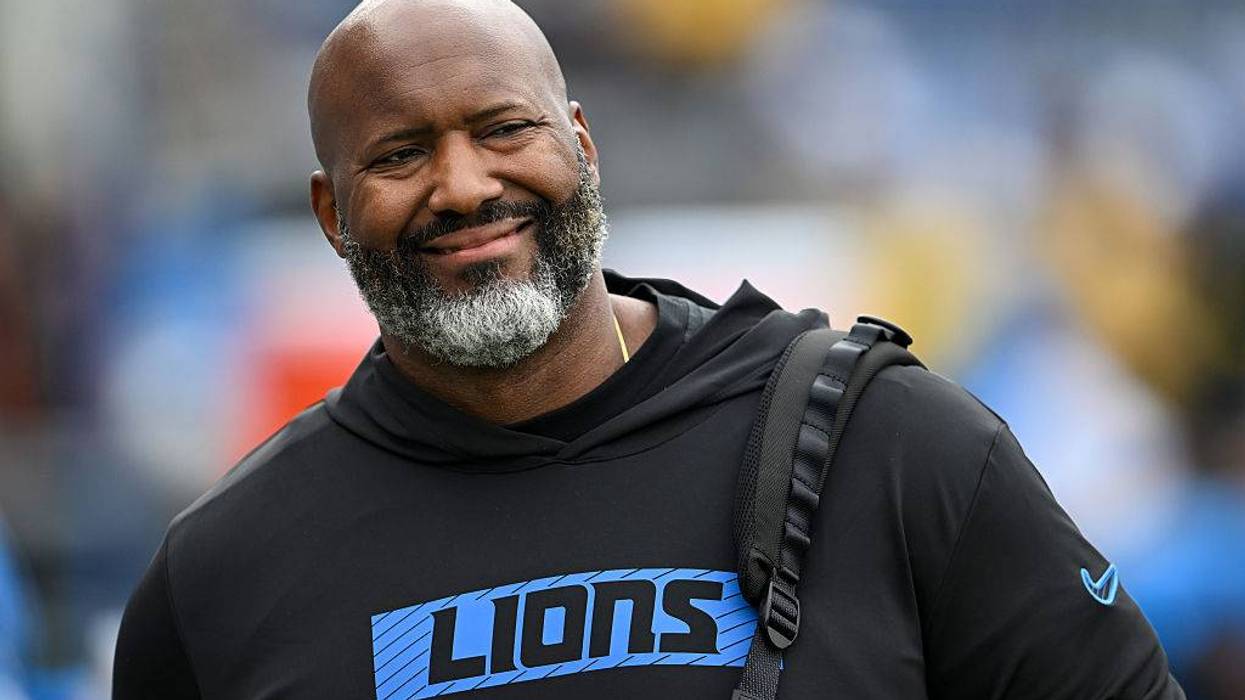

Lions general manager Brad Holmes sat down on Tuesday at the team facility in Allen Park for an exclusive interview with the four members of the Lions Collective: 97.1 The Ticket's Will Burchfield, Justin Rogers of the Detroit Football Network, Colton Pouncy of The Athletic and Jeff Iafrate of Crunch Time Sports.
They hit on topics like the losses of Taylor Decker and David Montgomery, the team's offseason spending plan, prioritizing the offensive line, how that limited Detroit's moves at edge rusher, the respective outlooks for Terrion Arnold, Kerby Joseph and Brian Branch, and a recent report on The Ticket that coming off a 9-8 season in which the Lions fell from first to last in the NFC North, Holmes and Dan Campbell have had more differences in opinion on roster construction than in years past.
A few highlights from the interview are shared below, along with the full video.
Question: From a wider view of free agency, you guys handed out 14 contracts. All but one were one-year deals. That's generally how you guys have operated in the past. We should probably pause to mention that most free agent contracts in the NFL tend to be one-year deals. But can you explain to our larger audience why those one-year deals fit your team-building plan?
Holmes: "I'm trying to find the most concise way to explain this. We knew what kind of financial constraints that we were in entering this. And it (required) a lot more looking at everybody from top to bottom. When you have more money to spend and lesser constraints financially, you can (put) a lot more focus on just the mid- to upper-echelon guys. And you can get to the, let's call them, tier 2 and 3 and 3 guys a little bit later.
"But when we're looking at the constraints that we had financially entering (free agency), it's like, 'OK, alright, We're not going to be able to do a lot of multi-year deals because for what we're trying to do with these extensions that we have upcoming, the implications that it would have on our cap would be – I don't want to call it crippling, but it would have been hard to overcome, I guess I should say. So we were kind of limited in how many multi-year deals that we actually could get in.
"Like, yeah, we can want that, but then the player and the agent have to agree to it, too. So it's not like you're looking for prove-it kind of guys, but you can find a lot of good football players that maybe have started out playing some good football and had some bumps in the road and then they kind of get it back and they want to just do a prove-it deal, factoring age into that.
"But it did make a lot of sense of where we're at from a financial constraints standpoint."
Question: The departure of David Montgomery -- you and Dan both mentioned you wanted him back. Can you just walk us through the timeline of how that all came to be with him going to Houston and the return you got?
Holmes: "Look, it was pretty it was evident that there were less touches that he had (last season). And look, a lot of it is not just him. It's how Jahmyr (Gibbs) has ascended. So, me and David's agent, we all had – and David -- we all had really healthy dialogue. We just kind of thought it was best for all parties. It was right after the end of the season that (we decided), let's just see if we can get the proper return.
"I told his agent, 'Look, this guy's a good player, man. Like, we're not just giving him away, you know.' So we were happy with the return that we got. I'm happy for David, but I think he's in a good spot. But that's going to be not only a loss of just the player, but he was such an impact on our locker room from a leadership standpoint, our culture.
"But it was all healthy dialogue. There was never any bad blood or anything. And I think it worked out well for both parties."
Question: The Decker situation was a little bit of a roller coaster on the outside. He announced he's coming back at the combine right after we talked to you, and a couple of weeks later he's asking for his release. Were you surprised at all with how that worked out? And just given what he's meant to the team, is there any disappointment from the franchise in the way that situation played out?
Holmes: "I wouldn't say it's disappointment or really surprise, either way. I think a lot of those situations that happen, it all starts with communication and what you've communicated with the player or what you've communicated with the player's agent. It starts there, but there were really no surprises.
"You don't know when a player is going to put something out (on social media), so if you want to say that if there's surprise, maybe that was a surprise. But in terms of the decisions that he made, I wouldn't say that that'd be a surprise.
"Again, he's been a really good player for our franchise for a really long time, so he's going to be missed. I know the fans are going to miss him. The locker room is going to miss him. But unfortunately, those are the kind of difficult decisions that have to be made at times, but we wish him nothing but the best.
"I know that he was a favorite. He always has been, and just wish him the best of luck going forward."
Question: "Has there been any contact with Taylor in his camp since those talks fizzled out or is that door kind of closed at this point?
Holmes: "Look, I'll never say never. I've learned that a lot in this business, but no, there hasn't been any recent dialogue."
Question: "I want to bring up a very under-discussed, overlooked, cast-aside topic in this town: Edge rusher. It's about time someone talks about edge rusher in this town. You guys have tried different players across from Hutch over the past few seasons. None have really stuck year to year. Al-Quadin Muhammad seemed like a great signing last year. He signs for similar money in Tampa, as you guys gave DJ Wonnum to sign here. Can you just explain your thought process in choosing, in some ways, Wonnum over Muhammad?
Holmes: "Well, actually, it didn't come down to that. It didn't come down to this player versus the other. He was another one (where) I knew what we needed to do on the offensive line. We were all very aware of what we were going to do on the offensive line. Once we made those financial commitments on the offensive line, I pretty much had a good sense that I don't think we're going to be able to do much else when it comes to that position (edge rusher). That's another expensive position. Call it -- it's a premium position.
"So it wasn't like we were choosing this player over that player. And I wouldn't even say the financials were exactly the same as well. But once we made that decision for the offensive line, we made that commitment, it kind of took us out of some of those other options at edge rusher, including Muhammad. And I'm a huge fan of Muhammad. I was so happy for what he did last year. He was another player that we had great dialogue with, but just weren't able to make it happen.
"But we're really excited about finding Wonnum. Always been a fan of him coming out, especially when he was in the division, he has done a lot of great things. He had some things that he had to overcome, but watching his tape last year, it was impressive, and they had him doing some things that I would say were probably not right in his wheelhouse -- a lot of dropping and showing some athletic ability in the middle of the field. That was refreshing to see.
"But he can still can set edges, he can set hard edges, and he can still win rushes, and he can play all up and down the line. So we're excited to get him."
Question: We read the court report on Terrion Arnold, we've read his attorney's statement. It just seems like a fluid situation. As you're managing the roster, how much do you have to stay on top of that? And is there even a little concern that you may not have him for some portion of next season?
Holmes: "Well, look, you control what you can control. You're aware of everything. That's really about the most that I can say about that. But --I could say there's not one thing that you're not aware of that you don't think about.
"So, in any situation, whether it's something that a player went through off the field or something that a player is going through on the field from a medical standpoint, I'm just a more of a, let's call it, pessimistic planner, in terms of, like, I just like to prepare myself for (the worst). I'm not saying that something's going to come out the worst (about Arnold), but that's how I prepare in all situations.
"But I always hope for the best as well. That's kind of my way of saying that we look at every single avenue and every single possible outcome, and make sure that we're prepared."
Question: This came up last week, and I thought it was important to toss it to you to give you a chance to address it. It caught fire a little bit that maybe you and Dan were having more disagreements behind the scenes on the roster. I think we saw for the first four years, this thing was on a steady incline. And when things are on a steady incline, everything's easy, but all decisions you've talked about are joint.
You've talked about disagreement is expected, healthy. You welcome it. I'm just wondering, can we characterize the conversations as 'more intense' when you have a season that is that first step back and maybe you're trying to figure out how to get it back on the track you wanted?
Holmes: "I think the only intensity I would say is just that when you have a disappointment of the season like we had, it's more intense in terms of, it is a deeper, harder look from top to bottom on everything. And that's what me and Dan have done in joint alignment. That would be the only intensity that was probably a little further, because you get this (season) and it's like, 'Whoa, hold on now. Let's just make sure that we're not overlooking something or if there's not a tweak or an adjustment that needs to be done.'
"So I would say that would be the intensity. That's what's happening. I don't know where the other stuff came from, but no, if anything, it's me and Dan in total lockstep, like we always have been. And we're just looking at everything top to bottom, which we already have done and we'll continue to do, for sure."