

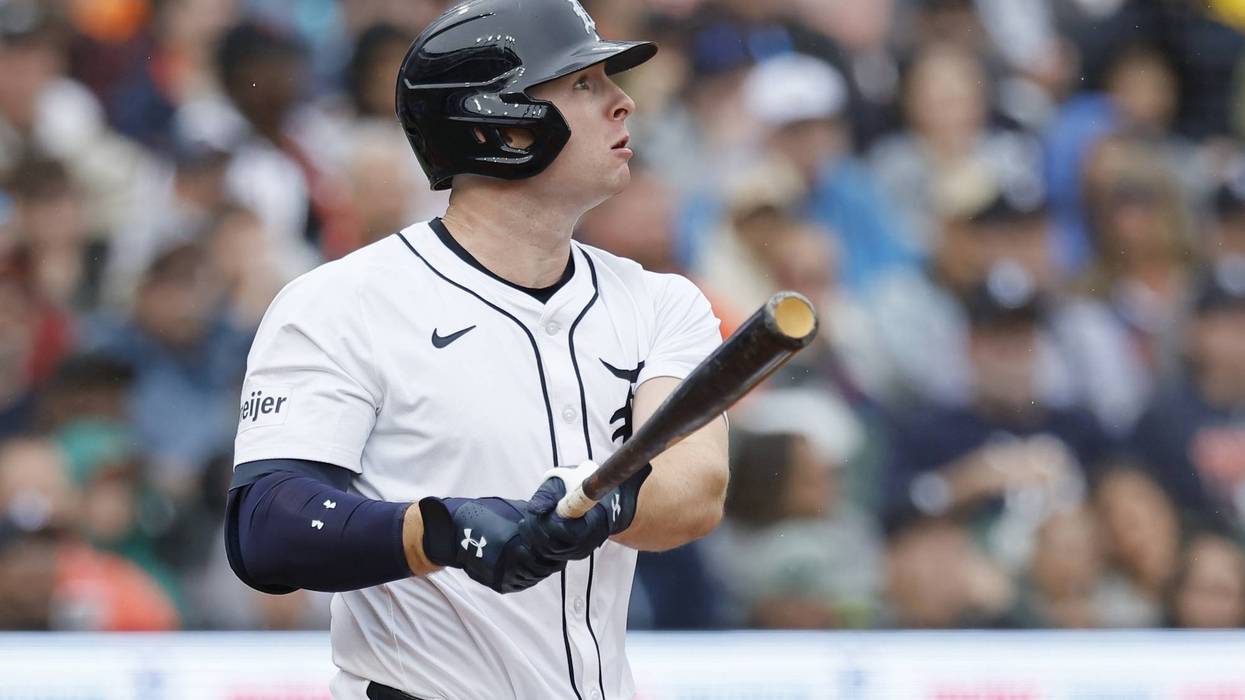

The hits were flowing, until they slowed to a drip. The power has all but dried up. Recently, Colt Keith has gone back to the well. Two months into year three with the Tigers, Keith is off to both the best and the worst start of his big-league career. Baseball will do that to you.
"Started off really good," Keith said Thursday before the Tigers dropped their seventh straight series. "Felt like I was crushing pitches I could do damage on, and I wasn’t chasing much at all. And then randomly stopped seeing the ball well. Things weren’t coming as easy, felt like I was in survival mode for a while, trying different things every day to get back to that feel I had in the beginning of the season.
"But this last week has felt better, seeing the ball better. Just trying to keep that going and find ways to help the team. I feel like I’ve been good on the bases, OK on defense. Just gotta get back to helping the team win at the plate."
The Tigers have lost 7 straight series, 6 of those against sub-.500 teams, 4 against teams at bottom of their division.
Hear from Flaherty, Keith and Hinch after 7-1 loss to Angels.
"This is the same offense we started in a playoff series — two of them, in fact, one we won." pic.twitter.com/6Iu2Jcpm6L
— Will Burchfield (@burchie_kid) May 28, 2026
Baseball will also do this to you: Keith smoked two line drives that afternoon -- one had an expected batting average of .710, the other .640 -- and walked away with nothing to show for it in the Tigers' 7-1 loss. It was nonetheless one of Keith's better series of the season. In the starting lineup for all three games against right-handed pitchers for the Angels, Keith reached base safely six times. He's batting .292 about a third of the way through the season, second on the team to Riley Greene.
But Keith knows what you're probably thinking -- he's thinking it, too: "Obviously it’s almost June and I don’t have a homer again -- which is ridiculous. Because I’ve been hitting the ball really hard all year. But it’ll come. I believe it’ll come. Everyone around me is telling me it will come. And the past shows that."
In his first season with the Tigers, Keith didn't homer until May 24. He didn't homer last year until April 30, which triggered a 55-game stretch where he posted a .914 OPS. But over his next 55 games to close the season, his OPS fell to .666. This spring, A.J. Hinch was talking about the next step for Keith -- a player the Tigers have under contract through 2032 -- and said, "He’s a guy who can use the whole field more than he has and be a more complete hitter."
"I know I get a lot of questions about the power, and I don’t think you can really question the actual power," said Hinch. "The production is going to come with it as he gets better pitches to hit. He even admitted getting into trying to beat the ball too much to the spot to pull in the air a little bit too much, and it took away a little bit of what got him to the big leagues, which is just hitting the ball hard to all fields."
When this was relayed to him, Keith nodded. He fell into the same trap this month trying to snap his homer drought. He sighed and admitted "it would have been a lot easier if that one in Arizona would have just gone out. Chasing that first homer kind of got me out of whack." Funny thing is, Keith could be referring to one of two near homers he hit against the Diamondbacks in the Tigers' second series of the season, one that clanged off a section of seating just below the yellow home run line in dead center, another that hit off the top of the yellow line on the wall in right center.
The first would have been gone in 24 of 30 big-league stadiums, per MLB Statcast, the second in 16 of 30. Of course, Keith is no stranger to deep fences. He has fought the urge to pull the ball through most of his young career at Comerica, which, ironically, should be exactly the type of park that rewards Keith's gap-to-gap approach.
When he struggled in the second half of last season, "I was trying to artificially input power into my game, which causes me to fly open and the bat to drag behind and I’m going to not hit balls hard, chase splitters down -- which, it’s the big leagues. They’re going to realize that I’m leaving the plate early, so they’re just going to throw them down and away and I’m not going to be able to do much to it."
Who is a part of the Tigers core? pic.twitter.com/mXy1nK4RGV
— 97.1 The Ticket: (@971theticketxyt) May 27, 2026
Power has to come naturally. One of Keith's best swings this week produced a triple into the left-center field gap. The two balls he drilled Thursday went to center. When he tries to manufacture power, Keith becomes less of a hitter. Among the 211 MLB players with at least 150 plate appearances this season, Keith is 204th in isolated power -- and tied for last with seven RBI. His walk rate has also been sliced in half from last season, meaning that he's not getting on base as often as you'd like for a player hitting almost .300.
"A.J.'s right," said Keith. "In the past when I’ve had my best power production, it’s when I’m using all fields, hitting them to left center, hitting them to right center. Obviously we play in a big park and I think that subconsciously makes me want to pull the ball more. That’s the battle we go through every day as players on this team, is making sure we’re staying true to our approach."
Here's where Hinch -- and Scott Harris -- might be wrong: Should a supposed building block be a platoon bat? The Tigers signed Keith for up to nine years and $82 million before he'd played a game in the majors because they saw, as Hinch said, a "complete hitter." But are they letting him become one?
First of all, they've yanked him around the infield from second to first to third, which has been a general source of unease for Keith and probably a detriment at the plate. Moreover, the Tigers have basically stopped hitting him against lefties. For an organization so keen on internal development, this feels like a minor act of self-sabotage. Keith hit .305 (64-for-210) against lefties over his final three seasons in the minors. In his first season against lefties in the majors he hit ... .305 (25-for-82).
But the opportunities have been increasingly scarce the past two seasons, while Keith's average against lefties has fallen to .151. He has 10 plate appearances against them this season. Asked if there's a connection between his lack of at-bats and declining numbers against left-handed pitchers, Keith said, as diplomatically as possible, "Yeah, I think definitely."
"When I’m not facing them as much, I go in there and the arm slot’s way different than a righty, obviously. So I believe the more I face them, the better I’ll get. I do believe I can hit anybody in the big leagues, minor leagues, it doesn’t matter, lefty, righty. I’m just doing whatever I can to earn those at-bats, and I hope it comes soon," said Keith.
A lot of them fell by the wayside last season when the Tigers signed right-handed hitting Gleyber Torres to play second and shifted Keith to first as a replacement for Spencer Torkelson, who looked bound for Triple-A. Then Torkelson hit his way back into an everyday role, while Hinch and the Tigers continued prioritizing right-on-left at-bats for Andy Ibañez and later Jahmai Jones.
It was hard to argue with the results initially. Ibañez was the lefty-killer in 2024 (Josh Hader!) and Jones in 2025, but Jones has fallen off this year like Ibañez did last. At this point, it feels problematic that among Tigers' regulars, Keith has the fewest plate appearances this season against lefties (fewer, even, than Zack Short). Harris' roster construction, plus Hinch's constant matchup-hunting -- which, again, helped Detroit reach the playoffs the last two seasons -- has come at the cost of Keith's big-league maturation.
As crazy as it sounds, the Tigers may have to start a rebuild here pic.twitter.com/ZiloALV4tT
— 97.1 The Ticket: (@971theticketxyt) May 27, 2026
Optimizing each day's lineup is central to the Tigers' offensive identity, which is losing credibility by the week. But finding at-bats against same-side pitching for players like Keith feels crucial to their evolution into a more stable team. How does Hinch balance this?
"The short answer is, we’re trying to win the game," said Hinch. "If you go the other way and start to optimize for what you want or what you’re trying to do, what are you willing to give up in order to get that? Are you willing to give up any of these right-handed at-bats to try that? I think we have to really agree that the No. 1 goal is to try to win the game, so I’m not trying to do anything other than that."
If the season continues on its current track, the Tigers' No. 1 goal should shift. They are desperate for more everyday players, as their AL-worst record would indicate. How will they ever know what they have in Keith, who turns 25 in August, if they don't find out? He's seen four plate appearances in less than half Detroit's games this season. It's hard for young hitters to find a rhythm against big-league pitching as it is; doubly difficult when their opportunities can be sporadic.
"That’s definitely a thing," said Keith. "Say you play three days in a row, you start seeing it well, and then we face three lefties and maybe you don’t play two of those games. That’s definitely a challenge. But that’s why we get paid so much, to go out there and stay professional, and do whatever it takes behind the scenes to stay ready and help the team. Obviously that’s how A.J. and Scott run this team, is platooning and giving ourselves the best chance with lefty-righty and righty-lefty matchups, so just doing our best to stay locked-in. I’m doing what I can in the cage to make sure I’m still seeing the ball best I can."
In the meantime, said Keith, "I’m going to keep trying to not think about not having a homer." (Would help if annoying reporters stopped asking about it.) "And when it does come, I’ll be excited."
"Every year in my career they’ve always come late for some reason, and I’ve done everything I can to try and reverse that," he said. "Just going to keep trying to have good at-bats and swing at good pitches. And I think eventually it will click."