



In the big leagues, talk is cheap. It's also sometimes costly.
It sounded bad last year when Riley Greene said on his way to striking out the most times in a single season in franchise history that "nobody cares about the strikeouts." His point, while delivered poorly, was that they are a necessary evil of doing damage at the plate in a year where he hit 36 homers.
It likewise sounded great when Greene came to camp this spring and talked about adopting a more disciplined approach, even admitting that at times last season "I was swinging at everything trying to hit a homer." But it's one thing to say it, quite another to do it.
Five months later, Greene is having the best offensive season of his young career. His swing is mostly the same. His intentions in the box are refreshingly different. In a word, Greene has become more flexible as a hitter. His power is down, and his arrow is clearly up.
"I would just say having more quality at-bats," Greene said this week. "I’ve still struck out quite a few times this year, but not as much as last year. I think the quality of the at-bat is what’s been better. I've still had some at-bats where I’ve gone three pitches and I’ve walked back to the dugout like, 'What the heck just happened?’ But I feel like most of my at-bats have been pretty good."
Riley Greene is the first #tigers OF to make three straight All-Star Games since Al Kaline: “It’s super special to be in the same sentence as that guy.”
Says he’ll spend the time in Philly with his mom and dad: “I wouldn’t be there without them, and I owe it all to them.” pic.twitter.com/hZAtdwrfAA
— 97.1 The Ticket: (@971theticketxyt) July 7, 2026
After the Tigers' offense slumped in the second half of last season and cratered in September, Scott Harris outlined three areas in which they needed to improve. One, he said, was making "more contact as an organization."
"We need to move the baseball in the big leagues more than we are," said Harris. "This has been a theme for the last two years. I think there are a lot of players on our team right now that have some swing and miss in their games. I think there are some things we can do to improve upon it. But the time for that is now."
Harris didn't name names, but Greene got the message. He gave more time in the offseason to what he calls "competitive" sessions in the hitting cage. Instead of the "feel-good days where we just take some BP right down the middle," Greene said, he and his hitting coach cranked up the velo and the spin on the pitching machine and varied locations up and down in the zone, forcing Greene to be more selective.
To make better swing decisions. He has carried that into the season.
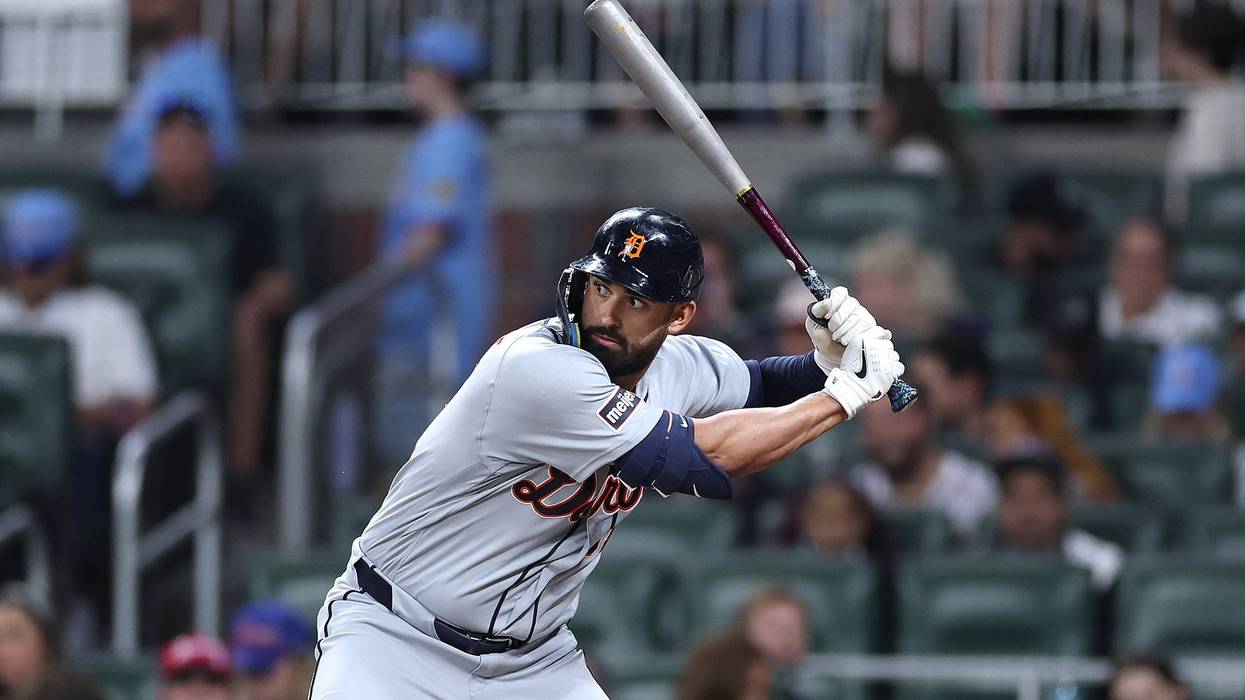
Greene is hitting fewer homers this year, but making more hard contact. He's whiffing less, and walking more. A year after leading the American League in strikeouts, Greene is one of the AL leaders in batting average (.292). He describes his adjustment rather simply: "Just not getting too excited. 0-2 count, not trying to hit a homer. Trying to just find the barrel. Put the barrel on the ball, instead of taking a huge swing pull side and striking out."
Greene had one of the highest chase rates in the majors last season, and by far the highest of his career. He has cut it down significantly this year. That's probably his biggest area of growth, which has led to a lower strikeout rate and a much higher walk rate. Greene likely won't have another 30-homer, 100-RBI season like last year, and that's fine. He also won't strike out 200 times.
"I’m not trying to go up there and walk, but I’m trying to get on base for my team," said Greene. "I’m trying to do things to help the team win, having good at-bats. Last year when I got to a 3-2 count I would swing at a curveball in the dirt, and I’ve done it a few times this year, but not as much."
Last year, Greene was in the 45th percentile of big-league hitters in hard-hit rate -- not quite ideal for a middle-of-the-order slugger. He's in the 90th percentile this year. He's first among AL outfielders in hits, second in average and third in OPS (.850). Greene was a dangerous hitter last season, but he wasn't a difficult out. He's becoming both this year. He has been named an All-Star for the third straight season, this time by his peers.
"I think maturation is probably the right word," said A.J. Hinch. "He’s learned a lot about how to hit at this level and not just, see ball, hit ball. Some of the power numbers are down, I guess, but the overall at-bat quality is up. The empty at-bats are fewer and fewer. There’s only minor gaps in him contributing — he doesn’t go through those 8-, 10-, 12 at-bat (spells).
"As well rounded as he’s become, it’s part maturation, part approach, and then part understanding that in today’s game not every ball is intended to go 500 feet. And that’s been a big step forward for him, unless all you value is a home run total."
Greene will still pick his spots. In a 2-1 count against right-hander Kumar Rocker of the Rangers last Sunday, Greene was looking for a pitch down, got one, and pulled a fastball 430 feet for a go-ahead homer in the Tigers' 6-3 win. But for the most part, "especially with runners on," said Greene, "just trying not to do too much." He's eyeing the gaps instead of the seats, and will happily settle for the grass.
With the bases loaded and one out in the first on Wednesday, Greene got into a 3-1 count against lefty Jeffrey Springs of the A's. A year ago, he might have been thinking grand slam. Instead, Greene got a fastball he liked up in the zone and dropped it into right field to give the Tigers the lead in their fourth straight win, and seventh out of the last eight.
That reminds us. A year after posting a .620 OPS against lefties -- and getting pinch-hit for against a lefty in a playoff game -- Greene is up to .774, befitting a hitter who handled lefties at every rung of the ladder on his way to the bigs. Greene theorizes that it simply "might be because I’m facing them more. I feel like I face a lefty every single day now. You see them more often, you get more comfortable facing them."
For Greene, extended slumps have been an issue in the past. The longest he's gone this year without reaching base is two games. He had an .853 OPS through April, a .780 OPS in May -- while the rest of the lineup fell apart -- and he has a .912 OPS since June. He's been a steady force in the middle of Detroit's order. He got his first off-day of the season last week, and responded with two homers the next day.
Greene has avoided the ruts, he said, by "just going back to the approach and making sure that, OK, if I’m not feeling the best, maybe let’s not take a big swing. Let’s just find the barrel. Hit a 2-iron the other way instead of hitting a driver."
He's not perfect. His outfield defense isn't great, even while it's sprinkled with diving catches. He sometimes looks stiff on the bases. And yes, he still strikes out more than you'd like.
But Greene is 25 years old and the first Tigers outfielder to make three straight All-Star Games since Al Kaline, the fourth Tiger to ever do so at any position, joining Miguel Cabrera and Justin Verlander. And this selection feels like his most deserving one yet.
Greene is more self-aware than some of his comments last year might have suggested. He knows that after the All-Star Game in 2025, when he was voted in as a starter for the first time, he hit .218 with a .694 OPS. He knows that he was guilty as anyone for the Tigers' second-half swoon. He knows that he let the team down.
He had this in mind when he was asked a couple days ago if this is the best version of himself that we've seen in the majors. Greene shrugged a little reluctantly and said, "I don’t want to speak too soon because there’s a lot of season left. But it’s been some of the best I’ve felt."