


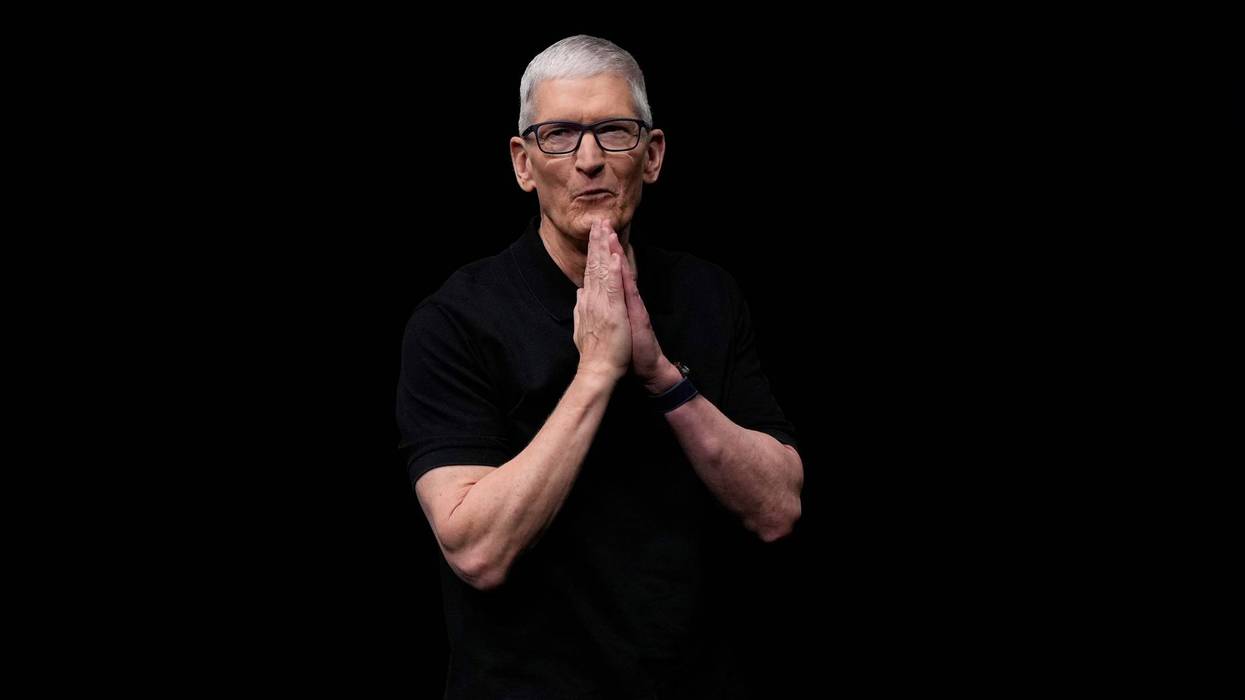

Apple CEO Tim Cook is stepping down from the job that he inherited from the late Steve Jobs, ending a 15-year reign that saw the company’s market value soar by more than $3.6 trillion during an iPhone-fueled era of prosperity.
Cook, 65, will turn the CEO duties over to Apple’s head of hardware engineering, John Ternus, on Sept. 1 while remaining involved with the Cupertino, California, company as executive chairman. That’s similar to the transitions made by Amazon’s Jeff Bezos and Netflix’s Reed Hastings after they ended their highly successful tenures as CEO.
To allow Cook to assume his new job, Arthur Levinson will relinquish his role as Apple's non-executive chairman while remaining on its board of directors.
“It has been the greatest privilege of my life to be the CEO of Apple and to have been trusted to lead such an extraordinary company," Cook said in a statement. “I love Apple with all of my being, and I am so grateful to have had the opportunity to work with a team of such ingenious, innovative, creative, and deeply caring people.”
Ternus, 50, has been with Apple for the past quarter century, including the past five years overseeing the engineering underlying the iPhone, iPad and Mac — a role that made him a prime candidate to succeed Cook.
“I am profoundly grateful for this opportunity to carry Apple’s mission forward,” Ternus said in a statement.
Cook and Ternus may have more to say about the changing of the guard on April 30 when Apple is scheduled to release its financial results for the first three months of the year.
The transition to a new CEO comes at a pivotal time for Apple. Artificial intelligence has unleashed the most upheaval within the industry since Jobs unveiled the first iPhone in 2007. Apple has gotten off to a rough start in AI after stumbling in its efforts to deliver new features built on the technology, as promised nearly two years ago.
Earlier this year, Apple finally turned to Google — an early leader in the AI race — for help making the iPhone's virtual assistant Siri into a more conversational and versatile helper.
“Cook created a major legacy at Apple but it was ultimately time to pass the torch to Ternus with the AI strategy now the focus,” Wedbush Securities analyst Dan Ives said.
Although he never shook the perception that he lacked Jobs’ vision, Cook leveraged the popularity of the iPhone and other breakthroughs orchestrated by his predecessor to lift Apple to heights that seemed unfathomable when it was on the brink of bankruptcy during the mid-1990s.
Not long after Cook took over, Apple became the first publicly traded company to be valued at $1 trillion, then became the first to be valued at $2 trillion and $3 trillion, too.
But after Apple's slow start in AI, chipmaker Nvidia rode the feverish demand for its processors that power that technology to be the first company to reach the $4 trillion threshold and then the first to break through the $5 trillion barrier, too. Apple is currently valued at $4 trillion, up from $350 billion when Tim Cook took over in August 2011, shortly before Jobs died after a long bout with cancer.
“Steve Jobs was never going to be an easy act to follow, yet Tim Cook took Jobs’ legacy and transformed Apple into a durable, resilient financial powerhouse,” said Forrester Research analyst Dipanjan Chatterjee.
Besides guiding Apple to a phenomenal run of financial success, Cook also made his mark in an October 2014 essay acknowledging his homosexuality – a disclosure by the leader of a renowned company that was hailed as a breakthrough for the gay rights movement.
Before his death, Jobs spent time grooming Cook to be his successor – a move that reflected the Apple co-founder’s respect and admiration for an executive that he hired in 1998 to oversee the company’s supply chain. Knowing his successor would likely be measured against his legacy, Jobs advised Cook to be guided by his own instincts and never bother musing, “What would Steve do?”
Cook, an Alabama native who previously worked at Compaq Computer and Apple’s former nemesis, IBM, masterminded the intricacies of an international supply chain that plumbed the cheaper labor and efficiency of China’s manufacturing plants. It has played an instrumental role in the production of the Mac computers, iPods, iPhones, iPads and other products that account for most of Apple’s annual revenue of $416 billion – up from $108 billion when Cook became CEO.
But most of Apple’s best-selling devices were all conceived while Jobs was still CEO, raising questions about whether Cook was more of a logistics man than an idea man.
“While Cook has kept Apple’s growth trajectory moving at a steady clip, he has not overseen a step-change innovation that would reset Apple’s competitive position for the next two decades, as Jobs did with the iPhone,” Chatterjee said.
The company did create the two popular new product lines – the Apple Watch and wireless AirPod headphones – and a still-niche Vision Pro headset for experiencing virtual reality, but none of them have been the kind of breakthroughs that became Jobs’ trademark. Meanwhile, other ballyhooed projects such as Apple’s effort to build a self-driving car never materialized after years of research and investments.
Apple’s reliance on overseas manufacturing required Cook to master the art of political diplomacy, particularly while President Donald Trump waged trade wars with China during both his terms in the White House. After persuading Trump to exempt the iPhone and other products from Trump’s first-term tariffs, he faced a more daunting challenge during the current administration.
While insisting that Apple shift its iPhone manufacturing from China to the U.S., Trump imposed some tariffs on the device this time around. But Cook still managed to minimize the fees by shifting the production of iPhones destined for the U.S. market to India and also winning some exemptions after promising Apple would invest $600 billion in the U.S. during Trump’s second administration.