


MACKINAC ISLAND, Mich. (AP) — Michigan Democrats hoping to avoid a bruising primary in a must-win U.S. Senate race instead found themselves with a fiery and at times combative debate Thursday, as progressive candidate Abdul El-Sayed repeatedly went on offense against his rivals.
The clash underscored a broader fight inside the Democratic Party as it tries to recover from its 2024 losses and chart a path forward in a premier battleground state. Voters in Michigan’s Aug. 4 primary will choose among three candidates offering different visions for the party’s future.
“Democrats across our country and across Michigan are crying out for a new Democratic Party. We need a reckoning,” state Sen. Mallory McMorrow said from the stage Thursday.
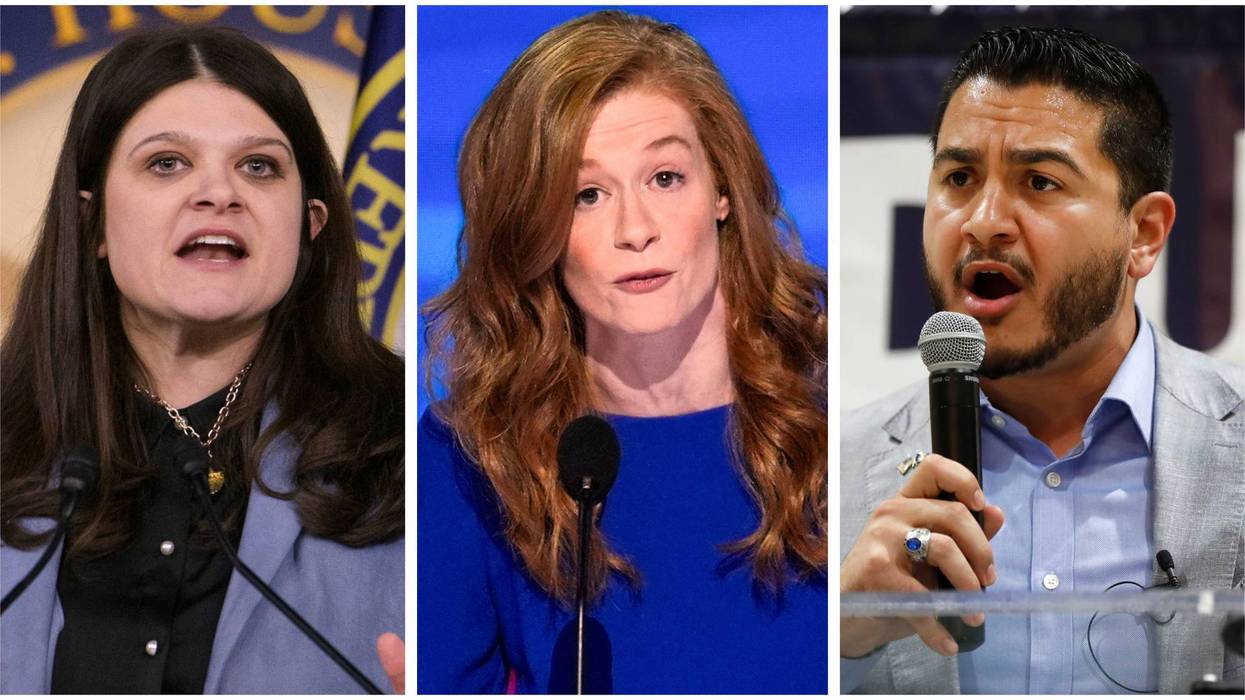
The seat being vacated by Democratic Sen. Gary Peters is one the party must hold if it hopes to reclaim the Senate majority in this fall's midterm elections. Seeking the nomination are Rep. Haley Stevens, McMorrow and El-Sayed, a former public health official.
Here’s what else took place at the first statewide televised debate and where things stand in the race:
Campaign funding at issue
The debate at Michigan’s annual bipartisan policy conference laid bare the increasingly sharp contrasts emerging in one of the nation’s last major Democratic primaries.
El-Sayed repeatedly attacked the other candidates over campaign donations, arguing he was the only candidate in the race not accepting corporate money.
“I'll tell you this, the revolution is definitely not coming if we're not fighting for it," El-Sayed said before targeting both his rivals and a sponsor of the conference. “So let's play a game. If you're on this stage and you've never taken a check from Blue Cross Blue Shield, raise your hand.”
El-Sayed then raised his hand as the other two on the stage didn’t, drawing laughs from the crowd.
Stevens, a fourth-term congresswoman representing a district just outside Detroit, is seen as the more moderate, establishment-aligned candidate. She has described herself as a “staunchly pro-Israel Democrat" and has previously received support from the American Israel Public Affairs Committee, or AIPAC.
A newly formed outside group, Center for Democratic Priorities Inc., recently reserved over $5 million in television advertising backing Stevens. AIPAC has denied affiliation with the group.
Stevens largely focused Thursday on her congressional record and what she framed as a results-driven approach. She mostly avoided directly attacking her rivals and declined to take questions from reporters afterward.
“The people of Michigan deserve a functional Congress,” Stevens said from stage. “I write bills, I pass bills on behalf of the people of Michigan.”
McMorrow, meanwhile, took a strategy somewhere in the middle of the others — both in her campaign and on the debate stage. She emphasized unity and generational change while still pushing back at El-Sayed during several exchanges.
“There is more that unites us than divides us,” McMorrow said about the candidates on stage in closing remarks.
Still, she did not shy away from responding sharply at times. After El-Sayed said he would choose “having a message” over donors, McMorrow shot back that “you actually need to know how to deliver" on that message.
One issue the candidates aligned on during Thursday’s debate was eliminating the filibuster, the longstanding Senate rule that effectively requires 60 votes to advance most legislation in the 100-member chamber. Trump has repeatedly urged Senate Republicans to eliminate it, but Senate Majority Leader John Thune has made clear there is not enough support within the GOP conference to do so.
Primary has grown ‘messier than I would have liked’
Among the many elected officials attending the Mackinac Island conference were Michigan’s two Democratic senators.
Peters and Sen. Elissa Slotkin both told The Associated Press on Thursday that they were not planning to make an endorsement in the primary and while they thought primaries could be beneficial, it was becoming more contentious than they had hoped.
"It is messy. Messier than I would have liked. I think it’s important in any primary that the candidates focus more on what they want to do and their positive affirmative plan,” Slotkin said.
Peters said the eventual nominee will need to bring the party together.
“What are the types of candidates that win in purple states? That should be what we’re looking for," said Peters. “Who can bring people together and build the kind of broad coalition to win in a purple state?”
Winner will face former Rep. Mike Rogers
Rogers lost to then-U.S. Rep. Slotkin in 2024 by fewer than 20,000 votes in a state that Republican Donald Trump carried on his way to a second term.
This time, Rogers will not benefit from having Trump atop the ballot. But Rogers heads into the general election with advantages of his own, including an uncontested primary.
In a telephone interview Wednesday, Rogers acknowledged the difficulties in the last campaign, saying the financial disadvantage he faced after a tough primary “made it really difficult” to win the general election.
But he said this year is different.
“This is a change election. People want to talk about Washington. This is about Michigan,” Rogers said.
It may prove difficult to localize a race shaped by national issues such as tariffs and gas prices, both of which are hitting Michigan hard. Outside spending is expected to climb into the nine figures. The Republicans’ U.S. Senate campaign organization has reserved $45 million in ads, compared with $20 million by Democrats.
“They're going to spend a lot of money trying to make you not like me. We're going to spend our money trying to tell people what we're going to do for them and make their lives in our state better," Rogers said.